Piston-Based Information Engine Operating on Active Matter ✛
Context
Information engines, proposed by Szilard for analyzing Maxwell's demon, are now realized at micro- and macroscales. For thermal particles with hard walls, the thermodynamics of a piston-based information engine is universal: the average work per measurement equals −p₁ ln p₁, where p₁ is the probability of finding the region next to the piston empty. However, active matter, composed of self-propelled particles, is fundamentally out of equilibrium, and its behavior in such engines is only beginning to be studied. Alongside this work on the archive are studies of quantum motors, Maxwell's demon in quantum systems, and information engines with noise, but this paper is the first to experimentally realize a macroscopic information engine with an active medium and directly compare it with its thermal counterpart.
Methods
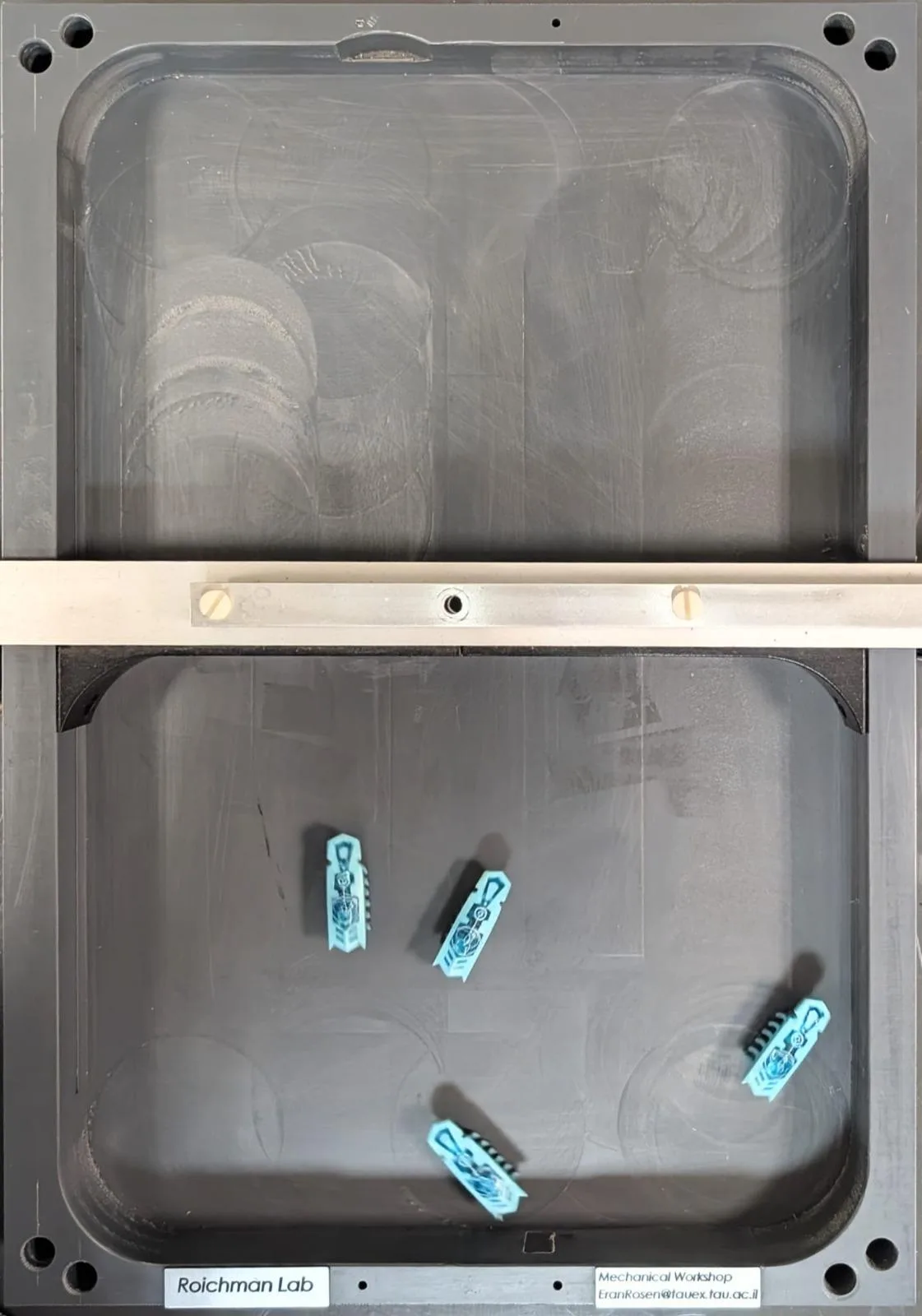
The experiment was performed in a rectangular arena about 30×30 cm with a movable piston wall. The working substance consisted of 3–12 brush robots (bbots) of length 4 cm, driven by vibration from a battery. Every 5 seconds (longer than the correlation time), a region of width Δx next to the piston was checked. If it was empty, the piston moved inward by Δx, compressing the gas without direct mechanical work. Pressure was measured via calibration of a flexible nylon partition: its deflection gave the force exerted by the robots. The spatial distribution of particles was reconstructed from webcam video and tracking algorithms. To test the role of friction, experiments on free expansion of the piston and numerical simulations with dry friction were performed.
Results
The pressure of the active gas was found to be linear in the area fraction Φ with coefficient α = 40.3±3.7 mN/m, analogous to an ideal gas but with kBT replaced by an active energy scale α̃ ≈ 2.0±0.2 mN·cm. The spatial distribution of robots showed pronounced accumulation at walls: the density near the piston is several times higher than in the bulk. Because of this, the probability of an empty region p₁(Δx) falls faster than for a uniform gas at small Δx, and slower at large Δx. The average work per measurement W̄(p₁) deviates from the thermal curve −p₁ ln p₁: at low density the maximum lies at p₁ < 1/e (large Δx), and at Φ ≈ 0.08 there is a switch to p₁ ≥ 1/e (small Δx within the boundary layer). In a finite cycle with dry friction and measurement waiting time, the optimal regime also switches at the same density, although the value of p₁ at maximum power is no longer 1/e.
Implications
This work shows that activity changes not only the energy scale but also the feedback statistics due to particle accumulation at boundaries. This distinguishes it from neighboring studies where information engines were built either for thermal particles or for microscopic active systems without a macroscopic boundary. Here, for the first time, a transition between two optimal control regimes, caused precisely by the boundary layer, is demonstrated. Such a mechanism should work for any active particles with persistent motion in confined geometry, making the result general for a class of systems.
Future development
The topic could develop toward accounting for correlations between particles that are not captured by simple independent-position models. Clustering, alignment with direction of motion, and other collective effects in the boundary layer may further influence p₁ and optimal parameters. It is also interesting to investigate how boundary geometry (roughness, curvature) and wall properties (elasticity, friction) can tune the statistics of empty regions and thereby maximize engine power.
Impact
The results are important for designing microscale devices that use active particles (bacteria, artificial microswimmers) to extract work from fluctuations. They also clarify how nonequilibrium properties of active matter alter fundamental limits of information thermodynamics.
Next steps
The immediate next step is to measure correlations between robot positions in the boundary layer and incorporate them into the model to refine predictions of p₁. Another step is experiments with variable piston geometry and different types of active particles to test the universality of the regime switching.
Key open problems
For the physics of active matter, an open question remains how collective effects (clustering, alignment) influence fluctuation statistics near boundaries. This work shows that even without explicit interparticle interactions, accumulation at walls drastically changes the work output of an information engine, but the role of correlations remains to be clarified.
The knowledge machine's view
This section is addressed to the author of the paper and their colleagues. Neighbouring works were found by meaning-based search across our archive, not by word overlap. We do not review: we show the field around the work.
What the work does
The paper reports an experimental realization of a piston-based information engine with an active medium made of self-propelled brush robots. The authors measured the probability of an empty region near the piston, compressed the gas when a void was detected, calibrated pressure from the deflection of the partition, and reconstructed the spatial particle distribution. They found that the average work per measurement deviates from the universal thermal form due to particle accumulation at the boundaries, and that the optimal operating regime switches as density changes.
Where its strength is
The strength of the work lies in the direct experimental comparison between active and thermal information engines, as well as in demonstrating the role of boundary accumulation in feedback statistics and its practical relevance for finite cycles with friction.
Where it could go next
- It might be interesting to see how quantum correlations or particle indistinguishability alter the statistics of measurements and feedback in information engines. In our archive nearby, there is an analysis of a Maxwell's demon experiment that uses indistinguishable photons to control thermodynamics.based on: Maxwell's Demon Prefers Indistinguishable Photons arXiv:2602.11276
- Another avenue is to consider collective effects in active media analogous to those in quantum many-body systems. The archive contains a full analysis of a work where a Maxwell's demon controls an ensemble of quantum oscillators, revealing unexpected collective regimes.based on: When Maxwell's Demon Conducts the Quantum Choir arXiv:2606.27868
- One could also compare with information engines operating on other nonequilibrium sources, such as thermal gradients. Nearby there is a quick analysis of an engine that uses a temperature difference of just one degree, where cycle optimization is also crucial.based on: Water Works on a One-Degree Difference arXiv:2603.07128
Worth trying
- Test how indistinguishability or quantum entanglement of particles would affect the probability of an empty region and the average work in a similar piston geometry.
- Investigate whether collective modes of active particles (e.g., clustering near walls) can be controlled via feedback, much like a demon controlling a quantum chorus.
- Try a measurement protocol that adapts to local density to maintain the optimal regime as global density changes.
Why this may matter
Such extensions could reveal general principles of converting information into work in nonequilibrium systems and help design more efficient micro- and macro-machines based on active matter.
Nearby works in our archive
- Maxwell's Demon Prefers Indistinguishable Photonssimilarity 0.50
- When Maxwell's Demon Conducts the Quantum Choirsimilarity 0.49
- Water Works on a One-Degree Differencesimilarity 0.47
- How to Stop Molecular Motors from Spinning Their Wheelssimilarity 0.47
- The Swing Detector: When Pumping Breaks the Rulersimilarity 0.47
- A Quantum Motor Powered by a Double Pendulumsimilarity 0.47
The archive is sparse around this work: the closest review is only 0.50, against a usual 0.64. It looks like few have drilled nearby.
The energy scale of the active gas, α̃ ≈ 2.0 mN·cm, is 15 orders of magnitude larger than the thermal energy kBT at room temperature, reflecting the macroscopic size of the robots. Yet formally the pressure behaves like that of an ideal gas, only with temperature replaced by an 'active temperature'.
The idea of extracting work from information about particle positions echoes Maxwell's demon, which appears in many science fiction works, for example, in Stanislaw Lem's story 'The Demon' from the 'Cyberiad' cycle, where a demon of the second kind tries to circumvent the second law of thermodynamics.
Key numbers
- pressure coefficient: α = 40.3±3.7 mN/m
- active energy scale: α̃ = 2.0±0.2 mN·cm
- density for regime switching: Φ ≈ 0.08
- time between measurements: t_m ≈ 5 s
- piston expansion time: τ = 48.7±0.2 s