Free energy is a thermodynamicpotential that measures the maximum amount of useful work a system can perform at constant temperature and volume (Helmholtz free energy, F) or constant temperature and pressure (Gibbs free energy, G). It is a central concept in thermodynamics and statistical mechanics, determining the direction of spontaneous processes: a system at equilibrium minimizes its free energy. Free energy also governs phase transitions, chemical reactions, and the efficiency of engines and biological processes.
History
The concept was developed in the 1870s by Josiah Willard Gibbs, who introduced the Gibbs free energy, and Hermann von Helmholtz, who formulated the Helmholtz free energy. Their work laid the foundation for chemical thermodynamics and statistical mechanics.
How it works
The Helmholtz free energy is defined as F = U - TS, where U is internal energy, T is temperature, and S is entropy. The Gibbs free energy is G = H - TS, with H = U + PV. The change in free energy (ΔF or ΔG) indicates whether a process is spontaneous (negative Δ) or requires external work (positive Δ). In statistical mechanics, the free energy is related to the partition function Z by F = -k_B T ln Z, providing a bridge between microscopic states and macroscopic properties.
In practice
Free energy calculations are used to predict chemical reaction spontaneity, design batteries and fuel cells, understand protein folding, and optimize industrial processes like distillation and refrigeration.
Fun fact
The free energy of a system is not 'free' in the everyday sense — it is the energy available to do work, and even in a perfectly efficient engine, some energy is always lost as entropy, which is why perpetual motion machines are impossible.
Units by system: SI: joule · CGS: erg · Planck: planck energy · natural: electronvolt
A piston in a cylinder with gas usually moves when the gas pushes on it. But there is a piston that moves when the space in front of it is empty. Every five seconds, it checks the space near its wall, and if no one is there, it takes a step inward, compressing the gas without direct mechanical force.
A proton beam aimed at a tumor cuts through soft tissue like a knife through butter, but its range depends on the subtle properties of water, the stuff we're mostly made of. Water is the body's main component, and how quickly protons slow down in it determines exactly where they deposit their energy.
A translator who has memorized all the lines in advance responds instantly — no need to listen to the whole conversation again. That's how the new model works: instead of running atoms through a computer for hours, it immediately outputs the crystal's free energy at any temperature and pressure.
Soil is not a solid sponge but a labyrinth of pores of various sizes. After rain, water does not fill them all at once: first the narrowest ones, then the wider ones. Physicists built a theory of this process based on a simple image — a set of communicating vessels.
In classical thermodynamics, heat engines are like a virtuoso musician on stage: the closer to perfection in performance (Carnot efficiency), the slower the tempo (power).
The old question of Maxwell’s demon, can an intelligent being circumvent the second law of thermodynamics and pump heat from cold to hot, gains new resonance in the quantum world.
A pot of water on the stove eventually settles down: the temperature evens out, the liquid stops boiling. Physicists call this thermal equilibrium — a state where energy is distributed in the most probable way.
A thermostat keeps a room at 20 degrees. Open a window in winter, and it kicks on the heat to restore equilibrium. The brain does something similar: it constantly predicts what will happen a moment ahead and corrects itself when wrong. That's how it learns.
A stone falls into a pond, and ripples spread across the water. Similarly, a black hole resting in the void may encounter a gravitational wave or a cloud of gas. It does not remain indifferent: its surface (the event horizon) bends slightly, like a stretched membrane under the weight of a drop.
Water can be ice, liquid, or steam. Physicists call these states phases. In theory, each phase has its own measure — a way to describe how likely it is. But not every measure you can imagine occurs in nature. Some phases are real, while others are just mathematical illusions.
Scientists have found a simple criterion that separates reality from mirage.
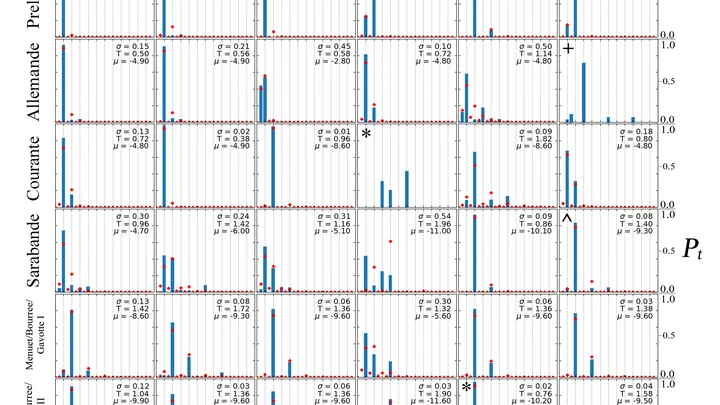
Music relies on repetition: we expect the beat to return, like a chorus coming back. But if you repeat the same thing for too long, it gets boring. The composer seems to walk a tightrope between the familiar and the unexpected.
Scientists translated this balance into the language of physics.
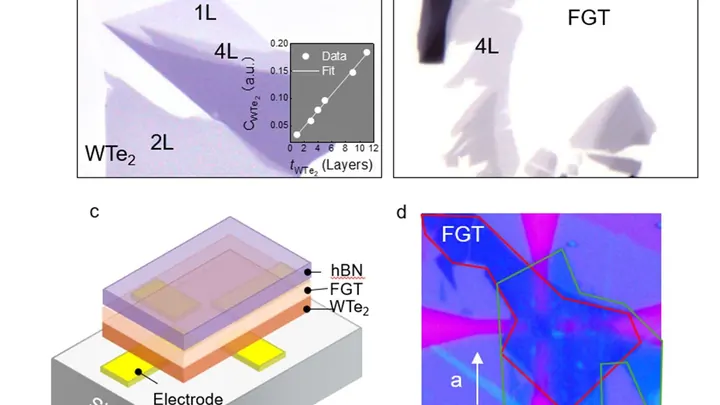
Usually, current in a metal acts like boiling water on ice: it heats the material and destroys magnetic order. But in a layered structure of tungsten ditelluride and the ferromagnet Fe3GeTe2, current behaves differently.
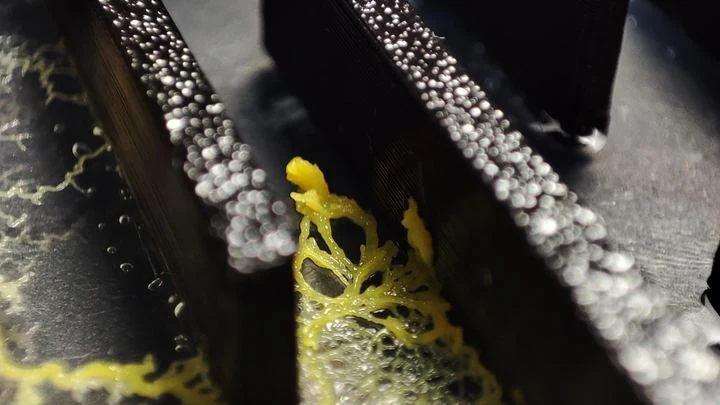
Splitting water into hydrogen and oxygen with electricity is an age-old dream of clean fuel. But tiny gas bubbles stand in the way: they cling to the electrodes like foam on the side of a soda glass, interfering with the current's work. Each bubble is a tiny plug, blocking part of the surface where the reaction should occur.
A physicist analyzing particle collisions typically spends weeks on dull work: cleaning noise from data, estimating how many false signals will slip through, double-checking every number. Now that routine can be handed to a program.
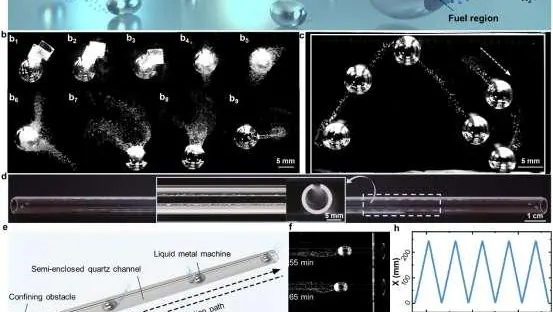
A droplet of liquid metal glides along a narrow channel like mercury from a broken thermometer. It needs no motor — the fuel is a chemical reaction with the surrounding liquid. But what happens when the droplet hits a wall? Previously, such machines were studied in open spaces, and in tight channels they behave differently.
A solar panel on a roof produces little current in the morning, a lot at noon, and stays silent at night. Wind doesn't blow randomly either: it's often stronger in the morning and evening than during the day. Energy providers need to know in advance how much energy will be available in an hour or three, so they can switch on backup plants or store electricity in batteries in time.
A cell is a city where tiny motors work nonstop. They carry cargo, move cilia, and make muscles contract. All this work generates heat, just like a car engine warms up. But measuring the heat from a single motor a few nanometers in size is no easy task.
Stochastic modeling helps us peek into this world.
Water in a glass settles down once you stop stirring it. Oil in an engine dampens vibrations. It seems viscosity is always about damping. But in some flows, it's the opposite: add friction, and waves start to grow as if from nowhere.
Physicists have found a simple explanation.
The idea of a expanding universe, proposed by Georges Lemaître, finds an unexpected analogy. Space behaves like a piston in a cylinder: dark energy pushes it, much like steam. The relationship between pressure and volume in this 'engine' is strikingly similar to that of a steam boiler.