A robot is a machine designed to execute complex sequences of actions autonomously or semi-autonomously, typically equipped with sensors, processors, and actuators. Robots range from industrial arms in factories to autonomous drones, humanoid machines, and microscopic nanobots. In modern research, robots are increasingly integrated with artificial intelligence, enabling them to adapt to unstructured environments, learn from experience, and collaborate with humans or other robots.
History
The term 'robot' was coined by Czech playwright Karel Čapek in 1920, but the first programmable robots appeared in the 1950s with George Devol's Unimate, installed in a General Motors plant in 1961. The field has since expanded from industrial automation to exploration, medicine, and everyday assistance.
How it works
A robot perceives its environment via sensors (cameras, lidar, tactile sensors), processes this information using onboard computers or remote systems, and then plans and executes actions through actuators (motors, servos, pneumatic systems). Advanced robots use control loops, path planning algorithms, and machine learning models to handle uncertainty and dynamic conditions. Swarm robotics relies on simple local rules to produce collective behaviors, such as foraging or formation flying.
In practice
Robots are used in manufacturing, space exploration (e.g., Mars rovers), surgical assistance, disaster response, and logistics, with emerging roles in agriculture, environmental monitoring, and personal care.
Fun fact
The word 'robot' comes from the Czech 'robota', meaning forced labor or serfdom, reflecting the original vision of machines as tireless workers.
A piston in a cylinder with gas usually moves when the gas pushes on it. But there is a piston that moves when the space in front of it is empty. Every five seconds, it checks the space near its wall, and if no one is there, it takes a step inward, compressing the gas without direct mechanical force.
An octopus waits with tentacles spread wide. No central controller directs its arms, but the moment prey touches one, all eight wrap around it. Physicists have recreated a similar trick in the lab with a body that has neither neurons nor muscles: a star polymer with self-propelled arms.
The polymer was assembled from small cylindrical vibrobots on a vibrating plate.
A tour with a single robot is a tedious monologue with no one to exchange glances with. Researchers turned that one-man show into a lively stage: they added a hologram sidekick to a real robot guide. This tandem chats, argues, jokes, drawing visitors into conversation instead of just spouting facts.
The robot juggler catches and throws balls in precise rhythm with a human, like two пульсара sending pulses in unison. Juggling three balls is a classic cascade, governed by a steady beat, like the uniform rotation of a cosmic lighthouse. Break the rhythm and the pattern crumbles.
In calm water, the route is clear. But in turbulent flows, a robot needs a different strategy. Typical approaches demand an accurate map of currents, but in reality, you can't get one. Nature does it differently: fish feel pressure and vortices right against their bodies.
A regular radar is like a microphone in a buzzing crowd: individual sounds blend into mush. PiVoT works like a conductor who instantly recognizes each instrument in the tuning chaos. Instead of shuffling through hypotheses, the algorithm tightens a loop around the most likely targets — cars, cyclists, pedestrians.
Technological disasters like Chernobyl rarely strike without warning. They gestate for years: organizations ignore warnings, their complexity mirroring the rise of entropy — a measure of relentless chaos that builds up unnoticed until it avalanches.
A robot swarm is like a cloud of fireflies: each moves on instinct to wherever is freer, and chaos turns into order. For a long time, it was a mystery how coherence emerges without communication or commands. The answer came with the creation of the Response Map — a tool that, like an X-ray, illuminates the hidden logic of the machine brain.
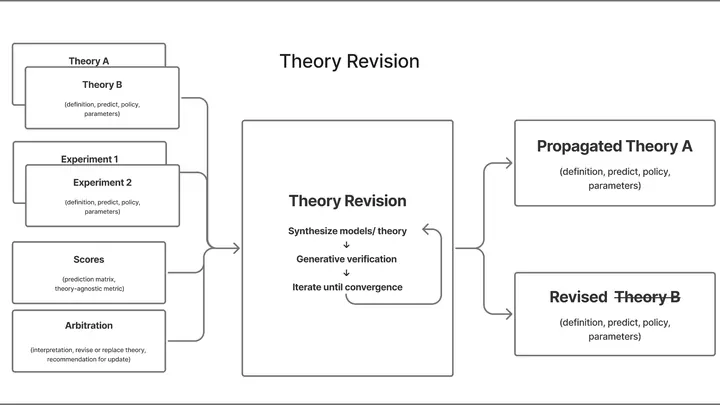
A closed loop: the machine proposes an idea, tests it on people, sees the failures, and spawns a new, more accurate guess. That's how AutoCog works — an automatic cognitive scientist. Previously, in the science of thinking (cognitive science), the hardest part, coming up with a theory, was done only by humans.
In the watery environment, vortices batter the mechanical fish. The AI agent, like an experimental chef, ran simulations, tried out 'recipes' of movements, and improved the program. Each experiment was like spectroscopy: the agent broke down behavior into elements, uncovering patterns. At first, the fish only paddled in one direction.
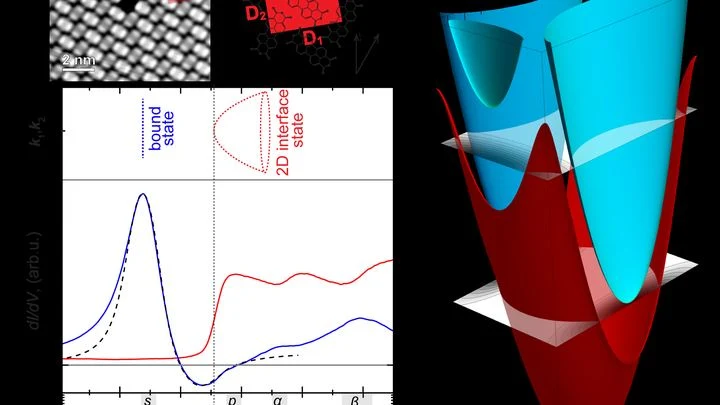
A wafer-thin film of organic molecules was grown on a silicon substrate. In this film, as if on a sheet of graph paper, tiny "pens"—artificial atoms — were laid out with the tip of a scanning tunneling microscope.
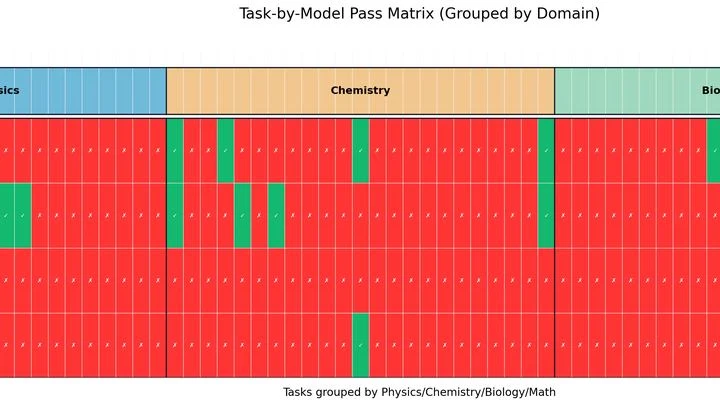
The best AI assistant for scientists scored worse on this exam than a C student on a pop quiz. Just 21% correct answers, and that's the ceiling for the four strongest models. The problems for the new test were written not by programmers but by graduate students: people who deal with real science every day.
The test is called COMPOSITE-STEM.
Making a new drug is like assembling a complex construction set, where each piece is a molecule and the instructions are written in an unfamiliar language. Chemists spend years finding the right combinations, but the slowest step isn't coming up with the idea: it's making it happen in a test tube. Synthesizing a molecule can take weeks, and any mistake sends the whole process back to square one.
Computer models that predict material properties at the atomic level usually require long, manual tuning. To work accurately, the model needs to see many examples — how atoms are arranged and how they interact. Scientists spend weeks hand-picking these examples. The new program AutoPot does it all by itself.
A bacterium in a drop of water doesn't just swim: it probes the space around it, decides where to turn, and finds its way out of a tangled maze. Artificial microscopic swimmers haven't been able to do that until now: they had to be led by the hand, with signals sent from outside.
Science is a vast kitchen where scientist-cooks seek new recipes. Once, they sifted ingredients by hand; now artificial intelligence, a seasoned chef, lends a hand. AI memorizes millions of flavors and suggests surprising pairings: through information search, the algorithm uncovers hidden patterns.