A heat engine is a device that converts thermal energy into mechanical work by exploiting a temperature difference between a hot source and a cold sink. The classical example is the steam engine, but the concept applies universally to any system that operates in a thermodynamic cycle. The efficiency of such engines is fundamentally limited by the Carnot bound, which depends only on the temperatures of the reservoirs. Recent research extends these ideas to quantum scales, where engines can operate on single particles or even use quantum effects like coherence and entanglement to improve performance.
History
The theoretical foundation was laid by Sadi Carnot in 1824, who introduced the concept of a reversible cycle and the maximum efficiency limit. The first practical heat engines, like Thomas Newcomen's and James Watt's steam engines, predated the theory by decades, driving the Industrial Revolution.
How it works
The engine operates by taking in heat from a hot reservoir, converting part of it into work, and rejecting the rest to a cold reservoir. In a cyclic process, the working substance (e.g., gas, electron, or photon) undergoes a series of transformations—compression, heating, expansion, cooling—that return it to its initial state. The net work output is the difference between heat absorbed and heat rejected. In quantum engines, the working substance can be a two-level system or a harmonic oscillator, and the cycle may involve quantum measurements or coherence to extract work, sometimes challenging classical limits.
In practice
Heat engines are ubiquitous in power generation (coal, gas, nuclear plants), transportation (internal combustion engines), and refrigeration (reverse operation). Quantum heat engines are being explored for nanoscale cooling and energy harvesting in quantum devices.
Fun fact
The most efficientheat engine ever built operates on a single trapped ion and achieves near-Carnot efficiency, but it produces only a tiny fraction of a watt of power.
A piston in a cylinder with gas usually moves when the gas pushes on it. But there is a piston that moves when the space in front of it is empty. Every five seconds, it checks the space near its wall, and if no one is there, it takes a step inward, compressing the gas without direct mechanical force.
A black hole is a maze with no way out. But what happens to the information inside? To test this, physicists didn't fly to the nearest hole; instead, they built a tiny replica on a quantum processor. The maze was played by a chain of 32 superconducting qubits, where each step leads only forward, like a one-way corridor.
Inside an MRI magnet, current flows through a closed superconducting loop, like water circling in a bucket after you give it a spin, it just keeps going on its own. To change that current, you heat the loop with a small heater: it stops being superconducting, becomes an ordinary resistor, and then an external source can 'top up' or 'draw off' current.
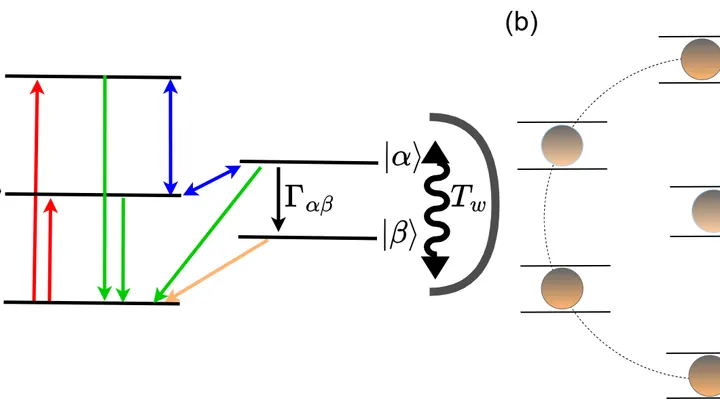
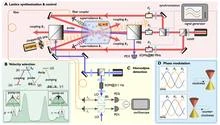
Inside an ultracold chamber, two atomic clouds collide: a few dozen cesium atoms acting as the working fluid, and thousands of rubidium atoms serving as the heat reservoir.
Hot water after a shower, warm air from ventilation, the heated walls of an engine — all this is heat below 100°C. Usually, it dissipates without doing any useful work. Now it can be captured and turned into electricity.
Inside the new device is a wire made of a nickel-titanium alloy. This material remembers its shape: when heated, it contracts; when cooled, it returns to its original shape.
Inside every cell, logistics is in full swing: tiny protein motors, like couriers, haul cargo along a network of microtubules. One of the main workhorses is kinesin, which steps using the energy of ATP (the cell's main energy currency). For a long time, researchers tried to evaluate it like a car: how much fuel it burns, how fast it gets there.
In classical thermodynamics, heat engines are like a virtuoso musician on stage: the closer to perfection in performance (Carnot efficiency), the slower the tempo (power).
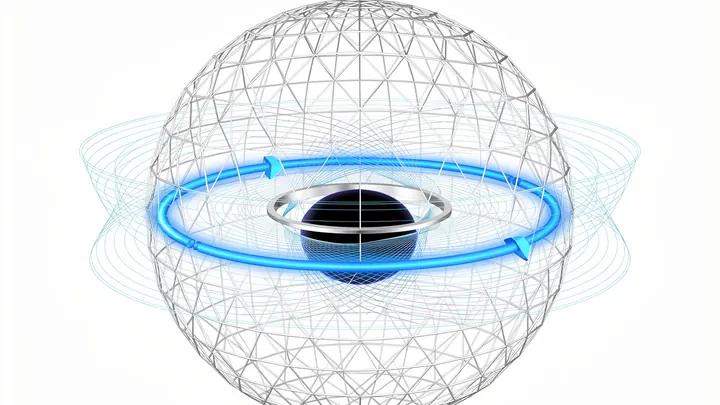
Imagine a steam engine where instead of a steel piston there is an event horizon, and the cylinder is curved space itself. This metaphor has gained mathematical flesh: physicists have for the first time constructed a complete set of reversible heat cycles with a Schwarzschild black hole confined in a spherical cavity.
The old question of Maxwell’s demon, can an intelligent being circumvent the second law of thermodynamics and pump heat from cold to hot, gains new resonance in the quantum world.
In boiling water you can see a prototype of a quantum trick: if part of the liquid turns into long-lived vapor bubbles, the main mass cools down. This is exactly what happens when you sharply jolt a system of interacting electrons: doublons flare up — pairs of particles that absorb excess energy and don’t decay for an astonishingly long time.
In a pot of soup, every grain is a tiny magnet that wants to flip opposite to its neighbor. Heat the soup, and the magnets start jittering, obeying the heat. But how do you know how unruly they are at each temperature? For an ordinary material, you'd calculate this on powerful computers by enumerating possibilities.
Heat a nail in a fire, and it will lengthen — everyone knows that. But heat only the tip and leave the other end cold, and the nail doesn't just get longer: it bends, because hot metal expands more than cold metal. It's this very bending, but at the atomic level, that physicists have turned into electricity.
A heat engine doesn't have to be made of iron. In the microworld, a single electron can play the role of a piston, and the measurement process itself can serve as fuel. Two neighboring 'pockets' for electrons are connected by a narrow bridge.
Steam rising from hot metal is a familiar sight in the kitchen. But if you use rubidium instead of water, that cloud becomes a battery. It doesn't run on chemical reactions but on the quantum coordination of atoms.
A kettle cools on the table. Heat escapes into the air, and is wasted. Yet you could squeeze a bit of electricity out of it. Devices that can do this are called thermomagnetic generators. Inside them, there are no pistons or turbines — only a material that changes its magnetic properties when heated and cooled.
A piece of metal heated at one end produces a weak electric current: this has been known for nearly two hundred years. But what if, instead of a simple metal, you take a layered "sandwich": a superconductor, a thin insulator, and a flat layer of electrons?
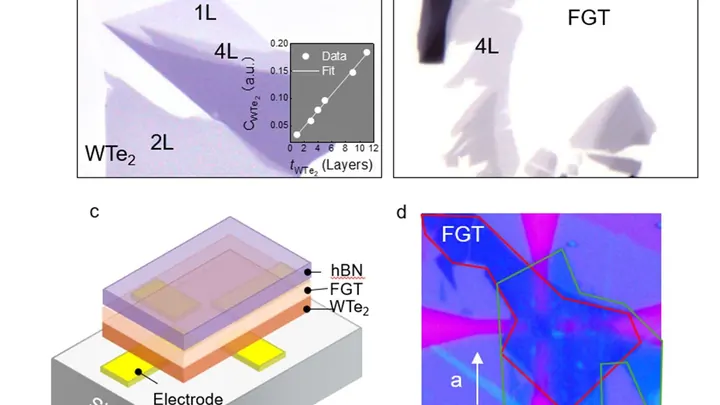
Usually, current in a metal acts like boiling water on ice: it heats the material and destroys magnetic order. But in a layered structure of tungsten ditelluride and the ferromagnet Fe3GeTe2, current behaves differently.
When servers in a data center run at full tilt, they get as hot as a forgotten iron. That heat goes to waste, and cooling them eats up even more energy. Engineers in Germany have proposed putting that heat to work: let it drive liquid through thin tubes all by itself, with no motors or pumps.
Their device looks like a flat box with an asymmetric bottom.
Physical systems can compute. If you build a landscape of hills and valleys so that the lowest point corresponds to the answer, the system will roll there by itself, like a ball. The problem is that the bottom is often flat, and the ball crawls around for a long time before settling.
The authors propose nudging the ball to the right place before it even starts.
Weather forecasting is like trying to predict where a rock will roll down a slope, knowing the shape of every bump and the force of the wind. Make a mistake at the start, and a week later that error grows into a full-blown storm. In the past, accurate forecasts required massive computers and days of computation.
The quantum battery works like a sponge that absorbs light but won't release it without a forced squeeze. The inspiration came from bacteria's natural solar traps: capturing solar photons, they transfer energy almost losslessly, as proven by spectroscopy.
An ordinary heat engine is like a mill between the hot and cold banks of a river: the greater the drop, the stronger the current. Here, the drop is tiny, just one or two degrees, but water can still turn the wheel. The secret is that water is made to boil not by heating but by a sudden drop in pressure, so steam bursts out even from barely warm liquid.
A pot on a stove receives heat, but not work: the gas under the lid just heats up. But what if the stove is not ordinary, but quantum? Then heat and work can arrive simultaneously, like from an engine that also heats.
In a new study, exactly this case is described: a classical system (say, a pendulum or a small mirror) bathes in a quantum environment.
The idea of a expanding universe, proposed by Georges Lemaître, finds an unexpected analogy. Space behaves like a piston in a cylinder: dark energy pushes it, much like steam. The relationship between pressure and volume in this 'engine' is strikingly similar to that of a steam boiler.
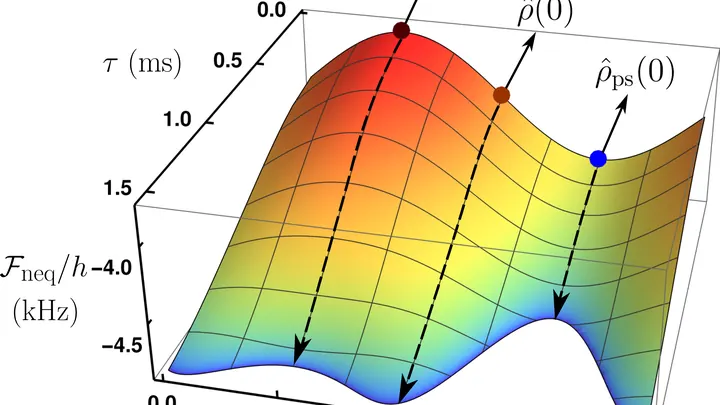
The Mpemba paradox, hot water sometimes freezes faster than cold, has gained a quantum sequel. In the microworld, a particle pushed farther from the finish line gets there first. Experimenters demonstrated this on a single spin: like a racer, they pushed it farther from equilibrium, and it reached it faster than after a weak nudge.
A regular motor burns fuel and wastes a ton of energy as heat — that's dictated by the laws of thermodynamics. A quantum engine does it differently: its fuel isn’t heat, but a perfect rhythm. Physicists call this rhythmic precision quantum coherence.
In the quantum world, particles can walk through walls: this is quantum tunneling. If you place a detector right in the path of such a 'ghostly' passage, the moment of detection acts like a starting pistol: the particle gets a sharp kick and flies out of the barrier with excess energy, turning into a tiny engine.
Atoms, like a swarm of fireflies, shine in unison. When they flash together, the light multiplies — a hundred atoms shine ten thousand times brighter than one. Physicists have turned this trick into a heat engine. A typical motor needs both a hot and a cold source, but here the atoms operate with just a cold one.
An orchestra without a conductor, where each musician hears only the hall's echo, can create a powerful melody. That's how a quantum battery works: many particles, immersed in a warm environment, don't dissipate heat but exchange it synchronously. Instead of chaos, an orderly charge emerges.
Topological phases usually hide inside cryostats. Superconducting circuits, ultracold atoms, laser pulses: all of them shield quantum order from thermal noise.
A heat engine is like a sailboat: to move forward, it needs a difference. Usually that means a temperature difference between hot and cold reservoirs. But what if the reservoir itself starts moving? The wind that fills the sails is created not only by a pressure difference but also by the motion of air masses.
Two qubits, quantum bits, two-level systems, glide through hot and cold thermal baths. One moves at 0.8 times the speed of light. At that moment, familiar thermodynamics cracks: a moving qubit senses temperature differently than a stationary one. For it, the cold bath can feel hotter, and the hot bath colder.