Annealing is a heat treatment process in which a material is heated to a specific temperature, held there for a period, and then cooled slowly. This process alters the material's physical properties, typically by relieving internal stresses, reducing hardness, and increasing ductility. It is widely used in metallurgy and materials science to make materials easier to work with or to improve their performance.
History
Annealing has been practiced since ancient times, with evidence of heat treatment of metals dating back to the Bronze Age. The scientific understanding of the process developed in the 19th and 20th centuries with the advent of metallography and thermodynamics.
How it works
Heating a material gives atoms enough energy to move and rearrange themselves. During annealing, dislocations (defects in the crystal lattice) can move and annihilate, and grains can grow, reducing the number of grain boundaries. Slow cooling allows the material to reach a more thermodynamically stable state, minimizing internal stresses that may have been introduced by prior processing like cold working or quenching.
In practice
Annealing is used in the production of metals, glass, and semiconductors — for example, to soften copper for wiring, to relieve stress in welded structures, or to activate dopants in silicon chips.
Fun fact
In the context of optimization algorithms, 'simulated annealing' borrows the concept of heating and cooling to find global minima in complex problems, mimicking the physical process.
A lake in a drought doesn't dry up all at once. First, islands of dry land appear on the water's surface, they expand and merge, and only then does the water recede from the exposed bed. A mirabilite crystal behaves similarly when it loses water: round patches of anhydrous salt appear on its surface, growing outward and then beginning to deepen.
A regular battery releases heat smoothly: what you store is what you get. The power is fixed once and for all, like a faucet that pours water in a single stream. But sometimes you don't need a steady flow; you need a short, powerful burst: to instantly heat a part, trigger a reaction, or dump excess heat.
Hot water sometimes freezes faster than warm water: this odd fact is known as the Mpemba effect. Now something similar has been found in the quantum world: a state with weak entanglement (a special quantum connection between particles) can beat a more entangled one to the finish line.
A laser beam can do more than heat things up: it can also calm motion. When light enters a mirror trap, it exerts pressure on the mirrors, and if you tune the beam's color just right, that pressure becomes a gentle braking force. This is how tiny mechanical vibrations are cooled to nearly absolute zero.
Glass lenses and mirrors appear perfectly smooth and still. But beneath the surface, a hidden life teems. Atoms in an amorphous material (a substance without a crystalline lattice) are packed haphazardly, and this disorder creates a complex energy landscape, like a mountainous region with countless hills and valleys.
Today's Freon-based refrigerators and air conditioners silently poison the atmosphere. An alternative is solid-state caloric materials that cool under rapid pressure changes via the barocaloric effect.
In a hot mug, water sometimes freezes faster than in a warm one. This paradox is over half a century old and is called the Mpemba effect. It is usually attributed to fluid motion or evaporation. Now physicists have shown that a similar trick is possible without water, just through radiation of heat.
In boiling water you can see a prototype of a quantum trick: if part of the liquid turns into long-lived vapor bubbles, the main mass cools down. This is exactly what happens when you sharply jolt a system of interacting electrons: doublons flare up — pairs of particles that absorb excess energy and don’t decay for an astonishingly long time.
Heat a nail in a fire, and it will lengthen — everyone knows that. But heat only the tip and leave the other end cold, and the nail doesn't just get longer: it bends, because hot metal expands more than cold metal. It's this very bending, but at the atomic level, that physicists have turned into electricity.
Take a long thread, close it into a ring, and tie a knot in it. The knot slides along the thread until it hits something. Now imagine the thread is made of two different segments: one stiff and slippery, the other soft and sticky. When heated, the sticky segment softens, and the knot can slide off it, like a sled sliding off a melting hill.
A pot of water on the stove: the hotter the burner, the faster ice turns to water, and water to steam. Heat destroys order. But sometimes nature pulls a trick, and heating makes a liquid freeze, like a puddle turning to ice on a frosty morning.
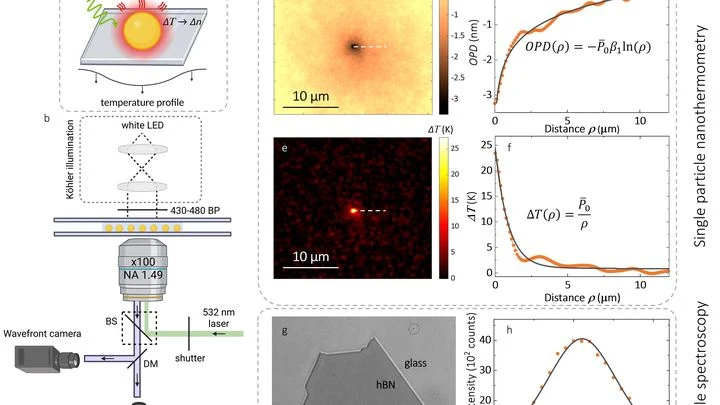
A gold speck the size of a hundred atoms catches a beam of light, and heats up. In everyday life, that's no big deal, but in the world of nanotechnology, this tiny heat can ruin a biosensor or fry a microchip. You can't just put a fan on it: at these scales, heat gets trapped like in a thick winter coat.
Plutonium is a metal with attitude. One form shrinks when cooled, another swells. But at room temperature, the alloy behaves strangely: the ruler says one thing, X-rays say another. The ruler shows the sample barely grows, while X-rays see atoms in the crystal lattice moving further apart.
In a solid piece of tin-lead alloy, the layers of the two metals lie like pages in a book. When heated from one side, the layers don't melt uniformly but in whimsical tongues and fingers. Scientists studied this process using a transparent alloy that can be seen through under a microscope and compared it with a computer model.
Two tiny dust grains hover at the crossing of laser beams. Each is held by its own 'tweezer'—a focused beam that keeps the particle from falling. Inside a mirrored cavity, light bounces between the walls, and its oscillations are coupled to the trembling of the grains.
Quantum annealing works like a smart way to find a path through a maze: instead of checking every dead end, it uses quantum effects to find the exit faster. But this maze has a quirk: the numbers that describe the walls and corridors must be roughly the same size.
The magnetic refrigerator of the future won't hum with a compressor. Instead, it will cool your groceries by exploiting a special material that heats up in a magnetic field and cools down when the field is removed. This cycle resembles the compression and expansion of gas in a conventional fridge, but here a magnet does the work of a piston.
Diamond is the hardest natural material, and working with it usually feels like a sculptor using a jackhammer: rough, with cracks and chips. But electronics demands jeweler-like precision, because diamond conducts heat superbly, withstands high temperatures, and can work in quantum devices.
A piece of aluminum alloy is heated, and it quietly tells you about its strength. You just need to listen to that story in how the metal absorbs heat.
The usual way to find out how strong an alloy is — pull it until it breaks. That takes time and destroys the sample.
Ice on a warm frying pan doesn't just melt: it starts to move. A thin layer of water forms beneath it, and the piece glides as if on oil. The speed of this sliding depends on how quickly heat travels through the water film and how steep the incline is.
The microchips inside smartphones and computers are getting denser: billions of transistors are packed onto a sliver of silicon the size of a fingernail. When they work, they give off heat like tiny stoves. If that heat isn't drawn away, the chip overheats, starts glitching, or fails outright.
A metal bar made of five different metals (hafnium, niobium, scandium, titanium, and zirconium) sits in a furnace. After heating to 600 degrees, regions appear inside it that look like a pattern of two mixed metals, like marble veins.
Molten metal is like an overcrowded hall where everyone is waiting for a signal to start dancing. Crystallization is that very moment when chaos turns into order. But to start the dance, you need a first step: the appearance of tiny crystal nuclei. Usually, this requires the metal to be cooled a lot. It turns out that a simple shake can replace some of that cooling.
Tiny particles that look like flowers can do two things at once: heat up and tell you how hot they are. This isn't science fiction: it's the result of working with nanoparticles made of cobalt ferrite, a magnetic material that responds to magnetic fields.
A printer that prints not with ink but with metal and ceramic is now a reality. Scientists took an ordinary drop of water containing dissolved metal salts and made it deposit copper, zinc oxide, or nickel hydroxide onto a surface — all with precision down to millionths of a meter.
The secret lies in electricity.
Snap the bottom of a soda can: it will dent inward and stay that way. Press again: it pops outward. That's bistability: a system with two stable states, like a light switch. An elastic arch is the simplest example. It can curve upward or downward, and to flip it, you need to apply force.
Picture a chef flicking water onto a sizzling skillet. The droplets instantly hiss and evaporate, giving immediate feedback on the temperature — far quicker than any thermometer. This intuitive idea underpins a new approach in quantum thermometry.
In a laboratory at Purdue University, a laser beam strikes a crystal of hexagonal boron nitride, and in response, a single point of light flashes. This is not just luminescence; it is a signal from a spin defect, a pair of electron spins, one of which is coupled to a carbon-13 nuclear spin.