A Street Map for the Radiation Guide ✛
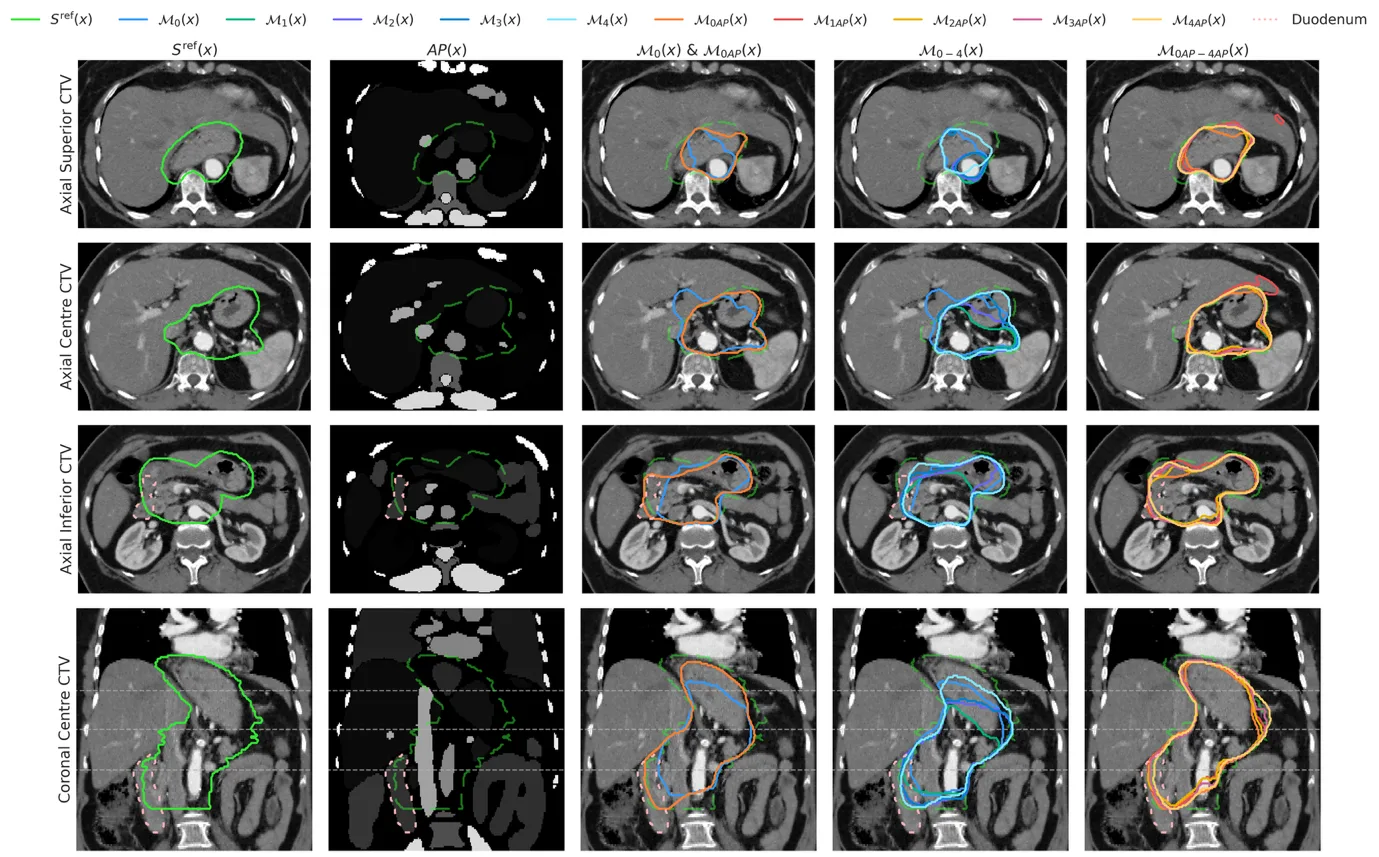
A radiation oncologist looks at an abdominal scan and mentally outlines the area to be irradiated. That area is not visible as a separate organ: its boundaries are set by protocol, not by tissue. So the doctor needs a map of the surroundings to avoid hitting healthy structures.
The nnU-Net model starts with the same task. First, it learns from ten annotated cases, but that is not enough: patients differ, and scans come from different centers. Then it is given an anatomical landmark map from TotalSegmentator, which is like a street map where all the neighboring buildings are labeled. The model sees where the stomach is, where the duodenum is, and draws the boundary more accurately.
Active learning works differently: the model itself finds cases where it is uncertain and asks to have them shown to a doctor. It is like a student who admits on an exam that they do not know the answer and then gets a review of exactly those problems. After four rounds of such retraining, accuracy rose from 0.84 to 0.87 on the Dice coefficient, a measure of overlap between two contours.
When the model gets both the map and the retraining, its result is almost indistinguishable from what different doctors would draw: inter-expert variability is 0.89, while the model achieves 0.87. This means the model can be used as a draft reference in clinical trials. The doctor only reviews cases where the model's contour raises doubts, saving hours of manual checking.
The street map and the ability to admit mistakes are two simple tools that make the guide accurate. Now it is ready to navigate the unfamiliar streets of the abdomen.
Training one model took about 22 hours on an NVIDIA Quadro 8000 GPU, while labeling anatomical landmarks for one CT scan took only 6 minutes. Adding this six-minute map saved four rounds of active learning, each of which required manual contour review by two oncologists.