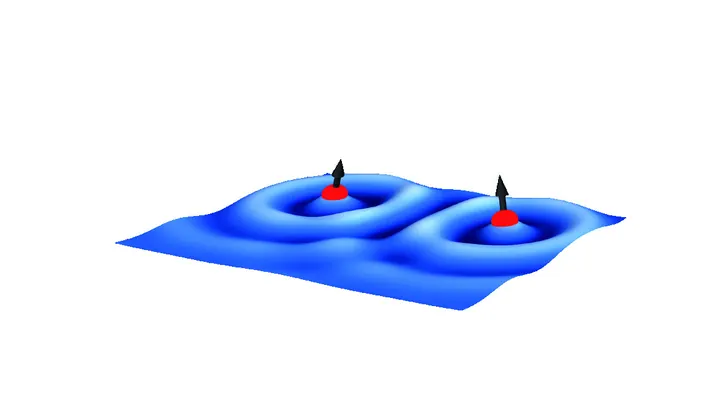
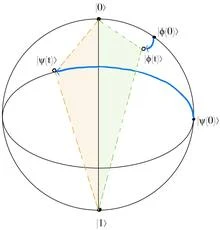
Boundary conditions are the rules that specify how a physical system behaves at the edges of the region being studied. They are essential because most physical laws, such as Maxwell's equations for electromagnetism or the Schrödinger equation in quantum mechanics, describe how a field evolves in the interior of a region, but they do not uniquely determine a solution without knowing what happens at the boundaries. Boundary conditions can be as simple as fixing the temperature at the ends of a rod or as complex as specifying the behavior of a quantum wavefunction at an infinite distance.
History
The concept of boundary conditions emerged in the 18th century with the development of partial differential equations, notably through the work of Jean le Rond d'Alembert and Daniel Bernoulli on vibrating strings. The formal mathematical treatment was later refined by figures like Dirichlet and Neumann, whose names are attached to common types of boundary conditions.
How it works
In practice, boundary conditions are mathematical constraints applied to the solutions of differential equations. For example, in a simulation of fluid flow in a pipe, the no-slip condition requires that the fluid velocity at the pipe wall be zero. In quantum mechanics, a particle in a box has wavefunctions that must vanish at the walls, leading to quantized energy levels. The choice of boundary conditions can dramatically change the outcome: the same equation with different boundary conditions can describe a vibrating guitar string versus a drumhead, or a confined electron versus a free one.
In practice
Boundary conditions are used in virtually every computational simulation in physics and engineering, from weather forecasting and aerodynamics to designing optical fibers and predicting the behavior of quantum devices.
Fun fact
In the simulation of crowd dynamics, boundary conditions can model the walls of a room, but they can also be 'absorbing' to represent exits where people leave the simulation domain.
A sculptor looks at a block of marble and sees the figure within, waiting to be freed from excess material. Instead of adding clay, he removes everything that is not part of the form. The authors of a new study on magnetic resonance took a similar approach: rather than complicating the tissue model by adding ever more details, they stripped away the superfluous to reveal the essence.
Dancers on a stage with moving walls: particles in a finite quantum system collide with each other and reflect off the edges, but the walls can move according to a prescribed scenario. Physicists have long been able to describe such dances only with fixed walls or in an infinite hall. Now there is a way to account for both the motion of the walls and the reflections from them.
Getting lost in a hall of mirrors is easy: every wall reflects another, and you feel like you've been here before. The brain gets similarly confused when surrounded by many similar places. Neurons responsible for the spatial map can fire the same signal for two different corners of a room. This is called spatial ambiguity.
If you pour honey into a colander with a hundred small holes, it will drip in thin streams, but each stream will swirl around the edge of the hole. Engineers need to understand such swirls: they affect how quickly water filters, how oil comes out of a reservoir, or how a drug seeps through tissues.
In the big world, there's a simple rule: energy density can't be negative, and its flow can't outrun light. In a café, that would look like this: a waiter can't deliver orders faster than he can run. Physicists call this restriction the energy dominance condition.
But in the microworld, where quanta rule and spacetime can bend, energy starts acting up.
A mountain pass connects two valleys. In one, the protein is folded; in the other, it is unfolded. To get from one to the other, you must cross the saddle — the highest point on the path. In protein science, this point is called the transition state, and the coordinate that shows the distance to it is the committor.
Imagine a postal service where couriers suddenly stop moving. It would seem that letters would stop arriving and communication between cities would break down. But what if the envelopes themselves suddenly gained the ability to change shape and transmit messages through a shared web without moving an inch?
The Josephson junction is a bridge made of superconductor, separated by an ultra-thin insulating layer. Current flows through it even without voltage. But when the current becomes too large, the bridge starts to oscillate, and even steps, Shapiro steps, appear on the voltage graph. Between these steps hide invisible gaps where the system behaves strangely.
The ring was assembled from several different segments. In each segment, particles behave in their own way, like musicians playing different notes. The most interesting part begins at the junctions: here particles often get stuck, like an echo trapped in a narrow corridor. This phenomenon is called the skin effect — particles pile up at the boundary, like a crowd at an exit.
But the authors noticed something new.
A regular object moves along a predictable path, like a ball. In the quantum world, a particle is smeared into a probability cloud. To find order in this fog, scientists have recast Schrödinger's equation in the language of flowing water.
Light or sound can be confined in a tiny region of a crystal, like a pearl in a shell. Usually, two methods are used. The first is like a heavy ball in a pit: a particle with large mass simply cannot roll out. The second is a perfect cage of mirrors, where waves cancel each other everywhere except in the trap itself.
At the very beginning of the universe, when all of space was compressed into a point, the laws of physics break down. This point is called a singularity — an edge where our equations lose meaning. But what if it's not an end, but a special type of boundary?
The authors of this work propose viewing the singularity as a free boundary.
A pebble drops into a pond, and ripples spread across the water. But one wave suddenly doesn't spread out: it clings to an invisible fold on the surface and runs only along it.
An ordinary magnet always carries two poles — north and south. Split it in half, and each piece immediately grows its own pair. But deep in particle theory lives a strange notion: the monopole — a particle carrying just one magnetic charge, a lone pole without a partner.
A pot of water on the stove eventually settles down: the temperature evens out, the liquid stops boiling. Physicists call this thermal equilibrium — a state where energy is distributed in the most probable way.
Every computer model of a black hole runs into the same inconvenience. A machine's memory is not infinite — at some point you have to cut off the calculation, as if placing a solid wall across space.
The void is not as empty as it seems. In the quantum world, even in a perfect vacuum, pairs of particles constantly pop in and out of existence, like ripples on a pond's surface, invisible to the eye but measurable. If you place a thin partition in this ripple, it alters the wave pattern.
A struck tuning fork fades: its vibrations leak into the air. But there are systems where the oscillation does not decay, even though there are plenty of free waves around, ready to carry energy away. Physicists call such 'captured' states bound states in the continuum (BIC).
A superconducting qubit is a tiny electrical circuit that behaves like an artificial atom. In its normal state, current flows through it without resistance, and the energy levels are evenly spaced, like steps on a staircase. But if a single electron gets stuck in the circuit, everything changes.
Quantum mechanics is a linear theory. This property is so fundamental that violating it would mean losing the superposition principle and, consequently, the possibility of superluminal information transfer. But physicists have long suspected that at a deep level, where gravity meets quanta, linearity might not survive.