French engineer Claude-Louis Navier (1821) and British physicist George Stokes (1845) combined into a system equations expressing the conservation of mass and momentum in a viscous fluid. The momentum equation: ρ (∂v/∂t + v·∇v) = -∇p + μ ∇²v + f. The left side is mass times acceleration (including convective transport), the right side includes pressure forces, viscous friction, and external influences. The incompressibility condition ∇·v = 0 is added. Their genius was accounting for internal friction (the term with viscosity μ).
History
Claude-Louis Navier derived the equations in 1821, introducing a molecular hypothesis about forces between particles. In 1845, George Gabriel Stokes refined the derivation, abandoning molecular notions and formulating the commonly accepted form with a continuum approach. Later, Leonhard Euler derived equations for an ideal (inviscid) fluid, and Navier and Stokes added viscosity.
How it works
The equations are the foundation of hydro- and aerodynamics, meteorology, oceanography, astrophysics (accretion disks, interstellar medium). Depending on the Reynolds number, they describe laminar or turbulentflow. Numerical methods of computational fluid dynamics (CFD) allow modeling everything from blood flow to aircraft aerodynamics, but high turbulence requires supercomputers.
In practice
Weather forecasts, wing aerodynamics calculations, climate modeling, and ocean current simulations — all are built on these equations.
Fun fact
The Clay Mathematics Institute has announced a $1 million prize for proving that solutions to the equations always exist and do not 'blow up' (remain smooth) in the three-dimensional case — it is one of the Millennium Prize problems.
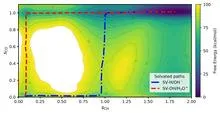
Picture a tiny hole in a sheet of graphene: a single missing carbon atom. It used to be thought that a water molecule splits apart at this defect only on its own, in dry gas. But if liquid water is sloshing all around, everything changes.
In 1934 Jean Leray proved that the Navier–Stokes equations always have solutions "in a generalized sense". Whether a solution stays smooth or can break down into a singularity he could not tell, and nobody could for ninety years. In 2000 the Clay Institute made the question one of its seven Millennium Prize problems.
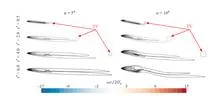
An airplane wing, like a skier on a ski jump, remembers its acceleration. Change the angle of attack sharply, and the lift does not immediately reach its new value. It builds up gradually, as if the wing is not yet sure the maneuver is for real.
This effect was discovered by engineer Herbert Wagner in 1925.
Water confined between two cylinders flows in smooth layers when the inner one rotates. But once the speed crosses a certain threshold, the layers crumple into toroidal rolls, like a stack of bagels. Physicists call these Taylor vortices: the flow loses stability and a regular pattern emerges.
As planets orbit the Sun, they don't just follow their paths: they give each other a slight tug. It's like a dance where each partner feels the movements of the others. Scientists set out to determine how strongly this mutual attraction alters the planets' trajectories.
It turns out there are small corrections that were previously overlooked.
A sphere rolls down a chute. What shape should the chute be to make the descent as quick as possible? Three centuries ago, the answer was the cycloid — a curve resembling the arc of an upside-down bridge. But submerge the chute in a thick liquid, and everything changes: the fluid slows the sphere, and the fastest path becomes something else.
When a fluid flows around an obstacle, it spawns vortices and shock waves. Describing their behavior means solving a nonlinear equation in which the flow velocity depends on itself. Classical supercomputers spend days on this, while quantum computers have barely been used: their native language is linear operations, but fluids are inherently nonlinear.
When two atomic nuclei smash together, a tiny fireball is born. It lives for an instant, but inside, entire epochs pass: compression, heating, expansion. Physicists have learned to eavesdrop on this process, and their "microphone" is the pairs of electrons and positrons that fly out of the ball at different stages.
In the new work, two scenarios were compared.
A thrown stone arcs through the air and falls. A planet orbiting a star is the same stone, but it falls forever, looping around the star in a closed curve. In Newton's world, that curve is a perfect ellipse, and the planet returns to the same point each orbit. In reality, the orbit slowly rotates: its closest point to the star, the perihelion, shifts.
The universe right after the Big Bang was like a boiling cauldron: bubbles of a new state of matter were bursting and growing everywhere. These were first-order phase transitions — exactly like water boiling, only at temperatures reaching trillions of degrees.
The early universe was less like a calm pond and more like a boiling cauldron. Matter flowed, collided, and swirled against the backdrop of rapid spatial expansion. To understand how stars and galaxies emerged from this hot soup, physicists build digital simulations.
This new work is the third part in a series on lattice-based cosmological modeling. The first two focused on fields; this one deals with fluids.
A solid under a microscope is not a monolith at all. In glass, polymer, or solidified resin, atoms are arranged randomly, and as a result, the material's properties vary from point to point. On large scales, we are used to describing them with smooth fields, like temperature or pressure in a room. But when you zoom down to a few atomic layers, that smoothness disappears.
Many natural processes are described by differential equations, but scientists often have only fragmentary data — a sort of torn map. The new computational method works like a cartographer who reconstructs a complete map of the terrain from a few landmarks.
Soil is not a solid sponge but a labyrinth of pores of various sizes. After rain, water does not fill them all at once: first the narrowest ones, then the wider ones. Physicists built a theory of this process based on a simple image — a set of communicating vessels.
In the intricate dance of active turbulence, where invisible engines spawn chaos, a soft droplet takes on the role of a detective. Its shape is not merely an outline but a sensitive cipher: it reads the hidden signals of its environment.
For decades, global atmospheric models resembled artists forced to paint planetary storms with coarse brushstrokes: a resolution of 25–100 km forced them to 'guess' convection through approximate schemes, introducing systematic errors in rainfall and climate forecasts.
Imagine a philharmonic orchestra playing, but the microphone picks up only a blended roar — a tutti where double basses, flutes, and timpani all merge. Physicists have grappled with a similar task for decades, staring at fields of density, temperature, or magnetic induction.
Picture a pot of boiling soup, but every grain in it is not just a point but a tiny top spinning around its own axis. That's the world of spin-1 particles. For example, some short-lived mesons born in accelerator collisions.
A stone falls into a pond, and ripples spread evenly in all directions. But some media behave as if the wave knows which way to turn, like water that only swirls clockwise. This asymmetry comes from odd viscosity and odd elasticity — properties of media with broken mirror symmetry.
A supersolid is matter that is both crystalline and fluid. It is created from atoms cooled almost to absolute zero. In new work, physicists obtained such a substance as a triangular lattice of droplets. Each droplet oscillates in its own rhythm.
Magnetic particles are attached to the surface of the diamond by DNA strands, like puppets on strings. They constantly dance under the thermal motion of the liquid molecules. The liquid's viscosity sets the pace: in honey, the particles barely tremble; in alcohol, they dance quickly.
Millions of cilia, thin hairs, work inside the tiny ducts of our bodies. They beat in synchrony, like the oars of a galley, pushing viscous mucus or fluid along. The authors of a new study propose viewing the ciliary carpet as an active porous medium — something like a sponge that squeezes and releases itself, driving water through.
A drop of honey spreads slowly across a table, while water spreads quickly. The resistance to flow, viscosity, differs from one fluid to another. But what if the viscosity changes on the fly, as the substance compresses or expands?
A drop of thick shampoo falls into water and freezes into a strange rope. A liquid that both flows and springs back is called viscoelastic. In it, tiny particles under ultrasound behave quite differently than in water. Viscoelasticity is a material's ability to both spread like honey and return to shape like rubber.
Strike a bell, and it hums at a single pitch. But if you place a second clapper inside, and they ring without touching each other, the sound becomes more complex. That's roughly how the neutron star from the new study is built. It's not just a hot sphere: inside, two immiscible fluids can flow — for instance, superfluid neutrons and ordinary plasma.
Imagine a spring being compressed with tremendous force. The harder you press, the denser it gets, but at some point the compression stops being uniform — some parts give way more easily, others are stiffer. That's roughly how the matter inside a neutron star behaves — an object born in the flames of a supernova.
A boiling pot, a gust of wind, a wisp of smoke from a campfire — all obey equations that mathematicians call 'nonlinear and dissipative.' In plain terms, energy is lost to friction, and parts of the flow influence each other so strongly that predicting the motion ahead of time is a task on the edge of feasibility.
In the first moments of the universe's existence, space was filled with hot plasma, where particles emerged and disappeared like bubbles in a boiling pot. The traces of these processes, stretched to gigantic sizes by expansion, are preserved in the cosmic microwave background — ancient light that has reached us across billions of years.
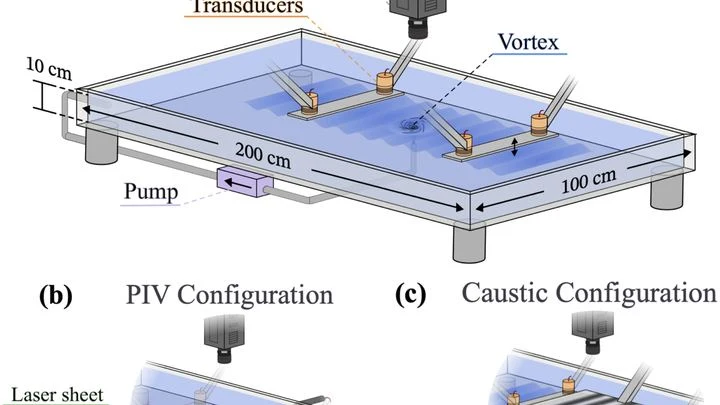
Water going down the drain swirls into a vortex. An everyday sight in the kitchen. But this very vortex turned out to be able to reproduce two effects that physicists usually associate with black holes and the rotation of planets.
The first effect is the shift of a wave as it goes around an obstacle.
A tiny glass bead hangs in a laser beam like a speck of dust in sunlight. Around it is a rarefied gas: atoms of krypton, xenon, and heavy molecules of sulfur hexafluoride. They collide with the bead, and each hit transfers a tiny impulse, like a pea thrown at a taut sheet makes it tremble.
Impulse is a measure of motion: mass times velocity.
The void can produce particles if a strong enough field is applied. Physicists call this the Dirac–Klein paradox. Previously, explaining it required the most complex calculations of quantum field theory. But we can make do with a visual image: a tightly stretched rubber band with a knot. The knot is a particle.
At the Large Hadron Collider, not only nuclei but also individual protons collide. Even in such small systems, collective behavior resembling the flow of a liquid is observed. But the proton is a quantum object; its state is described by a wave function, not by temperature and pressure.
Deep inside Earth lies a solid iron core about the size of the Moon. It floats in liquid metal and sways slightly, like a pit in a peach when you shake the fruit. Such oscillations are called Slichter modes: the core shifts both along the planet's axis and perpendicular to it.
Three forces act together to damp this motion.
In a narrow gap between two plates, water from humid air collects on its own: this is capillary condensation. If the gap is only a few nanometers wide, water no longer behaves like a continuous liquid: every molecule counts.
In the cold heart of a pure crystal, electrons flow like a viscous fluid — an idea predicted by Lev Landau. But the vortices of this fluid remained invisible, like a painting inferred from the noise of a crowd. Now scientists have created a nanostring: a semiconductor tuning fork with a circular cavity.
Water in a river flows around rocks, air bends around an airplane wing: these motions are described by equations that are hard to solve even on a powerful computer. Neural networks can approximate such solutions, but they often err when data is collected at only a few points or is noisy.
Drop tiny gold spheres onto a scorching skillet: each smaller than a hundredth of a hair's width. Under an electron microscope, you can watch them slowly evaporate. It seems simple: each sphere should shrink evenly, like an ice cube in warm water. But instead of a steady shrinkage, the particles behave like drunk pedestrians: one step forward, two to the side.
A drop of ink falls into a glass of water, and ripples spread out from it. Water seems simple, but if you look inside, each molecule isn't just moving forward: it's also spinning like a tiny top. Physicists call this intrinsic rotation spin. Usually, it goes unnoticed: in calm water, the tops spin every which way, and their rotation doesn't affect the fluid's overall motion.
Water swirling into a vortex eventually stops being smooth: foam and spray appear. Mathematicians describe such flows with equations, but there's a puzzle — sometimes the solution 'explodes,' becoming infinite, and no one knows why. Stochastic modeling doesn't help here; we need a precise tool.
In a protoplanetary disk, a cloud of gas and dust around a young star, dust grains don't just fly in circles. They are carried by the gas flow, like sand by the wind, and in turn alter that flow. Layers emerge, sliding past each other, and at their boundaries an instability arises — waves and vortices.