The electronvolt (eV) is a unit of energy that, despite its name, is not confined to electronics. It is defined as the kinetic energy gained by a single electron when it is accelerated through an electric potential difference of one volt. In practice, this is an extremely tiny amount of energy — about 1.6 × 10⁻¹⁹ joules — which makes it the natural measuring stick for the microscopic world of atoms, molecules, and subatomic particles.
History
The electronvolt was introduced in the early 20th century as a convenient unit for describing the energies of charged particles in vacuum tubes and early particle accelerators. Its exact origin is not well documented, but it became standard with the development of atomic and nuclear physics.
How it works
The definition stems directly from the relationship between electricpotential energy and charge. When a particle with a charge equal to that of an electron (about 1.6 × 10⁻¹⁹ coulombs) moves across a potential difference of one volt, it gains or loses exactly one electronvolt of energy. Because this unit is so small, physicists routinely use multiples: keV (thousand), MeV (million), and GeV (billion) for particle physics, and even TeV for the highest-energy cosmic rays.
In practice
The electronvolt is the standard energy unit in particle physics, astrophysics, and materials science — from describing the binding energy of electrons in atoms (a few eV) to the energies of particles in cosmic rays (up to 10²⁰ eV). It is also used to specify the energy resolution of detectors and the thresholds of nuclear reactions.
Fun fact
A single photon of visible light carries about 2 to 3 electronvolts of energy, which is why the electronvolt is a convenient unit for describing optical and ultraviolet phenomena.
Systems:SInaturalOne electronvolt is equal to 1.602176634e-19 joules, defined as the energy gained by an electron accelerated through one volt.
Two electrons that leave a metal needle tip almost simultaneously start to repel each other, like two people trying to squeeze through a narrow door at the same time. The closer they are, the more they get in each other's way.
An electron beam is a stream of tiny particles carrying an electric charge. When such a beam hits a material, it doesn't just heat it or knock out atoms: it also gives the surface a slight push, like a jet of water pushing against your palm.
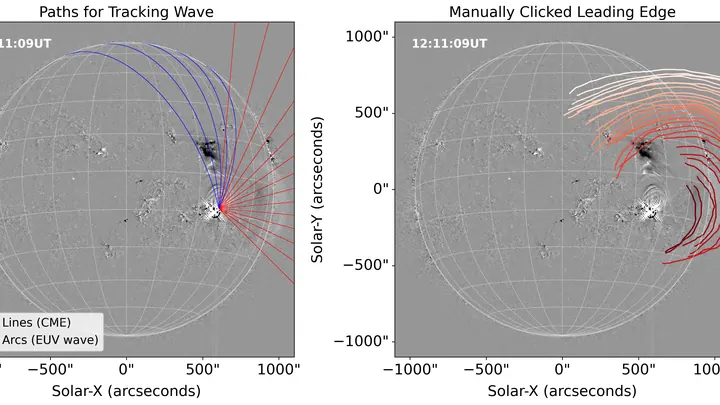
A shock wave in the Sun's corona is like the sonic boom from an airplane, except instead of air there is scorching plasma, and instead of sound there is a jump in density and magnetic field. On March 10, 2024, such a wave swept across the western part of the solar disk.
A water molecule resembles a tiny dumbbell: two hydrogen atoms attach to an oxygen atom at an angle. This dumbbell doesn't stay still: it stretches, compresses, and rotates. Each such motion has its own energy, like steps on a ladder.
The neutron is a particle with no charge but with internal structure. Like a ball that looks smooth on the outside but has a complex filling inside. Scientists have long wanted to understand how electric and magnetic forces are distributed inside the neutron. To do this, you need to "feel" it — collide it with its antiparticle and see what happens.
Measured dipole moment of tantalum-181: 3.39 × 10⁻³² e·cm — like spotting a one-atom shift across the entire Solar System. An ordinary atomic nucleus is perfectly balanced, like a spinning top. In tantalum, that balance is broken: the positive and negative charges are slightly offset from each other.
At Jefferson Lab, electrons are accelerated to 12 GeV and smash into protons to pry out their secrets. But existing detectors are like cameras with a narrow field of view: you either see a lot but dimly, or brightly but only a tiny patch. Electron scattering is the main tool, but statistics are insufficient for subtle effects.
High above Antarctica, a balloon carried an instrument that caught electrons from space. These particles come from distant stellar explosions and other powerful events. The instrument measured their energy, like the force of an impact. And in one energy range, there were more impacts than calculations predicted.