A supercomputer is a computing system that pushes the limits of processing power, memory, and speed, typically by connecting thousands or millions of processors that work in parallel. Unlike a personal computer, a supercomputer is designed for a single purpose: to perform massive calculations that would take ordinary machines years or centuries. They are used to simulate weather patterns, model the folding of proteins, predict climate change, and test theories of the early universe.
History
The first supercomputer is often considered the CDC 6600, designed by Seymour Cray in 1964. Cray went on to dominate the field for decades with a series of increasingly fast machines. The current era is defined by exascale systems, which perform over a billion billion calculations per second.
How it works
Supercomputers achieve their speed through massive parallelism. They divide a large problem into many smaller pieces, each handled by a separate processor core, then combine the results. The key challenges are keeping all processors fed with data (memory bandwidth) and coordinating their work (interconnect speed). Modern supercomputers also use specialized accelerators, like GPUs, which are optimized for the repetitive mathematical operations common in scientific simulations.
The fastest supercomputers today consume tens of megawatts of power — enough to power a small town — and most of that energy is wasted as heat, which is why they require elaborate cooling systems.
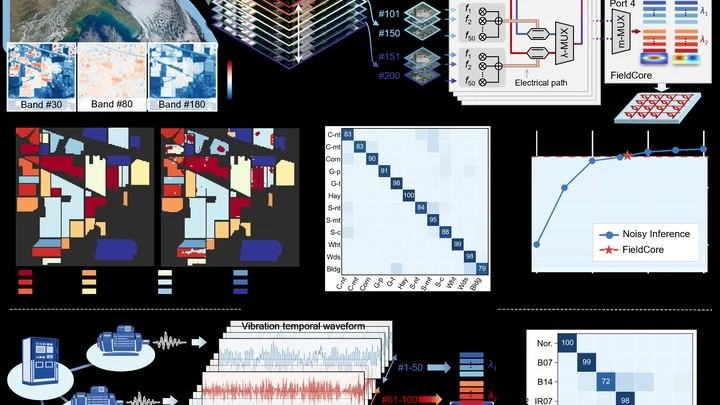
An artist makes a quick charcoal sketch, and the face in the portrait is already recognizable. Astrophysicists face a similar challenge: the spectrum of a star is its individual portrait, revealing temperature, composition, and gravity.
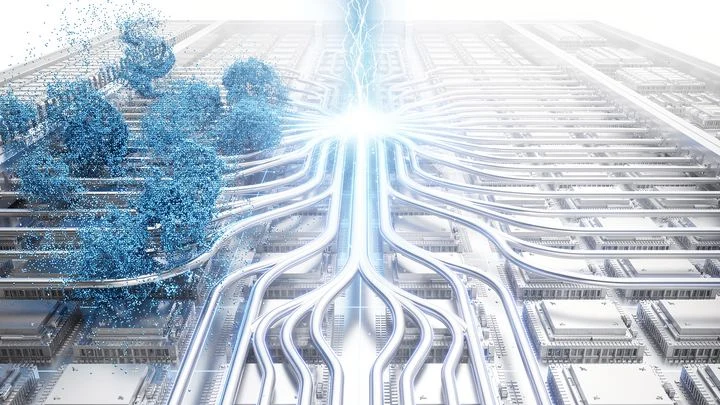
A typical computer shuttles electricity along copper traces, and every operation is a queue: first one thing, then another. Light works differently. In a single beam, you can mix dozens of signals without them interfering, like different voices in a choir, singing at once but each heard distinctly.
The new FieldCore chip uses five such "voices" at once.
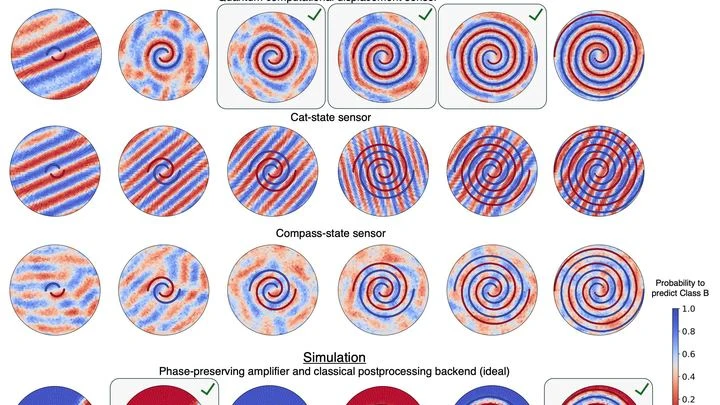
A judge walks into the courtroom but doesn't look at the evidence: he immediately delivers the verdict. That's how the new quantum sensor works: it doesn't measure the signal but directly decides which class it belongs to.
In conventional quantum sensing, it's all like a detective story: first you gather clues (measure the signal), then you analyze them.
A classical computer sorts data like a person meticulously sifting through grains of sand of different colors. A quantum processor takes its cue from nature: just as a droplet of water splits sunlight into a rainbow, revealing all hues at once, this new algorithm instantly grasps the essence of vast information arrays.
Weather forecasting is like trying to predict where a rock will roll down a slope, knowing the shape of every bump and the force of the wind. Make a mistake at the start, and a week later that error grows into a full-blown storm. In the past, accurate forecasts required massive computers and days of computation.
Light races through a maze of mirrors and beam splitters, but at the end of its journey, it doesn't just flash on a detector: it transforms itself. In the new photonic computer, nonlinear modules have been added to the familiar linear circuits, and now light can perform any quantum operation, not just a subset.
Inside every cell, chemical reactions are constantly underway, like a tiny kitchen where protein chefs whip up essential compounds. But seeing exactly how a chef prepares a dish is tricky when you're surrounded by a crowd of other molecules.
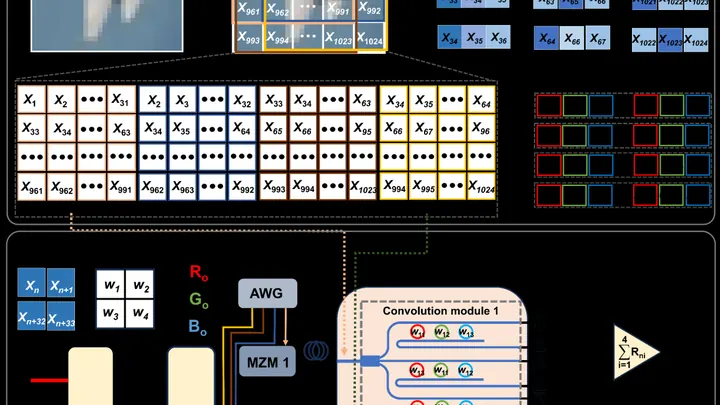
A conventional computer sees the world flat: numbers are just points on a line. But a color image or a 3D scene demands more — four numbers that describe both position and rotation. Such quadruples are called quaternions, and until now electronics handled them clumsily, breaking them apart and reassembling them.
The new chip changes the approach.
An orchestra plays inside a giant refrigerator. The musicians are qubits, the elementary cells of a quantum computer. To play in harmony, they need silence: thermal noise drowns out the melody. That's why the heart of a quantum processor is cooled to nearly absolute zero — minus 273 degrees Celsius.
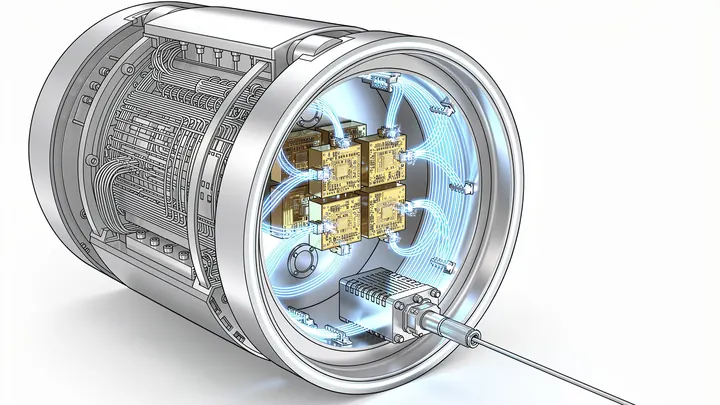
A massive refrigerator the size of a wardrobe hums, maintaining an interior colder than outer space. At its heart lies a silicon chip with tiny superconducting loops — qubits. But to make the chip work, dozens of thick copper cables snake from room temperature down to it.
Ordinary wires: electrons jostle, lose energy, and heat up: that's resistance. In superconductors, some electrons pair up in sync, like dancers swirling without collisions. But these pairs hide: you can't see them directly, only infer their presence from flawless coordination.
Atoms, like a swarm of fireflies, shine in unison. When they flash together, the light multiplies — a hundred atoms shine ten thousand times brighter than one. Physicists have turned this trick into a heat engine. A typical motor needs both a hot and a cold source, but here the atoms operate with just a cold one.
Three thousand meters above sea level, a sheer cliff face. A classical climber picks a single route and crawls up step by step, often getting stuck in a local minimum: a small niche with no upward path. A quantum climber acts differently: it can leap across a canyon and land in a neighboring energy basin where the route is better.
Inside a cryostat cooled to tens of millikelvins live superconducting qubits. There aren't many of them: tens, at most hundreds. Crosstalk and thermal noise prevent packing more. But cracking RSA-2048 requires anywhere from ten thousand to ten million physical qubits.
In 2019, a group of theorists asked a simple question: what would happen if you embedded a single irreversible element into an ordinary quantum computer, a gate that slightly "eats" probability? The answer was devastating. Any such gate, no matter how weak, instantly turns the machine into a device capable of solving problems in the class PostBQP = PP.
A superconducting quantum processor is like a microscopic metropolis locked in a cryogenic fridge: streets of superconducting lines, blocks of qubits. Each resident demands silence and cold, but expanding the city inside a single cryostat is like stacking skyscrapers in a cramped courtyard — wires heat the environment, noise builds up, coherence threatens to collapse.
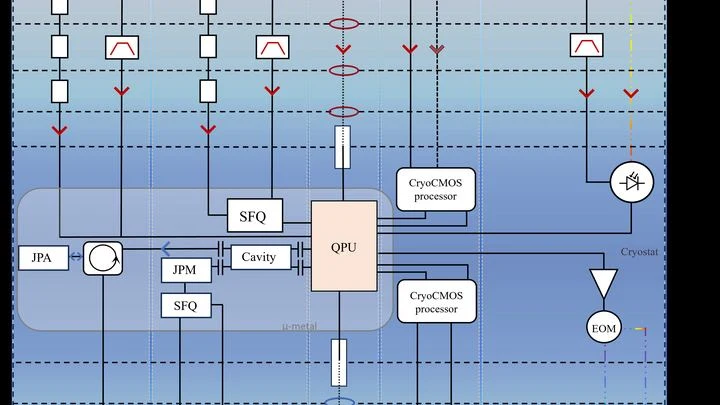
Imagine an orchestra where every musician plays an instrument that breaks at the slightest warmth. The conductor is the quantum processor, and the musicians are the qubits — fragile carriers of quantum information. To keep them in harmony, you need a whole team of tuners sitting in the next room, sending commands through a soundproof wall.
A single quantum processor is like a solo musician. It can play a simple tune, but a symphony requires an orchestra. To solve problems that demand enormous computational power, processors must be networked.
In 2023, a group of researchers at Oak Ridge National Laboratory ran a simulation of a 61-qubit quantum circuit on the Theta supercomputer. Storing its state vector would have required 32 exabytes of memory, more than the total capacity of all hard drives on the planet. But thanks to data compression, they fit it into 768 terabytes.
A supercomputer simulating laser plasma is like a kitchen where hundreds of chefs are preparing a single dish. If ten people crowd around one stove while another stands empty, the work grinds to a halt. The same happens in simulations: plasma particles bunch up in certain regions of space, leaving others nearly empty.
Today's blockchain is like a music box: the melody (the rules of the game) is embedded in the mechanism, and to change it you have to take the whole thing apart. Every time developers want to change an application's logic, they have to perform a fork, splitting the network into two branches that then compete with each other.
A quantum computer is like an orchestra where every musician plays an invisible instrument. Instead of violins and trumpets, there are qubits — fragile particles that are easily knocked off beat by the slightest heat or noise.