Agujeros negros invisibles: ¿planetas o algo más? exprés
Una estrella que baila sin pareja visible: así perciben los astrónomos sus oscilaciones. El corrimiento Doppler suele delatar un planeta, pero a veces el compañero sigue siendo invisible. Entonces podría ser un agujero negro primordial, un objeto de masa planetaria nacido en el universo temprano. A diferencia de los planetas comunes, este agujero no refleja luz ni oculta la estrella (no hay tránsito).
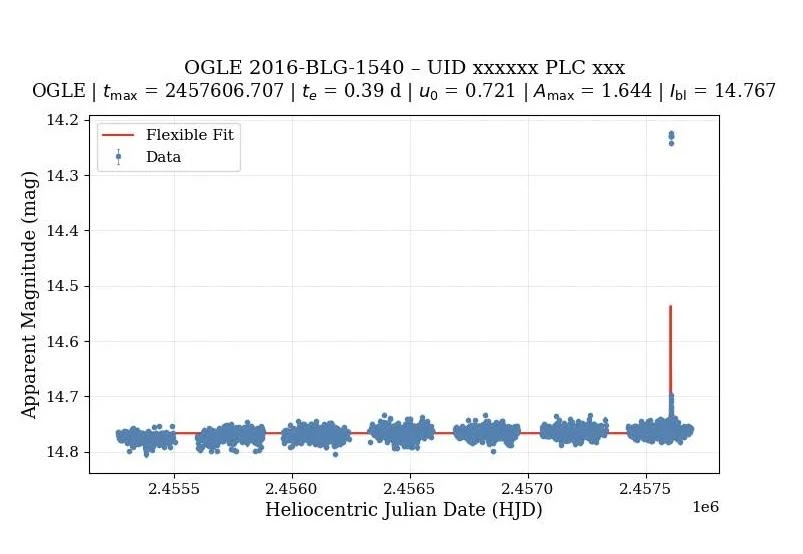
Tras revisar datos de miles de candidatos a exoplanetas, los científicos destacaron seis objetos que se manifiestan solo gravitacionalmente. Entre ellos están los compañeros de las estrellas Kepler-21, Gliese 686 y otras cuatro. Dos episodios de curvatura breve de la luz de estrellas lejanas (microlente gravitacional) también resultan sospechosos.
La danza gravitacional delata por igual a un planeta y a un agujero negro. Para distinguirlos ayudará la radiación de Hawking: los agujeros diminutos se evaporan más rápido y podrían emitir una señal débil. Si se confirma, estos compañeros invisibles se convertirán en la llave de la materia oscura, la sustancia misteriosa que quizás compone la mayor parte del universo.
Resumen original
tal como lo escribieron los autores, en inglés arXiv:2512.03118
We have sifted through astrophysical data collected by various radial velocity and gravitational microlensing searches for exoplanets with the goal of identifying potential signs of the presence of primordial black holes (PBH). Our motivation is that those hypothesized remnants of inhomogeneous energetic fluctuations in the early universe, though too small for direct detection, are thought to have a mass range similar to that of planets. Thereby, if captured by stars, they could conceivably make their presence known through stellar wobbles picked up by means of Doppler spectroscopy in the radial velocity method, or alternatively through microlensing. In our analysis of such data, we have identified potential PBH contenders by ruling out any exoplanet candidates that have been detected through direct imaging or transit methods, as they would have sizes consistent with planets rather than PBHs. In particular we focus on the objects Kepler-21 Ac, HD 219134 f, Gliese 686 b, HR 5183 b, HD 20794 e, and Wolf 1061 d, each of which has been found using the radial velocity method but never imaged (either directly or through transit). We also examine the microlensing events MOA 2009-BLG-387L and OGLE-2016-BLG-1540, which offer promise as candidate PBHs. We present these as a representative, but not exclusive list, of potential PBH contenders. Furthermore, future imaging, especially focused on signals of planetary dimensions versus evaporation signatures, might clarify which of these are indeed exoplanets.
Un agujero negro primordial con la masa de la Tierra cabría en una uva: su diámetro sería de solo 9 milímetros.