El callejón sin salida del oxígeno bajo una estrella roja exprés
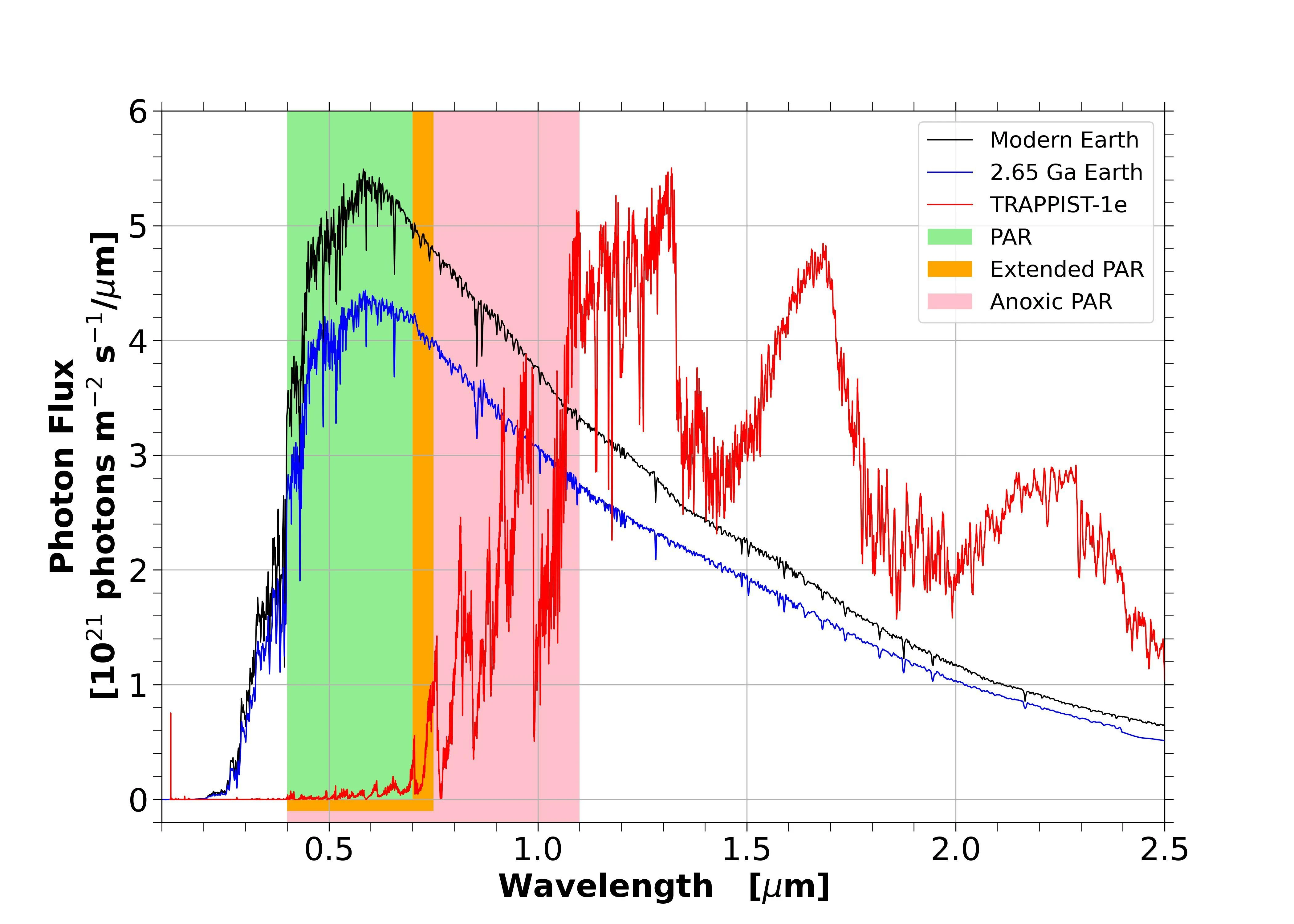
En TRAPPIST-1, la fotosíntesis oxigénica pierde la carrera. Esta estrella enana emite sobre todo luz infrarroja, no visible como el Sol. Las plantas terrestres, capturando luz de ciertos colores, acumularon oxígeno, pero aquí esos rayos son escasísimos. Por sí solo, el proceso tardaría 63 mil millones de años, más que la edad del Universo. Teniendo en cuenta que el exceso de luz daña las células y el rango admisible es más amplio, el tiempo se reduce a 1-5 mil millones de años. Pero entonces entran en juego bacterias que no producen oxígeno, pero ven perfectamente la luz infrarroja hasta 1100 nanómetros. En TRAPPIST-1 hay 22 veces más que luz visible. Ellas conquistarán los océanos, cortando los recursos a sus competidoras. En lugar de verdor, mares púrpura. Sin oxígeno no ocurre la explosión del Cámbrico: la avalancha de organismos complejos. Por eso, la mayoría de los planetas similares a la Tierra alrededor de enanas rojas, descubiertos gracias a William Borucki y David Charbonneau, seguirán siendo para siempre un mundo de microbios. El destino de la biosfera no solo depende de la distancia a la estrella, sino también del color de su luz.
Resumen original
tal como lo escribieron los autores, en inglés arXiv:2601.02548v1
The rise of oxygen in the Earth's atmosphere during the Great Oxidation Event (GOE) occurred about 2.3 billion years ago. There is considerably greater uncertainty for the origin of oxygenic photosynthesis, but it likely occurred significantly earlier, perhaps by 700 million years. Assuming this time lag is proportional to the rate of oxygen generation, we can estimate how long it would take for a GOE-like event to occur on a hypothetical Earth-analog planet orbiting the star TRAPPIST-1 (a late M star with Teff 2560 K). Although in the habitable zone, an Earth-analog planet located in TRAPPIST-1e's orbit would receive only 0.9% of the Photosynthetically Active Radiation (PAR) that the Earth gets from the Sun. This is because most of the star's light is emitted at wavelengths longer than the 400-700 nm PAR range. Thus it would take 63 Gyrs for a GOE to occur. But the linear assumption is problematic; as light levels increase, photosynthesis saturates then declines, an effect known as photoinhibition. Photoinhibition varies from species to species and depends on a host of environmental factors. There is also sensitivity to the upper wavelength limit of the PAR: extending just 50 nm increases the number of photons by a factor of 2.5. Including these and other factors greatly reduces the timescale to roughly 1-5 Gyrs for a GOE. However, non-oxygenic photosynthetic bacteria can thrive in low-light environments and can use near-IR light out to 1100 nm, providing 22 times as many photons. With this huge light advantage, and because they evolved earlier, anoxygenic photosynthesizers would likely dominate the ecosystem. On a late M-star Earth-analog planet, oxygen may never reach significant levels in the atmosphere and a GOE may never occur, let alone a Cambrian Explosion. Thus complex animal life is unlikely.
En la Tierra, las bacterias púrpuras del azufre, que usan luz infrarroja, aún viven en fuentes termales; quizás así era la vida en los océanos antiguos antes de la revolución del oxígeno.