El misterio del polvo cósmico: pesar una galaxia exprés
Los astrónomos apuntaron el James Webb hacia tres galaxias cuya luz ha viajado 12 mil millones de años. Los primeros datos indicaban un crecimiento increíblemente rápido — como si un bebé alcanzara la estatura de un adulto en un año, lo que contradecía la expansión del Universo.
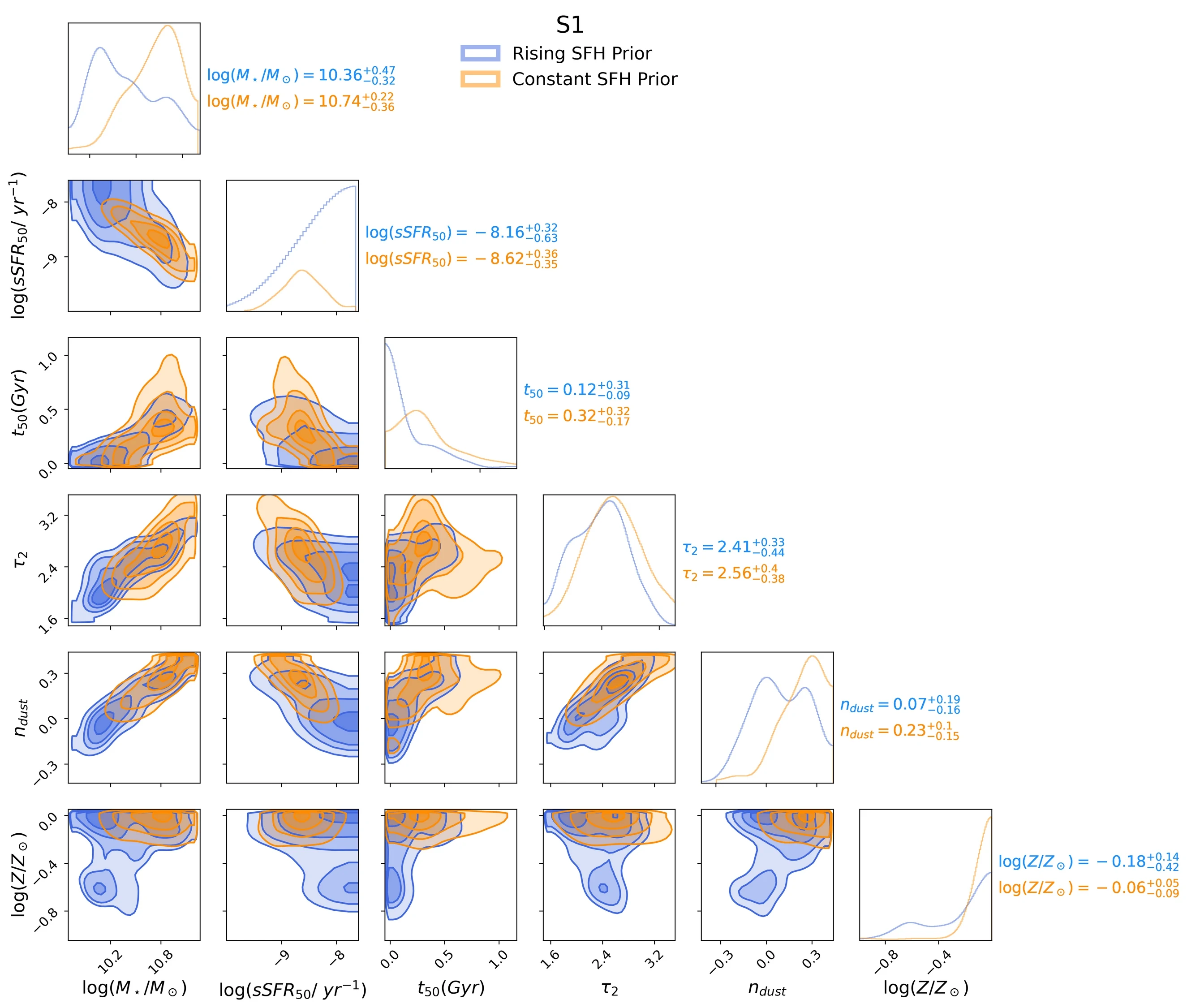
Un nuevo análisis de la luz (espectroscopía) reveló que una de las galaxias está más cerca, y el recálculo teniendo en cuenta el polvo cósmico (partículas microscópicas que dificultan las observaciones) arrojó nuevas cifras. La estimación de la masa depende de cuánto atenúe el polvo la luz, como si pesaras una estatua detrás de un cristal con diferente opacidad. El más mínimo cambio en la opacidad altera el resultado. Tras la corrección, los tres gigantes «adelgazaron»; en un caso la masa se redujo a la mitad. Aun así, dos siguen siendo demasiado pesadas para su edad, desafiando la cosmología.
Resumen original
tal como lo escribieron los autores, en inglés arXiv:2601.08693v2
JWST observations have suggested that some high-redshift galaxies may be ultra-massive, thereby challenging standard models of early galaxy formation and cosmology. We analyse the stellar masses using different modelling assumptions and with new data of three galaxies (S1, S2 and S3), whose NIRCam/grism redshifts were consistent with $$z>5$$. These three optically dark galaxies have previously been reported to host exceptionally high stellar masses and star-formation rates, implying extremely high star-formation efficiencies. Recent NIRSpec/IFU observations for S1 indicate a spectroscopic redshift of $$z_{\rm spec}=3.2439\pm0.0002$$, which is lower than previously reported. Using the Bayesian spectral energy distribution (SED) modelling tool \texttt{Prospector}, we investigate the impact of key model assumptions on stellar mass estimates, such as the choice of star-formation history (SFH) priors (constant versus rising SFH base for the non-parametric prior), the dust attenuation law, and the treatment of emission line fluxes. Our analysis yields revised stellar masses of $$\log(M_{\star}/M_{\odot}) \approx 10.36^{+0.47}_{-0.32}, 10.95^{+0.11}_{-0.10}$$ and $$10.31^{+0.24}_{-0.19}$$ for S1, S2, and S3, respectively. We find that adopting a rising SFH base prior results in lower inferred stellar masses compared to a constant SFH base prior. We identify a significant degeneracy between the dust attenuation curve slope, the amount of dust attenuation, and stellar mass. Our results highlight various systematics in SED modelling due to SFH priors and dust attenuation that can influence stellar mass estimates of heavily dust obscured sources. Nevertheless, even with these revised stellar mass estimates, two of the three galaxies remain among the most massive and actively star-forming systems at their respective redshifts, implying high star-formation efficiencies.
Las partículas de polvo cósmico son microsólidos (principalmente carbono y silicatos) del tamaño de un virus, nacidos en las envolturas de estrellas viejas; juntas crean un velo semitransparente capaz de ocultar ejércitos enteros de astros.