La turbulencia acelera las gotas de lluvia exprés
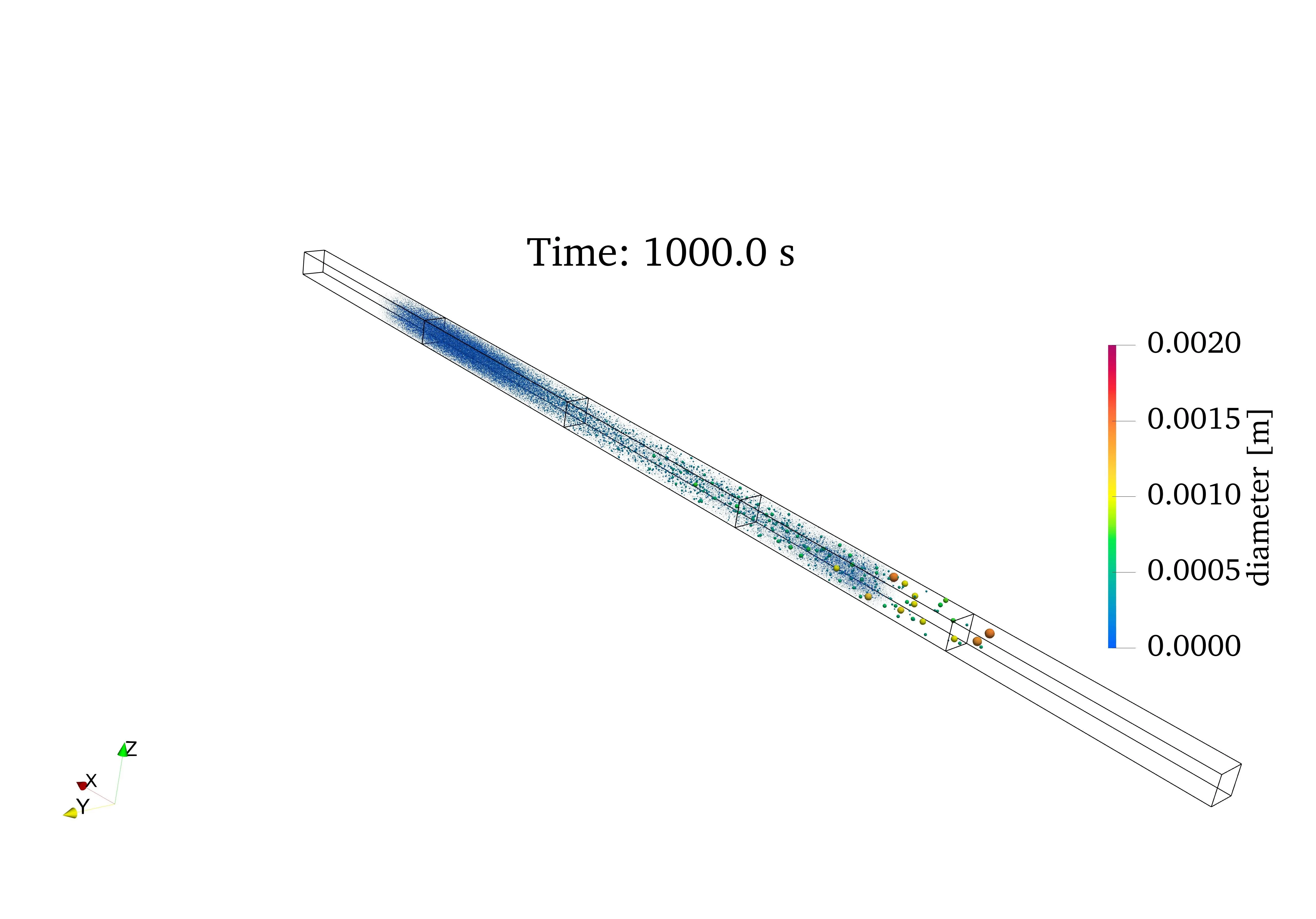
En una nube, miles de diminutas gotas de agua flotan en el aire. Para que llueva, necesitan crecer: unirse en gotas más grandes y volverse lo suficientemente pesadas como para caer al suelo. Pero, ¿cómo se encuentran exactamente las gotas en una nube enorme?
Los científicos crearon un modelo computacional que sigue cada gota por separado, como si cada una tuviera su propio pequeño sensor. El modelo abarca toda la columna de aire desde el suelo hasta la cima de la nube. Dentro de esta columna, incluyeron la turbulencia: remolinos de aire desordenados que mezclan constantemente las gotas. Para comparar, ejecutaron el mismo modelo sin remolinos.
El resultado sorprendió: los remolinos funcionan como manos invisibles que empujan las gotas unas contra otras. Primero, en el centro de la nube, chocan gotas del mismo tamaño, y así nacen las primeras gotas grandes. Luego, estas gotas grandes, al caer, recogen en su camino las pequeñas, como una bola de nieve que rueda montaña abajo. Por eso, en una nube turbulenta la lluvia comienza antes, y las primeras gotas que caen al suelo son más grandes que en aire tranquilo.
Resumen original
tal como lo escribieron los autores, en inglés arXiv:2604.10564
We developed a new explicit cloud microphysical model, based on direct numerical simulation (DNS) with Lagrangian particle tracking. The model employs a vertically-elongated quasi-1D computational domain extending from the ground to the cloud top to explicitly capture the vertical structure of clouds. This allows us to simulate the all warm-cloud microphysical processes, including activation, condensation growth, collision-coalescence growth, and sedimentation. A homogeneous isotropic turbulence field is incorporated into this domain to explicitly resolve the turbulent wind fluctuations. Cloud microphysics simulations with and without turbulent wind fluctuations were performed to clarify the impact of turbulence on droplet growth. We obtained new insights into the altitude- and time-dependent microphysical statistics, which cannot be obtained through conventional DNS researches for a cubic box domain with periodic boundaries. The comparison have shown that turbulence promoted the collision-coalescence growth of droplets. During the early developing stage, where the updraft was present, turbulence promoted the collisions between droplets with similar sizes (autoconversions) in the middle layer of the cloud. In later stage, relatively large droplets produced by autoconversions actively collected smaller droplets (accretions) in the middle and lower layers. The onset of precipitation at the ground occurred earlier and the first raindrop at the ground was larger in turbulence case than that in non-turbulence case.
La primera gota de lluvia de una nube turbulenta fue más grande que la de una nube tranquila. Los remolinos parecen reunir especialmente más agua para ella.