Un gas cuántico rompe las reglas de los libros de texto exprés
Los libros de texto dividen las partículas en dos bandos: a los bosones les encanta amontonarse en un mismo estado, mientras que los fermiones se niegan rotundamente. Pero la naturaleza admite una tercera opción. Los anyones son cuasipartículas cuyo comportamiento se sitúa en algún punto intermedio. Pueden «recordar» cómo se han intercambiado y obedecen a una prohibición no estándar de vecindad.
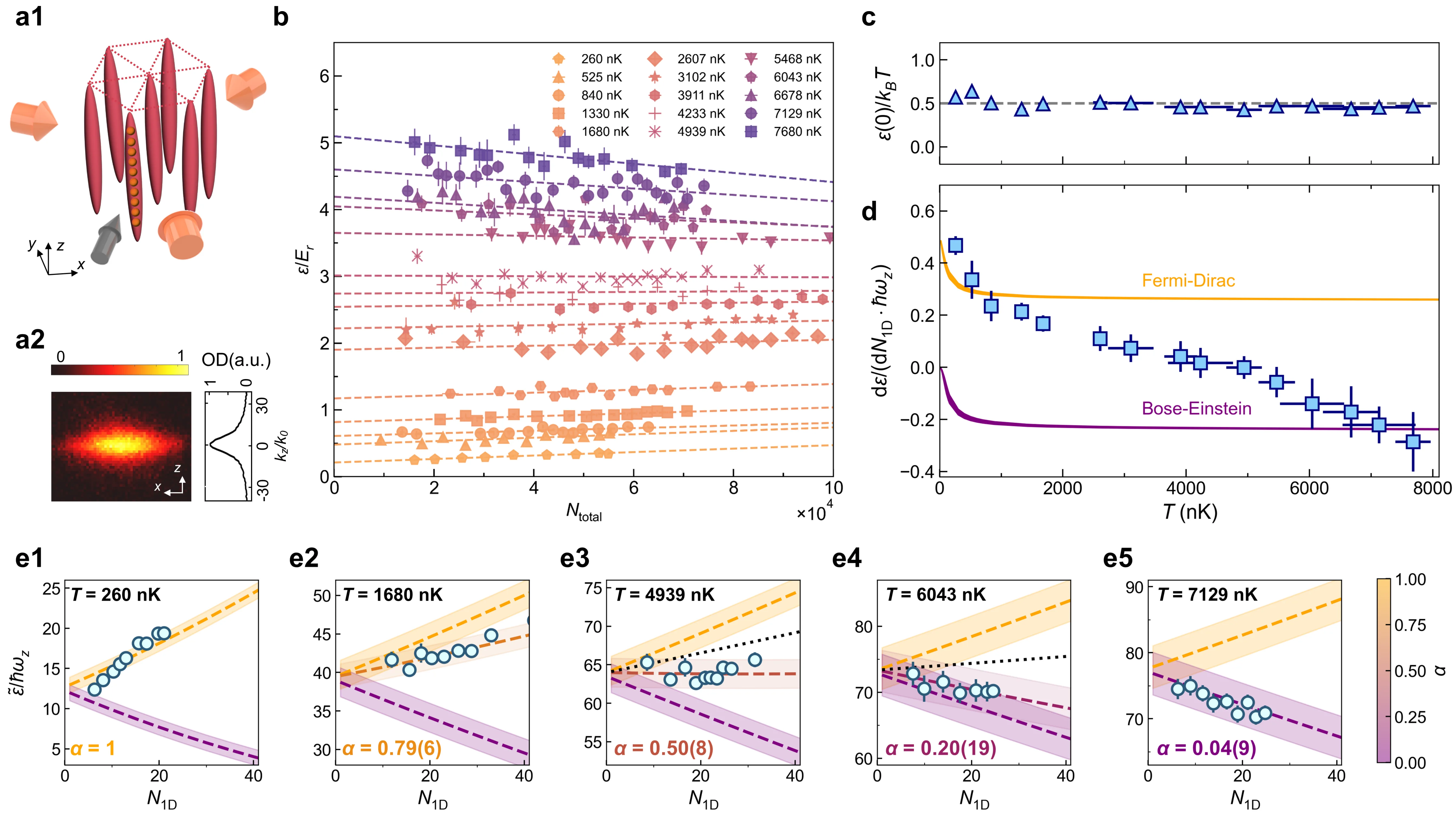
Un grupo de físicos tomó un gas cuántico unidimensional de átomos fuertemente interactuantes y lo convirtió en un conjunto termodinámico anyónico. En una dimensión, la interacción dinámica entre partículas puede recalcularse como estadística: es un truco matemático conocido. Variando la fuerza de repulsión y la temperatura, los autores registraron la ecuación de estado del gas. Las gráficas mostraron desviaciones claras de las estadísticas de Bose–Einstein y de Fermi–Dirac.
Estas desviaciones se ajustaron exactamente a las curvas de la estadística de exclusión generalizada, esa versión ampliada del principio de Pauli. Mediciones adicionales de la presión y del contacto de Tan confirmaron el panorama. En manos de los científicos quedó una plataforma donde la estadística de las partículas puede ajustarse con solo girar una perilla.
Resumen original
tal como lo escribieron los autores, en inglés arXiv:2606.19009
Anyons are quasiparticles with quantum statistics interpolating between those of bosons and fermions. Two distinct manifestations of anyonic behaviour have been theoretically established: fractional exchange statistics where particle exchange can produce any phase, and generalized exclusion statistics which extends the Pauli exclusion principle. While anyons exhibiting fractional exchange statistics have been observed in diverse platforms, experimental realizations of generalized exclusion statistics and direct measurements of its thermodynamic signatures have remained elusive. Here, we realize an anyonic thermodynamic ensemble obeying generalized exclusion statistics and detect its anyonic thermodynamics in a one-dimensional strongly interacting quantum gas. To achieve this, we exploit the bijective mapping between dynamical and statistical interactions in one dimension. By tuning interaction strength and temperature over a wide range, we measure the equation of state and identify clear departures from Bose-Einstein and Fermi-Dirac statistics. These deviations are quantitatively captured by generalized exclusion statistics, providing direct evidence for the generalized Pauli principle. Independent probes of other thermodynamic quantities including pressure and the Tan contact further validate this framework. Our results establish a versatile platform for engineering anyonic exclusion statistics and open the door to thermodynamic applications of anyons in quantum technologies.
El mundo unidimensional es mucho más amable con los anyones: en dos o tres dimensiones, crear una estadística tan ajustable mediante la interacción es mucho más difícil.