Calor bajo presión: cómo medir lo invisible exprés
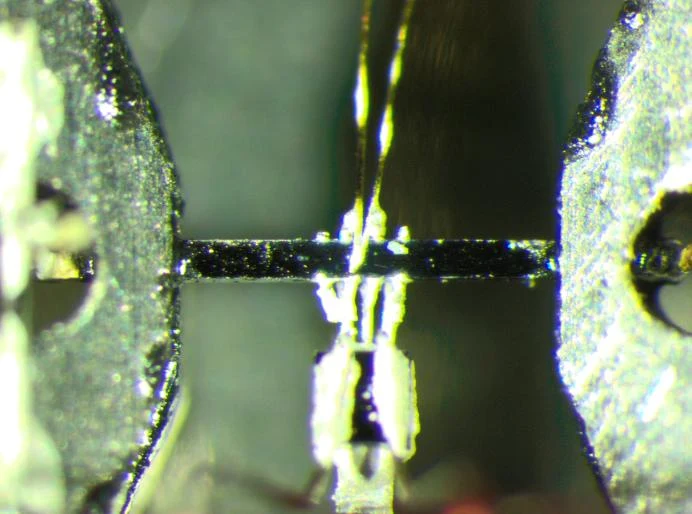
Un superconductor es un material en el que la electricidad fluye sin pérdidas, como el agua por una tubería perfectamente lisa. Pero si se comprime ligeramente, como un resorte, sus propiedades cambian. Los científicos llevaban tiempo queriendo medir cuánto calor absorbe un material así comprimido, pero los instrumentos no cabían en el reducido montaje. Ahora han ideado una forma de sortear este obstáculo.
No miden el calor en sí, sino las diminutas fluctuaciones de temperatura cuando el material se comprime y se suelta rápidamente. Es como observar la respiración de una persona sin tocarla. Combinando las mediciones con compresión lenta y rápida, obtienen un mapa preciso del calor en toda la muestra. Para el superconductor Sr₂RuO₄, ese mapa reveló algo sorprendente: con cierta compresión, el orden interno de la sustancia se vuelve más fuerte.
Este hallazgo ayuda a entender cómo controlar los superconductores mediante la presión. Quizás en el futuro estos materiales funcionen a temperaturas más altas, acercándonos a cables sin pérdidas en nuestros hogares.
Resumen original
tal como lo escribieron los autores, en inglés arXiv:2608.17777v1
Uniaxial pressure is a powerful tuning parameter for quantum materials, but conventional thermodynamic probes such as specific heat are difficult to realize in the constrained geometries of strain apparatus. We develop a quantitative analysis framework for a.c. elastocaloric effect measurements that enable the reconstruction of the absolute entropy and hence specific heat across complex phase diagrams. The absolute accuracy is achieved by combining measurements in the strong coupling regime at low frequencies with high signal-to-noise measurements in the quasi-adiabatic regime at high frequencies. Applying the approach to the correlated superconductor Sr$$_2$$RuO$$_4$$, we obtain an absolute entropy map across the phase diagram including across phase transitions deep into the superconducting state. We demonstrate that from such data one can derive the absolute specific heat which is currently not possible through other approaches. This data reinforces the finding that the quenching of entropy within the superconductor Sr$$_2$$RuO$$_4$$ is strongest at the critical strain consistent with the superconducting gap being maximized at the Van Hove singularity (VHs). Furthermore, we demonstrate that, although $$\Delta c /(\gamma T) $$ does increase at the VH strain, this increase is much weaker than previously inferred from more indirect caloric experiments.
La compresión en cuestión es menor que una centésima parte del grosor de un cabello humano, pero altera las propiedades del material más que calentarlo varios grados.