Космическая кухня: ядерная паста в недрах звёзд экспресс
Задолго до этого Фриц Цвикки предсказал, что после взрыва сверхновой рождается крошечная нейтронная звезда. Спустя годы Джоселин Белл Бернелл уловила её пульсации, открыв пульсары. А теперь выяснилось, что внутри этих звёзд — настоящая кулинарная феерия: ядра атомов вытягиваются в спагетти, укладываются слоями, как лазанья, и собираются в клёцки. Это назвали ядерной пастой.
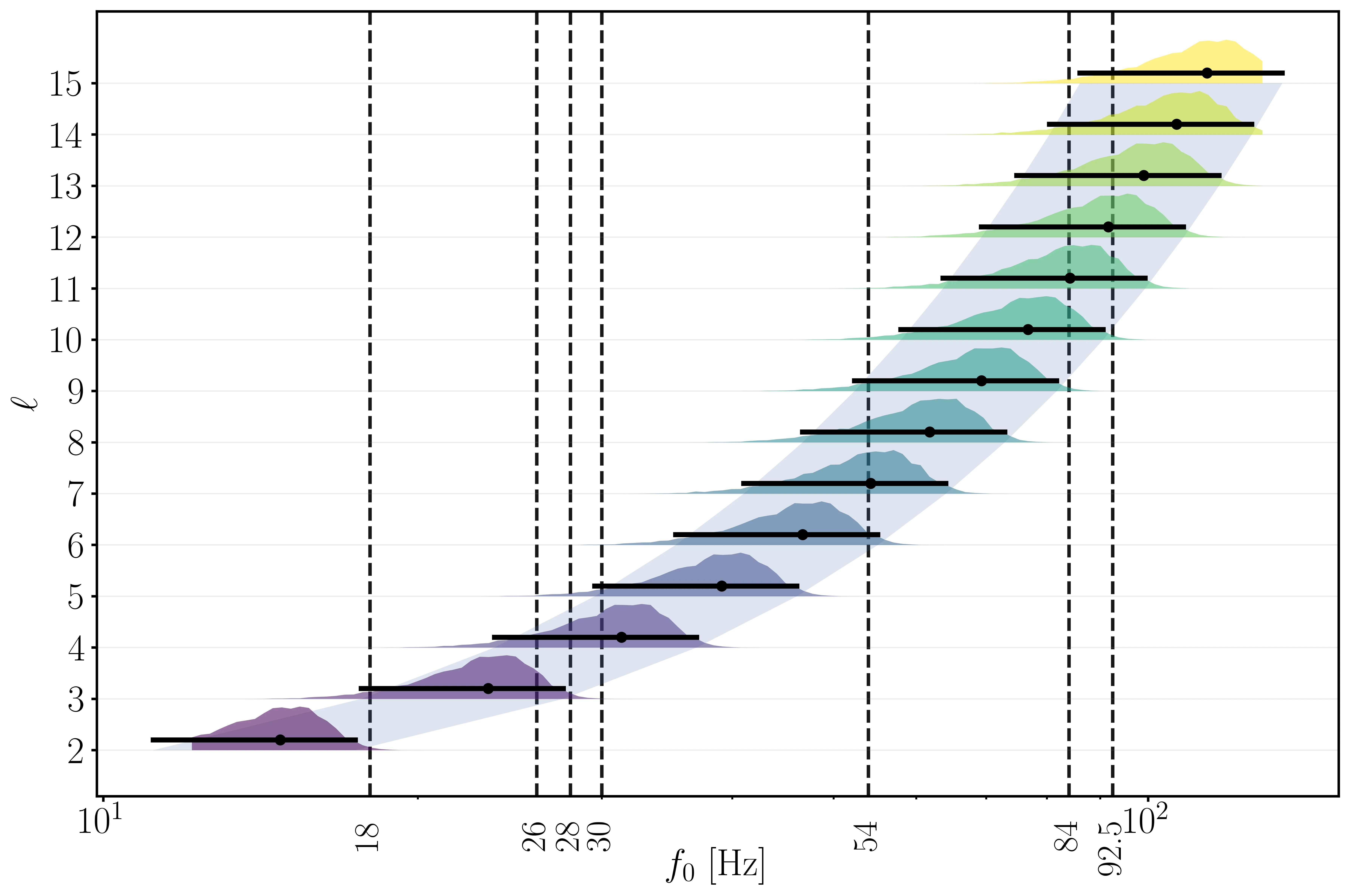
Недавнее исследование, объединив ядерные модели и данные о гравитационных волнах, показало, что переход от круглых ядер к нитям происходит при одной и той же плотности, словно природа сверяется с рецептом. Толщина пасты — всего 14% коры, но по массе она тянет почти на половину. Эти слои заставляют звезду дрожать на определённых частотах, и эти дрожания астрономы видят как мерцание пульсаров. Учёные впервые сопоставили расчётные частоты с реальными данными и обнаружили, что по ритму дрожи можно судить о свойствах ядерных сил — что-то вроде сейсмологии для звёзд.
Но самое неожиданное — эта ядерная паста может объяснять загадочные «глюки» в мерцании пульсаров, когда их пульс внезапно сбивается. Возможно, дрожание пасты вызывает резкие сдвиги, которые астрономы ловят уже полвека.
Оригинальная аннотация
как её написали авторы, на английском arXiv:2602.19125
We investigate the impact of nuclear pasta on crustal structure and torsional oscillations using a Bayesian ensemble of unified neutron-star equations of state based on relativistic mean-field models constrained by nuclear experiments, empirical saturation properties, chiral effective field theory, and multimessenger observations. For each posterior sample, we compute the pasta sequence within a compressible liquid-drop model and quantify the onset density, thickness, and mass fraction of the pasta layers. We show that the appearance and extent of nuclear pasta are primarily controlled by the symmetry-energy slope parameter $$L$$. While spherical and rod-like pasta configurations are present for all equations of state, only a small fraction of the posterior supports slab, tube, or bubble geometries. The transition from spherical nuclei to rods is tightly constrained to occur at a density of $$\rho_{\rm sr} = 0.0588^{+0.0045}_{-0.0065}\,\mathrm{fm^{-3}}$$. We further predict that the nuclear pasta layer occupies a relative radial thickness of $$\Delta R_{\rm pasta}/\Delta R_{\rm c} = 0.140^{+0.025}_{-0.036}$$ and contributes a relative mass fraction of $$\Delta M_{\rm pasta}/\Delta M_{\rm c} = 0.475^{+0.071}_{-0.113}$$. Using the resulting crust models, we present the first quasi-periodic oscillations (QPOs) analysis based on a Bayesian posterior ensemble of neutron-star equations of state and systematically assess their compatibility with observed low-frequency quasi-periodic oscillations. We find that the predicted QPO frequencies are strongly correlated with the curvature of the symmetry energy evaluated at sub-saturation density, $$K_{\rm sym}(\rho_0/2)$$, and that uncertainties in the equation of state translate into a range of angular indices $$\ell$$ consistent with the observed frequencies.
«Ядерная паста» — не фигура речи, а точный термин. Слои действительно напоминают спагетти, лазанью и ньокки. Но их прочность такова, что нить толщиной с волос выдержала бы вес мегаполиса.