Джеймс Уэбб выудил планету-невидимку из пылевого диска экспресс
С помощью Джеймса Уэбба астрономы «выудили» из мутного пылевого диска звезды β Живописца третью планету-гигант. Двух других уже знали, но эта пряталась в ярком свете, как рыба в илистой воде.
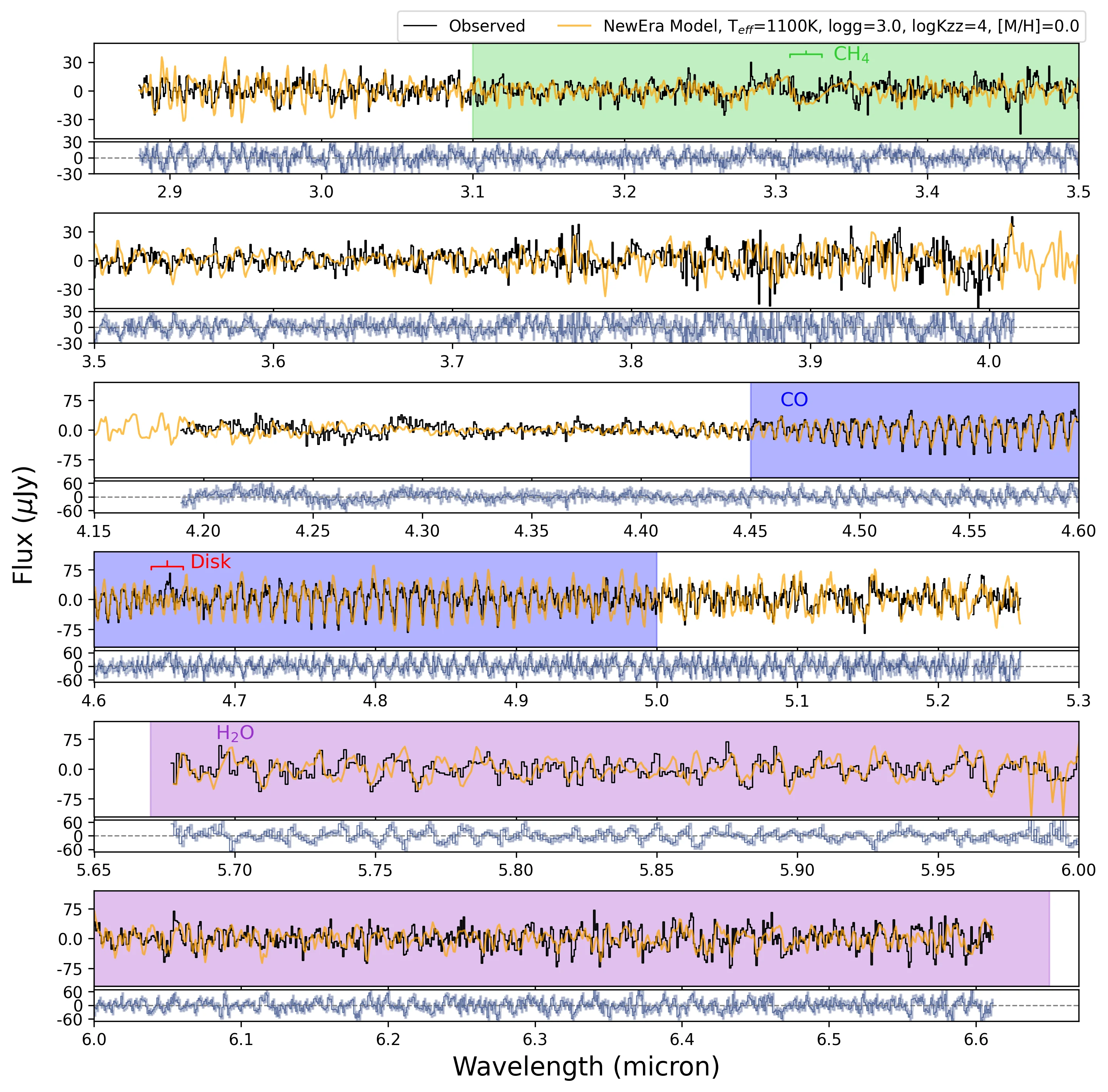
Обычная съёмка не помогала, поэтому применили разложение света на цвета: оно высветило отпечатки воды, метана и угарного газа. Это похоже на ловлю по химическому «запаху»: вместо того чтобы тянуть сеть наугад, использовали точную приманку — шаблон молекулярных линий.
Выуженная планета β Pic d в 2–4 раза массивнее Юпитера и кружит далеко — дальше, чем Нептун от Солнца. Своей тяжестью она выскребает внутренний край пылевого диска, словно сгребая ил. Год на ней длится более ста земных лет, а сам метод открывает глаза: искать миры там, где раньше видели только муть.
Оригинальная аннотация
как её написали авторы, на английском arXiv:2606.23789
We report the discovery of $$\beta$$ Pictoris d ($$\beta$$ Pic d), a third giant planet in the $$\beta$$ Pictoris system, which now becomes only the second directly imaged system with more than two confirmed planets. $$\beta$$ Pic d was serendipitously detected in JWST/NIRSpec IFU observations. A second epoch of NIRSpec and MIRI/MRS observations confirm the initial discovery. The extracted spectrum shows clear CH$$_4$$, CO, and H$$_2$$O absorption features, and $$\beta$$ Pic d's measured radial velocity is consistent with its orbital position. Radial velocity and astrometry measurements combined with orbital stability simulations suggest a semi-major axis $$>$$30 au, consistent with $$\beta$$ Pic d being responsible for carving the inner edge of the $$\beta$$ Pictoris debris disk. Using effective temperature estimates from atmosphere model grid fits combined with evolutionary models, we estimate a mass of 2--4 $$M_\mathrm{Jup}$$. $$\beta$$ Pic d is the first planet discovered using spectral template matching with moderate-resolution spectroscopy, highlighting its sensitivity to planetary molecular features hidden within bright extrasolar debris disks that are difficult to access with broadband imaging.
Год на β Pic d длится как минимум полтора столетия: планета так далека, что один оборот вокруг звезды занимает больше 100 земных лет.