مجرة أضاءت بعد 330 مليون سنة سريع
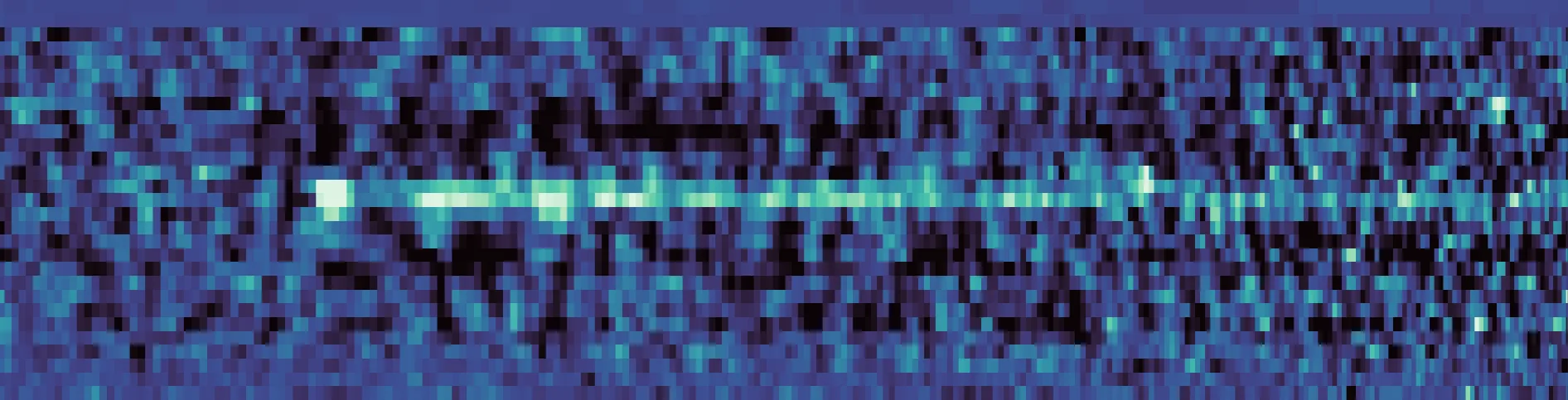
استغرق ضوء المجرة البعيدة 13.4 مليار سنة ليصل إلينا. التقطه تلسكوب جيمس ويب وحلله إلى ألوان. في الطيف تظهر خط هيدروجين ساطع — مثل بصمة إصبع تقول: المجرة GS-z13-1-LA تولد النجوم بنشاط.
النجوم الشابة الساخنة داخل المجرة تعمل مثل الكشافات. تصدر أشعة فوق بنفسجية تقتلع الإلكترونات من ذرات الهيدروجين المحيطة. هكذا يتشكل حول المجرة فقاعة شفافة — منطقة تبدد فيها ضباب الهيدروجين المتعادل. وفقًا للحسابات، يبلغ حجم الفقاعة حوالي 0.2 ميغابارسيك (أي حوالي 650 ألف سنة ضوئية).
بجانب GS-z13-1-LA رصد علماء الفلك 16 مجرة مرشحة أخرى. ربما تشكل معًا فقاعة أكبر. إذا كان الأمر كذلك، فستحتاج المجرة إلى جهد أقل، لكن كشافها ما زال يعمل عند أقصى حدود الممكن. هذه علامة مهمة: بعد 330 مليون سنة فقط من الانفجار العظيم بدأت المجرات الأولى تطهير الكون من الضباب. هكذا انتهت العصور المظلمة — الحقبة التي كان فيها الفضاء معتمًا للأشعة فوق البنفسجية.
تلسكوب جيمس ويب ينظر إلى الماضي مثل آلة الزمن. كل جسم بعيد من هذا القبيل هو نافذة على العصر الذي أضاءت فيه الأضواء الأولى. GS-z13-1-LA واحدة من أقدم المنارات التي تمكنا من رؤيتها.
الملخص الأصلي
كما كتبه المؤلفون، بالإنجليزية arXiv:2603.18775
$$\require{mediawiki-texvc}$$Galaxy assembly was already well underway in the first 400 Myr of cosmic time, as recently revealed by JWST. However, the contribution of these early galaxies to cosmic reionisation remains uncertain. Here we present new JWST/NIRSpec observations of GS-z13-1-LA obtained as part of the OASIS and JADES programmes, whose combined deep (56 h) NIRSpec/PRISM spectrum confirms the Lyman-$$\mathrm{\alpha}$$ line detection and blue UV continuum at redshift $$z = 13.1$$ presented in a previous work. The measured Lyman-$$\mathrm{\alpha}$$ emission (rest-frame equivalent width of $$66_{-9}^{+10}\,\AA$$) and steep continuum slope ($$\beta_\text{UV} \approx -3$$) point towards GS-z13-1-LA hosting a remarkably hot and powerful ionising source, and allow at most a modest contribution from the nebular continuum. The steep turnover of the continuum is still present, but less pronounced in the new OASIS spectrum. Combined, this implies that ionising photons may escape GS-z13-1-LA at a sufficient rate to weaken the other, still undetected UV lines, and to lead the formation of a small ionised bubble ($$R_\text{ion} \approx 0.2\,\mathrm{pMpc}$$). A yet larger bubble could alleviate the required ionising production efficiency of GS-z13-1-LA from $$\xi_\mathrm{{ion}} \approx 10^{26.4}\,\mathrm{{Hz\,erg^{{-1}}}}$$ down to $$\approx 10^{25.9}\,\mathrm{{Hz\,erg^{{-1}}}}$$, still extremely high but more readily reconcilable with stellar models. In turn, this would require a notable overdensity of galaxies with highly efficient ionising capabilities, a scenario for which tentative evidence is found in the form of 16 nearby photometric candidates and one spectroscopically confirmed source, JADES-GS-z13-0. The new OASIS observations therefore confirm the overall picture of GS-z13-1-LA as an early beacon of reionisation, providing compelling evidence for its start only 330 Myr after the Big Bang.
استغرق ضوء المجرة GS-z13-1-LA 13.4 مليار سنة ليصل إلينا — أي ما يقارب عمر الكون كله. عندما انطلق هذا الضوء في رحلته، لم تكن الأرض قد وُجدت بعد.
في مسلسل «ستار تريك»، تستكشف السفن السدم حيث يتم تأيين الغاز بإشعاع النجوم. عملية مشابهة، ولكن على نطاق الكون المبكر بأكمله، تصفها هذه الدراسة.