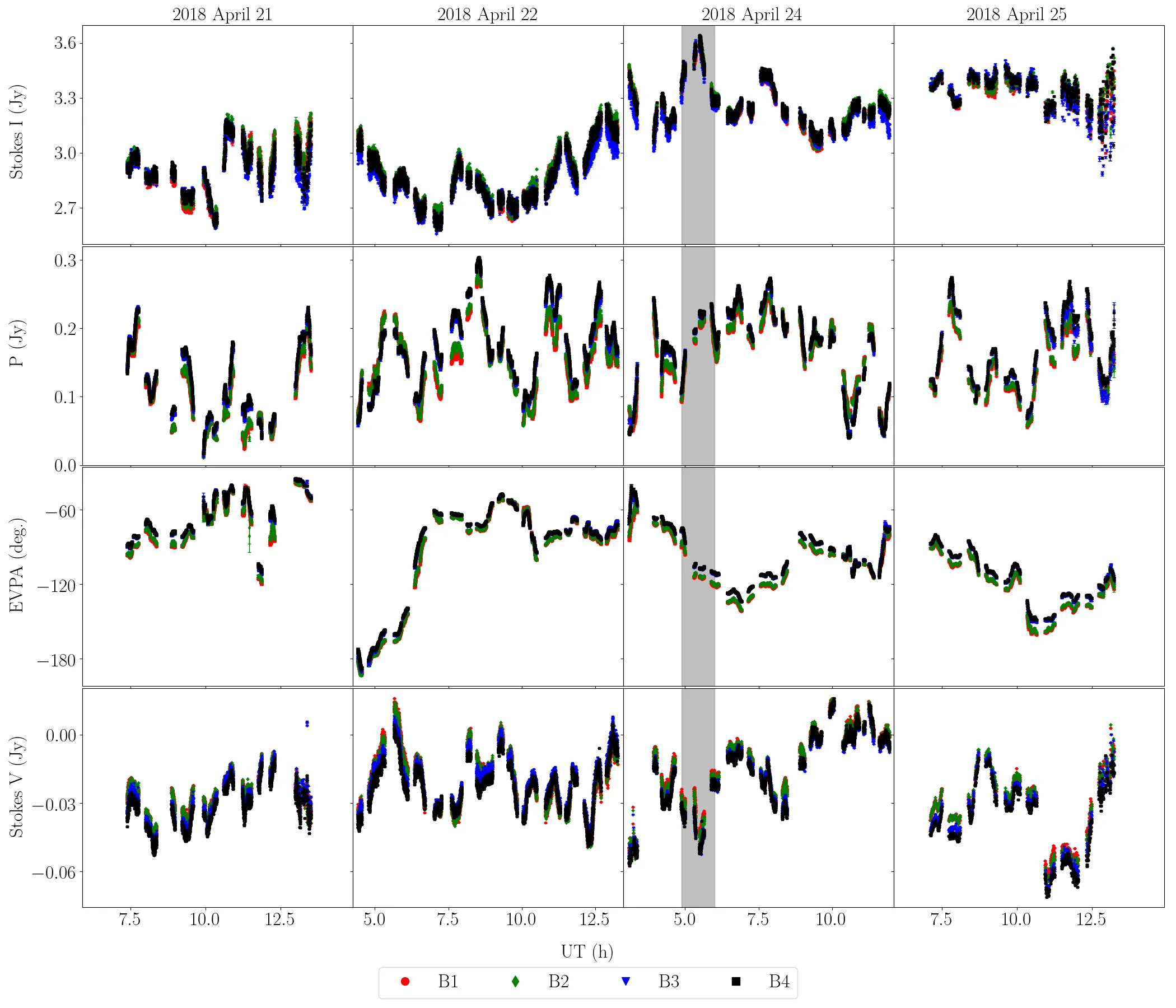
الثقب الأسود الهائل في مركز مجرتنا يضيء بشكل غير مستقر، واستقطاب إشعاعه يتغير أكثر من سطوعه الكلي.
📄 معروضة نسخة «بسيط» — «متقدم» غير جاهزة بعد. أضفه إلى المفضّلة للمساعدة في تسريعها.
في مركز درب التبانة يقع الثقب الأسود الهائل "القوس A*" (Sagittarius A*). كتلته تعادل أربعة ملايين مرة كتلة الشمس، لكنه وفقًا للمقاييس الكونية يتصرف بهدوء: فهو لا يتوهج إلا نادرًا، عندما يبتلع كمية من الغاز. راقبه علماء الفلك باستخدام تلسكوب ALMA الراديوي — وهو سلسلة من الهوائيات عالية في صحراء أتاكاما التشيلية.
اتضح أن السطوع الكلي للثقب يتغير بشكل ضعيف — أقل من 10%. لكن اتجاه اهتزاز الضوء، أي استقطابه، يقفز بشكل أكثر وضوحًا: بنحو 30% للاستقطاب الخطي و50% للاستقطاب الدائري. الأمر أشبه بنار تشتعل بثبات، لكن ألسنة اللهب ترقص في اتجاهات مختلفة. ظل الاستقطاب مستقرًا على مدار اليوم، بينما لم يكن السطوع كذلك. يبدو أن الضوء المستقطب ينشأ في كتلة مضغوطة واحدة، بينما ينشأ الضوء العادي في منطقة أوسع.
في 24 أبريل 2018، التقط تلسكوب شاندرا (Chandra) للأشعة السينية توهجًا من القوس A*. وفي اللحظة نفسها، وصلت ذروة الضوء المستقطب على موجات المليمتر دون التأخير المعتاد. عادةً، يتوهج الأشعة السينية أولاً، ثم يستجيب الراديو لاحقًا — مثل الرعد بعد البرق. لكن هنا حدث كل شيء في الوقت نفسه.
هذا التزامن يكسر الصورة المألوفة التي تظهر فيها الإلكترونات تتسارع أولاً ثم تبرد، مشعةً على أطوال موجية مختلفة تباعًا. وبدلاً من ذلك، يبدو أن الطاقة تُحقن باستمرار في منطقة مخلخلة. هذه إشارة مهمة لفهم كيفية تصرف المادة عند حافة الثقب الأسود.
Sagittarius A* (Srg A*), the supermassive black hole at the center of the Milky Way, provides a unique laboratory to study accretion dynamics and plasma processes near the event horizon. We investigated the variability and polarization properties of Srg A* using ALMA observations during the 2018 Event Horizon Telescope campaign. We analyzed high-cadence full-polarization light curves from ALMA at millimeter wavelengths, performed time-series analysis, and investigated the temporal behavior during an X-ray flare observed by Chandra on 2018 April 24. The variability characteristics are compared with expectations from standard accretion flow models. We find low variability in total intensity ($$\sigma/\mu < 10\%$$), but significantly higher variability in linear and circular polarization (~ 30% and ~ 50%, respectively). A time-series analysis reveals red-noise variability, with power spectral densities between -2 and -3 across all Stokes parameters. Polarized intensity shows stable intra-day timescales, while total intensity exhibits more variable timescales, suggesting distinct emission regions, with polarization likely arising from a coherent structure. On April 24, a statistically significant inter-band delay in polarized intensity coincides with a near-simultaneous X-ray and millimeter peak that deviates from the typical delayed flare scenario. This event also features enhanced millimeter variability and coherent polarization loop evolution. The observed simultaneity challenges standard models of transient synchrotron emission with cooling delays, favoring instead a scenario of continuous energy injection in an optically thin region. Our results offer new constraints on the physical mechanisms driving variability in Srg A*, and provide key observational input for refining theoretical models of accretion and plasma behavior in the vicinity of supermassive black holes.