Dong-Jin Kim

8 articles · 30 co-authors · latest: 2026-07-17
967 citations · h-index 10 · 27 papersData: Semantic Scholar

We have retold 8 papers by this author. 2 of them with a full read. most often about: microlensing, free-floating planet, gravitational lensing. 30 co-authors across our retellings.

Links in the knowledge graph
Exoplanets2025-12-311 minarXiv:2601.00057express
A Cosmic Wanderer Steps on the Scales for the First Time
In the darkness of interstellar space drift millions of rogue planets — worlds not bound to any star. They are almost impossible to see, but when such a wanderer passes in front of a distant star, its gravity bends the light and momentarily creates a cosmic magnifying glass.
High Energy2026-01-012 minarXiv:2601.00394express
A Black Hole's Shadow Betrays Its Spin
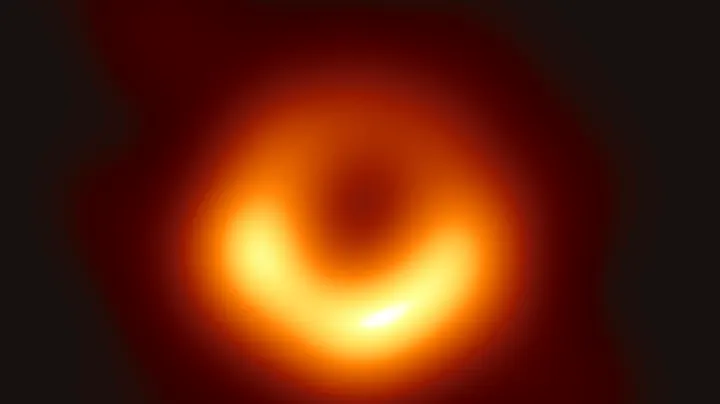
In 2019, astronomers unveiled the first-ever image of a black hole's shadow — a dark void encircled by a lopsided orange ring. This is the supermassive black hole at the heart of galaxy M87, 55 million light-years away. The ring isn't just glowing: one side is noticeably brighter than the other, like a campfire burning unevenly, with flames leaping higher on one side.
Exoplanets2026-01-161 minarXiv:2601.11469express
Invisible Lens Reveals a Planet 40 Times the Mass of Earth
One night, a star at the edge of the sky suddenly flickered and brightened for a few days. It wasn't a supernova, and no cloud passed by — an invisible planet drifted between the star and Earth. Its gravity bent the light of the distant star like a pair of glasses focusing a sunbeam.
High Energy2026-01-191 minarXiv:2601.13356express
The Shadow of a Black Hole and Its Invisible Tail
Radio telescopes scattered across the globe pick up waves from distant black holes. But two telescopes placed almost side by side see only a blurry blob — fine details are beyond them. Usually, such pairs are considered useless and discarded. But that's a mistake: even a blurry blob holds clues.
Galaxies2026-04-111 minarXiv:2604.10287express
The Heart of the Milky Way Flickers in Polarized Light
At the center of the Milky Way lies the supermassive black hole Sagittarius A*. It is four million times more massive than the Sun, but by cosmic standards it behaves quietly: it only occasionally flares up when it swallows a clump of gas.
Exoplanets2026-06-261 minarXiv:2606.27725express
A Lonely Wanderer in Einstein's Desert
A pebble drops into a night lake, and ripples spread across the water. You can't see the pebble itself, but the ripples give it away. Astronomers use a similar trick when hunting for dark bodies in space: these objects betray themselves by the way they warp the light of distant stars.
Galaxies2026-07-173 minarXiv:2607.16104