Luciano Rezzolla

7 articles · 30 co-authors · latest: 2026-07-22
1,161 citations · h-index 12 · 38 papersData: Semantic Scholar

We have retold 7 papers by this author. 4 of them with a full read. most often about: gravitational singularity, gravastar, black hole merger. 30 co-authors across our retellings.

Links in the knowledge graph
A Rescue Bubble in a Collapsing Star: The Birth of a Gravastar
A homogeneous dust sphere begins to contract under its own gravity. Inside it, like a rescue bubble, a region of negative pressure inflates: the de Sitter bubble. It expands, slows down near the very edge of the fall, and freezes at the Schwarzschild radius.
Listening to the Long Ring: How Gravitational Waves Reveal the Neutron Star Equation of State
The collision of two neutron stars is a strike heard across the universe. Gravitational wave detectors pick up the ripples in spacetime, but the most interesting sound begins after the impact: the merger remnant, a rapidly spinning hypermassive neutron star, continues to vibrate, emitting waves for a few more…
High Energy2026-01-012 minarXiv:2601.00394express
A Black Hole's Shadow Betrays Its Spin
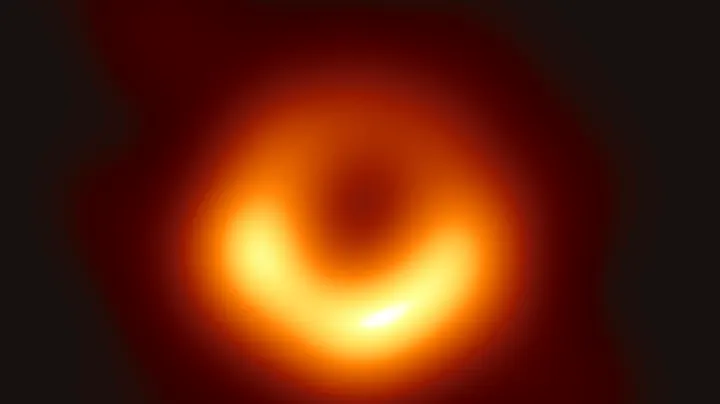
In 2019, astronomers unveiled the first-ever image of a black hole's shadow — a dark void encircled by a lopsided orange ring. This is the supermassive black hole at the heart of galaxy M87, 55 million light-years away. The ring isn't just glowing: one side is noticeably brighter than the other, like a campfire burning unevenly, with flames leaping higher on one side.
High Energy2026-04-081 minarXiv:2604.06749express
Cosmic Blender: How Electrons Outrun Protons
Near black holes and neutron stars, plasma churns like water in a boiling kettle. But this 'kettle' has no walls — only magnetic fields that twist and tear. At the tears, thin sheets form where magnetic field lines reconnect, giving particles a kick like a surfer catching a wave.
Galaxies2026-04-111 minarXiv:2604.10287express
The Heart of the Milky Way Flickers in Polarized Light
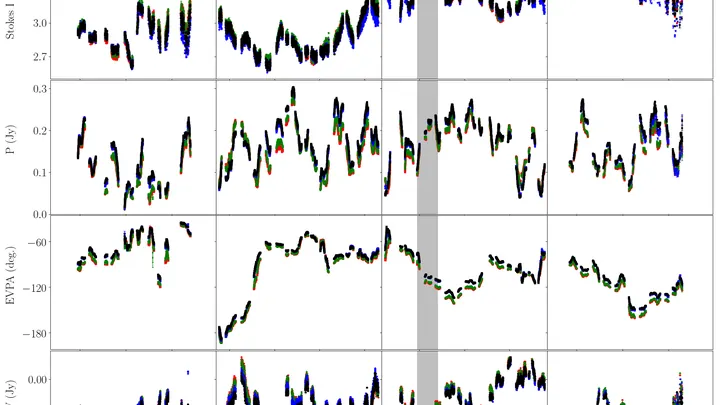
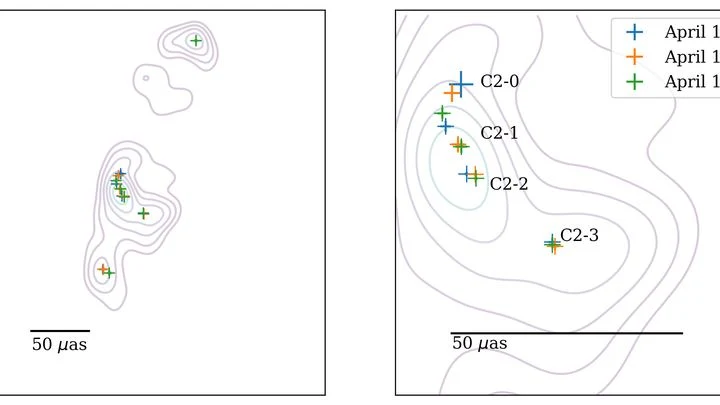
At the center of the Milky Way lies the supermassive black hole Sagittarius A*. It is four million times more massive than the Sun, but by cosmic standards it behaves quietly: it only occasionally flares up when it swallows a clump of gas.
Galaxies2026-07-173 minarXiv:2607.16104
The Celestial Forge: How Black Holes Forge Gold
Three milliseconds before the merger. A gargantuan black hole spinning at breakneck speed drags in a neutron star — a ball the size of a city but with 1.5 times the Sun's mass. Tidal forces stretch the star into a thread as thin as a needle and fling its matter outward.