Yosuke Mizuno

7 articles · 30 co-authors · latest: 2026-07-17
236 citations · h-index 9 · 32 papersData: Semantic Scholar

We have retold 7 papers by this author. 2 of them with a full read. most often about: black hole, dark matter, Accretion disk. 30 co-authors across our retellings.

Links in the knowledge graph
High Energy2026-01-012 minarXiv:2601.00394express
A Black Hole's Shadow Betrays Its Spin
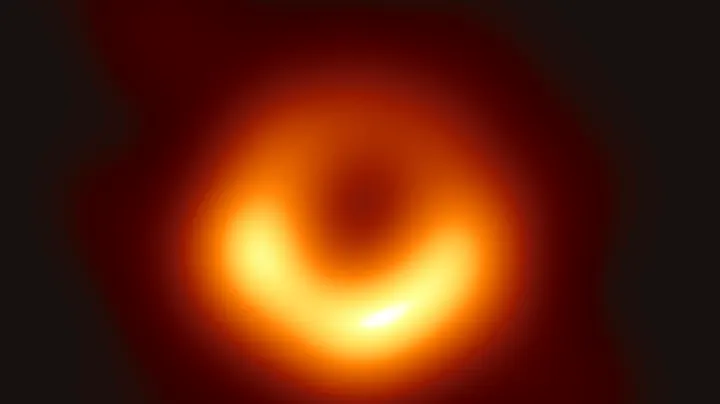
In 2019, astronomers unveiled the first-ever image of a black hole's shadow — a dark void encircled by a lopsided orange ring. This is the supermassive black hole at the heart of galaxy M87, 55 million light-years away. The ring isn't just glowing: one side is noticeably brighter than the other, like a campfire burning unevenly, with flames leaping higher on one side.
Galaxies2026-01-061 minarXiv:2601.02812express
A Lunar Telescope Will Reveal the Shadows of Distant Black Holes
The farther apart the antennas, the finer the details they pick up. By merging signals, astronomers effectively turn multiple dishes into a single telescope as big as the distance between them. Add a lunar antenna to the Earth-based array, and you get a virtual eye 384 000 km wide.
High Energy2026-01-191 minarXiv:2601.13356express
The Shadow of a Black Hole and Its Invisible Tail
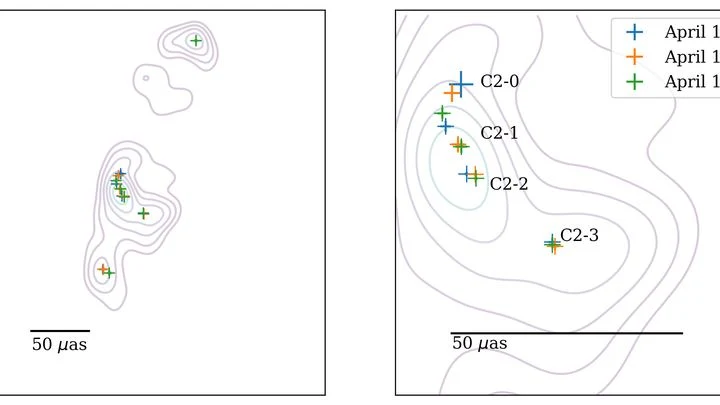
Radio telescopes scattered across the globe pick up waves from distant black holes. But two telescopes placed almost side by side see only a blurry blob — fine details are beyond them. Usually, such pairs are considered useless and discarded. But that's a mistake: even a blurry blob holds clues.
Stellar2026-03-122 minarXiv:2603.11945express
The Hidden Magnets of White Dwarfs
A white dwarf is what remains of a star like the Sun after it sheds its outer layers. What's left is a hot core the size of Earth but with a mass close to that of the Sun. A teaspoon of this material would weigh as much as a truck. Some of these stars have extremely strong magnetic fields — a billion times stronger than Earth's.
Galaxies2026-04-111 minarXiv:2604.10287express
The Heart of the Milky Way Flickers in Polarized Light
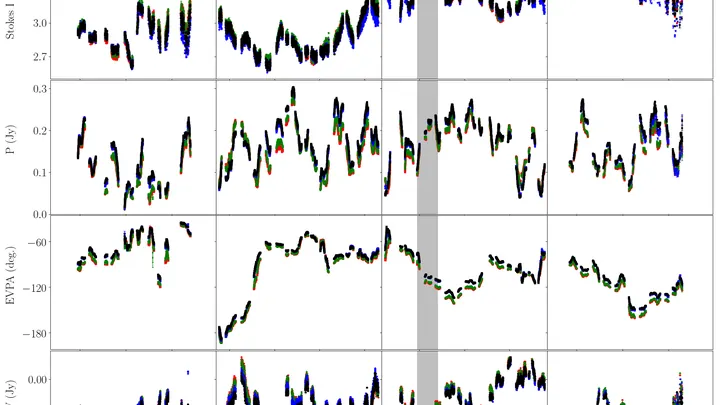
At the center of the Milky Way lies the supermassive black hole Sagittarius A*. It is four million times more massive than the Sun, but by cosmic standards it behaves quietly: it only occasionally flares up when it swallows a clump of gas.
Cosmic Hourglass: The Flickering Shadow of a Wormhole
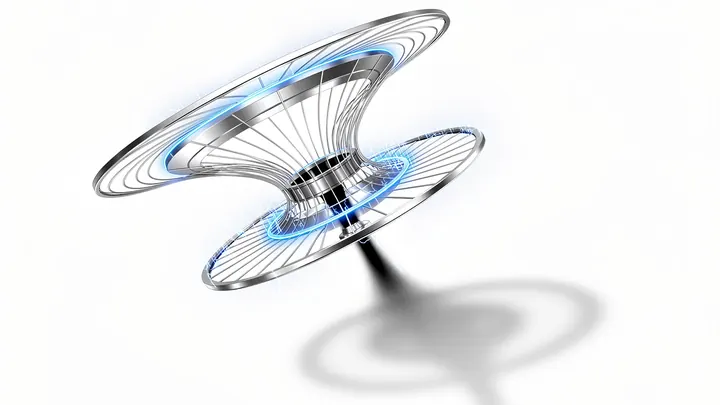
The shadows of supermassive objects at the centers of galaxies, M87 and the Milky Way, have become icons of modern astrophysics. But what if these shadows are not from absorption, but passage? The equations of Einstein allow for traversable wormholes — tunnels in the fabric of spacetime.
Galaxies2026-07-173 minarXiv:2607.16104