Seven Lives of a Photon: Exceptional Points Control Spontaneous Emission ✦
Original: "On-chip Non-Hermitian Cavity Quantum Electrodynamics"
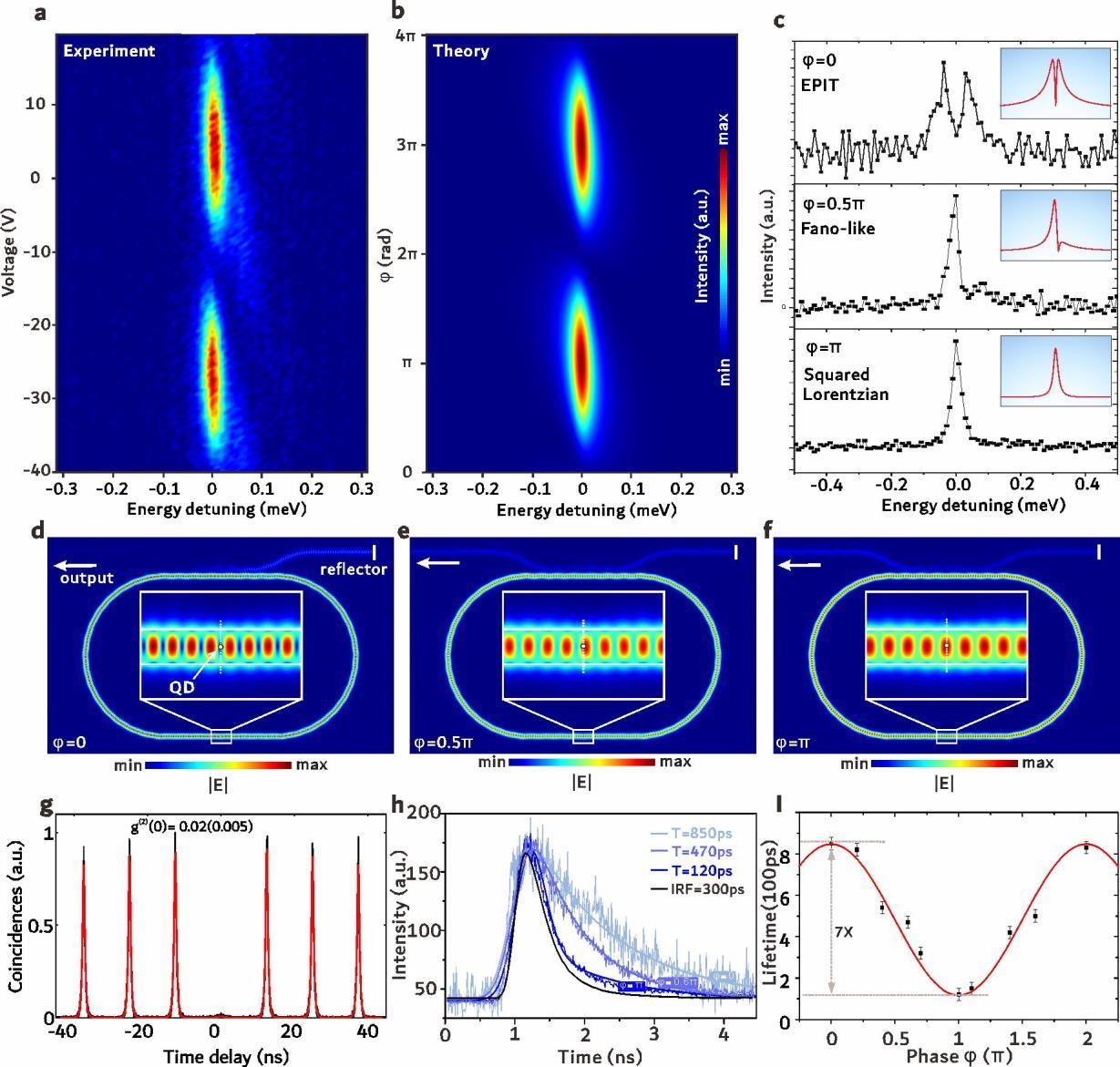
An experiment on a hybrid quantum chip showed how exceptional points turn spontaneous emission of single photons into a tunable tool with a record sevenfold change in lifetime.
Links in the knowledge graph 1
Acoustics where walls shift instantly and the singer falls silent. That's how exceptional points on a quantum chip control photon emission: lifetime changes sevenfold, line shape switches on the fly. Lithium niobate and gallium arsenide, woven into a resonator, produce light with a programmable spectrum. This is a step toward all-optical quantum networks, where every photon is a bit obeying a command.
🎯 Predicted in 1946, the Purcell effect long remained the only lever for controlling spontaneous emission. Exceptional points go further: now emission can be not only enhanced but also completely quenched, by manipulating field topology rather than just spectral detuning.
S(\Delta \omega) \propto \frac{(\gamma/2)^2}{\Delta \omega^4 + (\gamma/2)^4}
Local density of states in the quadratic Lorentzian regime. The intensity falls off with the fourth power of the detuning, providing much sharper spectral discrimination than in the ordinary Lorentzian case.
Scientists
Christian DopplerD. B. McLaughlinDidier QuelozMichel MayorR. A. RossiterNiels Bohrquantum optics
quantum information
quantum computer
spectroscopy
superposition
Quantum Field
electromagnetism
wave-particle duality
quantum measurementLaws
Doppler effectHeisenberg uncertainty principleNoether's theoremMaxwell's equationsPlanck's lawPlanck–Einstein relation