A chip that quenches single photons on the fly ✛ ✦
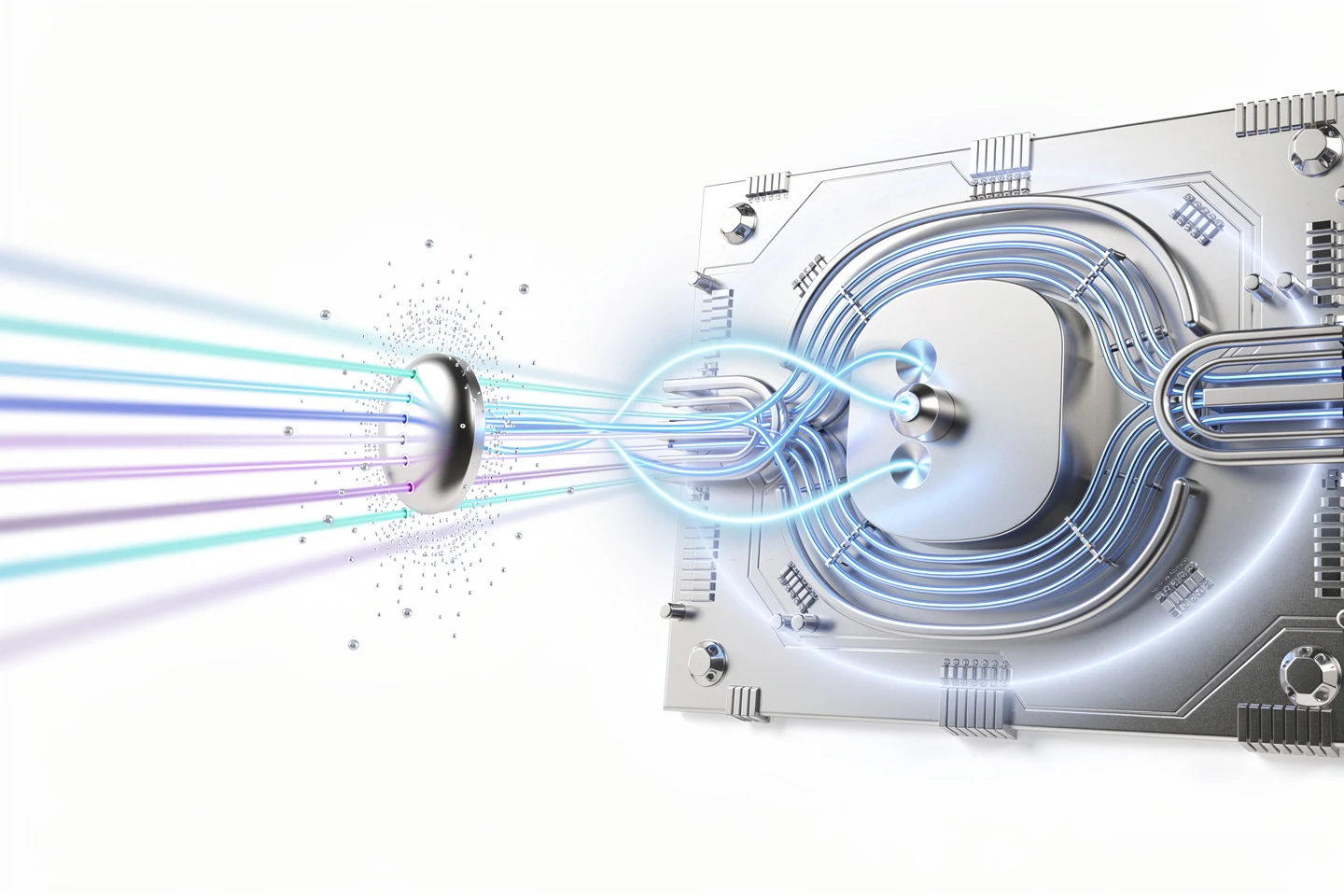
The light ring on the chip is like a room where echo can be turned on and off. Inside it is embedded a single-photon source — a quantum dot. An electrical voltage creates a special node of waves in the ring, where the light field drops to zero, preventing a photon from being born, and when the setting is changed, it accelerates emission sevenfold. This effect was predicted by Serge Haroche and Roy Glauber, but now it has been implemented in a microchip with voltage control.
Measurements of light spectra confirmed that the photon lifetime reversibly changes more than sevenfold, and its spectrum in the wave-particle duality shows a dip to zero — in agreement with lossy electrodynamics. This opens the way to ultrafast optical switches for quantum information and quantum computers, where photons in superposition of states serve as qubits, and their quantum measurements guarantee protection against eavesdropping.
The Purcell effect, which enhances emission in a resonator, predicted by Edward Purcell in 1946, is now complemented by the inverse phenomenon: scientists have for the first time learned to completely quench the emission of a single photon without changing the structure, merely by creating a standing wave node.