Non-Hermitian Photonics: How Exceptional Points Control Quantum Electrodynamics on a Chip ✛ ✦
Context
Controlling the quantum state of light at the single-photon level is a key challenge in quantum optics, critical for quantum information technologies. In ordinary Hermitian systems, the interaction of an emitter with a resonator is described by the Purcell effect, which enhances spontaneous emission but is limited by a Lorentzian spectral response. Non-Hermitian physics, arising in systems with controlled loss and gain, offers new degrees of freedom through exceptional points—singularities where eigenvalues and eigenvectors coalesce. At these points, the superposition of modes becomes degenerate, and the quantum field inside the resonator acquires non-classical properties, as predicted in the works of Serge Haroche on cavity quantum electrodynamics. This opens the door to unprecedented control over single photons, unattainable in Hermitian electrodynamics.
Methods
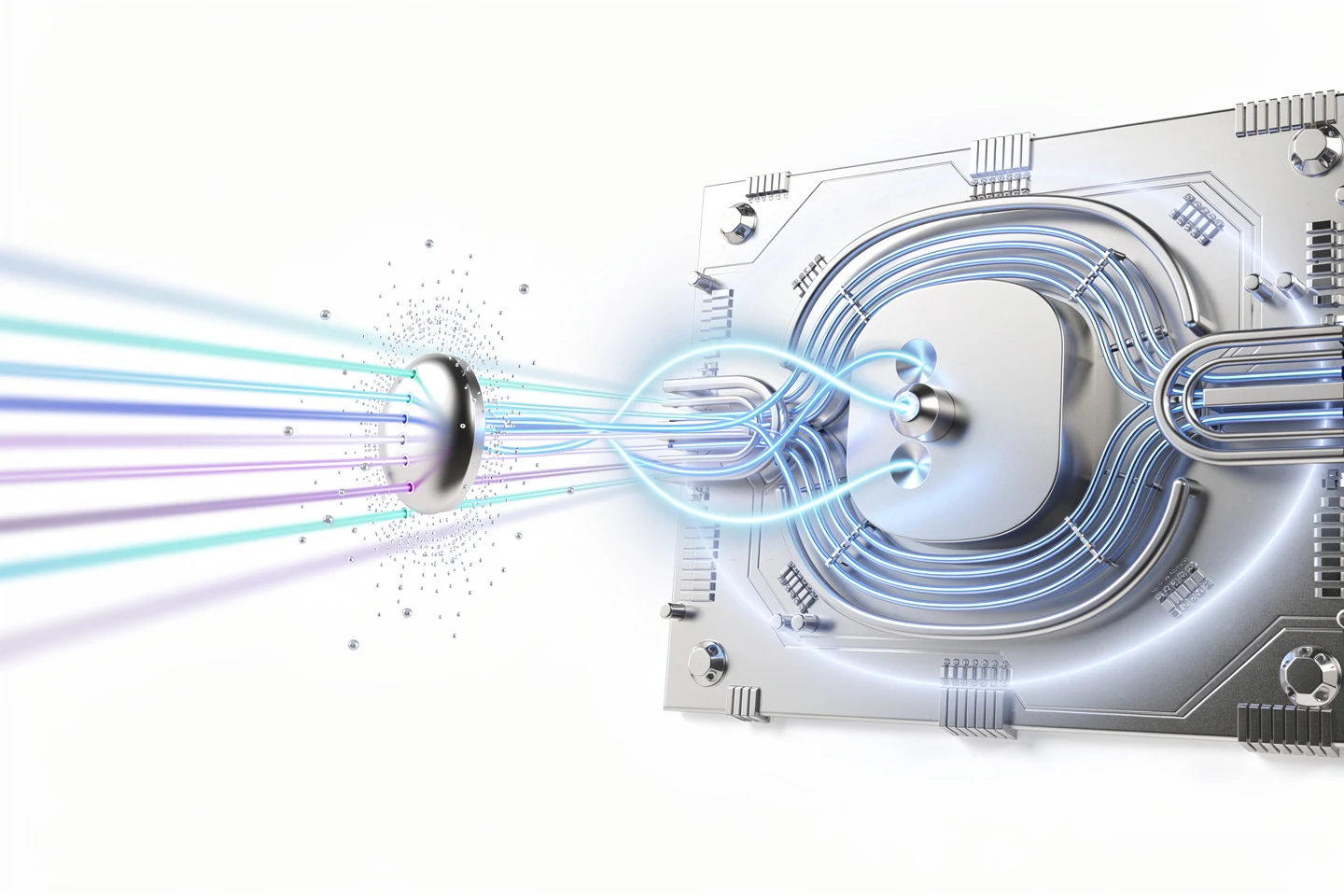
To realize non-Hermitian quantum electrodynamics on a chip, the scientists developed a hybrid platform combining lithium niobate (LN) and gallium arsenide (GaAs) with integrated quantum dots. At its heart is a 15-μm-radius LN ring microresonator coupled to a waveguide, one end of which is closed by a Sagnac mirror. An electro-optic phase shifter on LN (using the Pockels effect) dynamically controls the feedback phase, tuning the coupling between counterpropagating modes. GaAs-based quantum dots were transferred onto the resonator via microprinting with sub-100-nm precision. For spectral tuning, the inverse piezoelectric effect in LN was used to shift the emission energy of the quantum dots by 0.6 nm without affecting the resonator. Detailed analysis of optical modes and emission was performed using high-resolution spectroscopy. This architecture, inspired by the pioneering work of Roy Glauber on quantum coherence, enables reconfigurable light–matter interaction at the quantum level.
Results
The experiment demonstrated three distinct regimes of the local density of states (LDOS) depending on the phase φ. At φ = 0, exceptional-point-induced transparency (EPIT) emerges: the spectral density vanishes at zero detuning, leading to emission suppression. At φ = π/2, a Fano-like profile is observed, and at φ = π, a squared-Lorentzian appears. Single photons emitted by the quantum dot inherit this shape: the measured spectra agree well with calculations. Lifetime measurements showed a reversible modulation from 850 picoseconds (in the EPIT regime) to 120 picoseconds (in the squared-Lorentzian regime)—a sevenfold change. The purity of single-photon emission is confirmed by the second-order correlation function g²(0) = 0.020(5), indicating nearly ideal antibunching—essential for quantum computing and quantum measurements. Electric field simulations revealed that standing waves form in the resonator, with nodes at the emitter's location explaining suppression, or with maxima giving enhancement.
Implications
Realizing exceptional points in quantum electrodynamics upends the usual rules of wave–particle duality: now we can not only be near a node or antinode of the field, but purposefully engineer the topology of the standing wave. This provides a qualitatively new tool for controlling spontaneous emission, without requiring precise mode tuning. For quantum technologies, this means the emergence of ultrafast, voltage-controlled single-photon switches and routers, accelerating the development of all-optical quantum networks.
Future development
This technology can be scaled to multi-resonator circuits with integrated quantum-dot arrays, paving the way for non-Hermitian quantum simulators and topological photonic devices. Using traveling-wave electrodes will enable switching speeds in the gigahertz range, essential for quantum gate operation. Moreover, employing other materials, such as diamond with NV centers or semiconductor heterostructures, will expand the platform's functionality.
Impact
This work will impact the field of quantum information, including quantum cryptography and distributed quantum computing, by offering compact integrated single-photon sources with electrical tunability.
Next steps
Next steps include increasing resonator quality factors to enhance effect contrast and developing multi-emitter systems to study collective effects in non-Hermitian environments.
Key open problems
The experiment is directly connected to the fundamental problem of quantum systems interacting with a controlled environment—key both for understanding decoherence and for building quantum processors. Non-Hermitian quantum electrodynamics also touches on issues of spontaneous symmetry breaking in open systems.
The knowledge machine's view
This section is addressed to the author of the paper and their colleagues. Neighbouring works were found by meaning-based search across our archive, not by word overlap. We do not review: we show the field around the work.
What the work does
The work demonstrates an experimental realization of non-Hermitian quantum electrodynamics on a chip using a hybrid lithium niobate/gallium arsenide platform. By tuning the feedback phase, the authors control the local density of optical states through an exceptional point and observe three regimes: emission suppression, a Fano-like profile, and a quadratic Lorentzian. The lifetime of single photons is reversibly modulated by a factor of seven (from 120 to 850 ps).
Where its strength is
The system's strength lies in its reconfigurability: dynamic phase control allows the quantum dynamics of the emitter to be reshaped without altering the physical structure. This paves the way for adaptive on-chip quantum devices.
Where it could go next
- It might be interesting to explore the use of controlled losses to create quantum states of light with nonclassical statistics, as in the work on order from loss. Your platform with tunable coupling could serve as a basis for generating squeezed or sub-Poissonian states.based on: Loss Creates Order: The Quantum Dance of Photons arXiv:2604.05422
- A related idea is the quantum chip turnstile for photons, where controlled interaction with a resonator ensures unidirectional motion of single photons. Your method of controlling the LDOS via an exceptional point could be applied to build a similar nonreciprocal device.based on: A Quantum Turnstile Chip for Photons arXiv:2511.00570
- There is also work on trapping atoms in an on-chip optical trap; combining your non-Hermitian platform with atomic systems might allow exploring new regimes of strong coupling with nontrivial topology.based on: An Atom in a Light Trap on a Chip arXiv:2605.09532
Worth trying
- Test whether the exceptional point can be used to generate single photons with tailored wave-packet shapes suitable for quantum networks.
- Implement a scheme for nonreciprocal single-photon transmission by exploiting the asymmetric mode coupling near the exceptional point.
- Investigate photon statistics in the EPIT regime to reveal possible sub-Poissonian emission.
Why this may matter
Controlling quantum electrodynamics via exceptional points could lead to compact tunable single-photon sources, nonreciprocal quantum elements, and new platforms for quantum computing and communication.
Nearby works in our archive
- A Quantum Turnstile Chip for Photonssimilarity 0.64
- An Atom in a Light Trap on a Chipsimilarity 0.63
- Light Instead of Wires: A Quantum Computer on Fiber Opticssimilarity 0.62
- How to Catch Acceleration by the Tailsimilarity 0.62
- Loss Creates Order: The Quantum Dance of Photonssimilarity 0.62
- How the Electron's Shape Controls Gamma Lightsimilarity 0.62
The closest work in the archive sits at 0.64 by meaning — the usual level for our corpus.
Original abstract
as written by the authors arXiv:2505.05490v1
Exceptional points (EPs) promise revolutionary control over quantum light-matter interactions. Here, we experimentally demonstrate flexible and reversible engineering of quantum vacuum fluctuation in an integrated microcavity supporting chiral Eps. We develop a hybrid lithium niobate (LN)-GaAs quantum photonic platform, seamlessly combining high-quality quantum emitters, a low-loss photonic circuit, efficient electro-optic (EO) effect, and local strain actuator in a single device. Chiral EPs are implemented by dynamically tuning the coupling between the modes associated with a micro-ring resonator, resulting in anomalous spontaneous emission dynamic with a 7-fold modulation of the lifetime (120 ps to 850 ps). Meanwhile, we reshape single-photon spectra via cavity local density of states (LDOS) engineering and generate non-Lorentzian spectral profiles: squared-Lorentzian, Fano-like, and EP-induced transparency (EPIT), a suppression of emission at zero detuning. This work unveils exotic cavity quantum electrodynamics (cQED) effects unique to EPs and establishes a universal paradigm for non-Hermitian quantum photonics.
The Purcell effect, describing the enhancement of spontaneous emission in a resonator, was predicted by Edward Purcell in 1946. However, only with the advent of non-Hermitian physics has it become possible not just to enhance, but to completely suppress emission through topology rather than detuning.
Key numbers
- lifetime range: 120 to 850 ps
- Q factor: 14 000
- ring resonator radius: 15 µm
- wavelength tuning range: 0.6 nm
- g²(0): 0.020(5)