Cloud Spices: How a Neural Network Improves Climate express
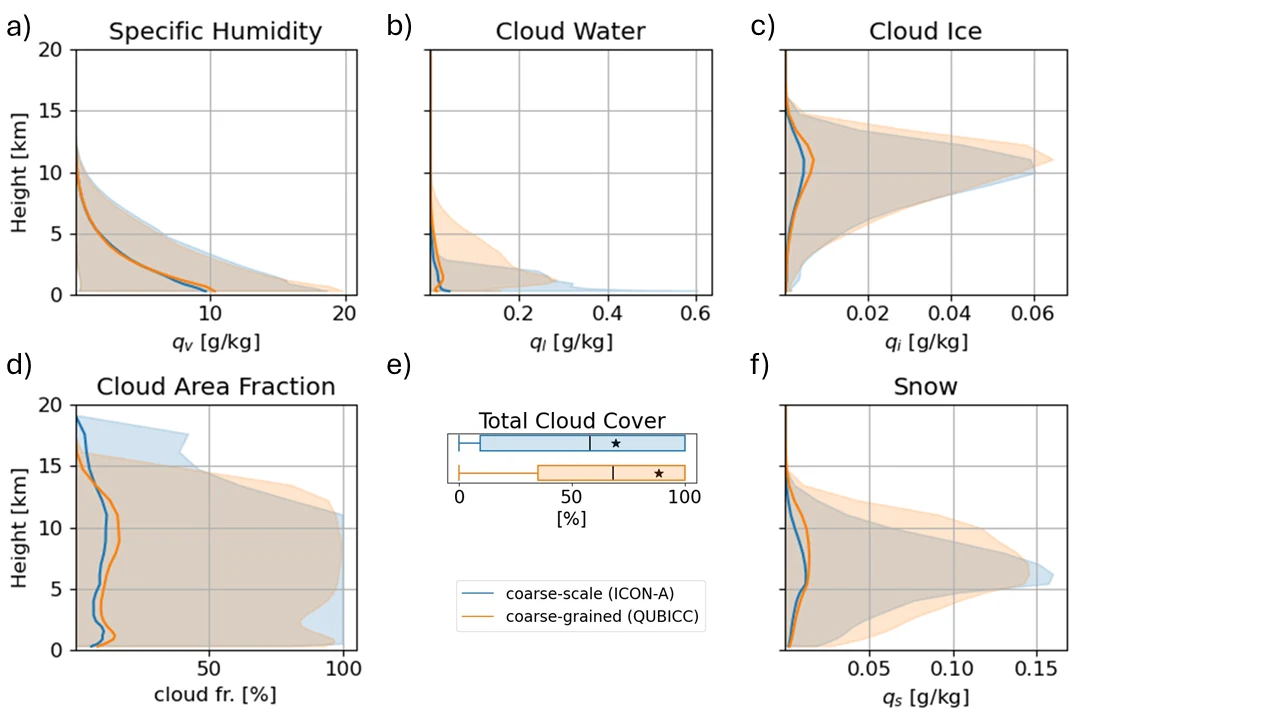
Climate forecasting is like a complex recipe: one wrong pinch and the whole dish is ruined. So it is with clouds — small but decisive. Climate models divide the sky into 50–100 km cells and don't see individual clouds. It's like throwing pepper by the handful when the recipe calls for a pinch.
Scientists trained a neural network on detailed calculations where clouds are visible down to the smallest details. It learned to predict the part of solar heat that depends on clouds. Cloud-free skies are still computed with physics — so the method doesn't become outdated at any level of CO₂ and solar activity. Errors shrank by a factor of 4–10.
An unexpected twist: the neural network never actually sees the clouds. It works with large cells but captures their hidden influence. A microscopic detail governs the global picture.
Original abstract
as written by the authors arXiv:2510.05963
Improvements of Machine Learning (ML)-based radiation emulators remain constrained by the underlying assumptions to represent horizontal and vertical subgrid-scale cloud distributions, which continue to introduce substantial uncertainties. In this study, we introduce a method to represent the impact of subgrid-scale clouds by applying ML to learn processes from high-resolution model output with a horizontal grid spacing of 5km. In global storm resolving models, clouds begin to be explicitly resolved. Coarse-graining these high-resolution simulations to the resolution of coarser Earth System Models yields radiative heating rates that implicitly include subgrid-scale cloud effects, without assumptions about their horizontal or vertical distributions. We define the cloud radiative impact as the difference between all-sky and clear-sky radiative fluxes, and train the ML component solely on this cloud-induced contribution to heating rates. The clear-sky tendencies remain being computed with a conventional physics-based radiation scheme. This hybrid design enhances generalization, since the machine-learned part addresses only subgrid-scale cloud effects, while the clear-sky component remains responsive to changes in greenhouse gas or aerosol concentrations. Applied to coarse-grained data offline, the ML-enhanced radiation scheme reduces errors by a factor of 4-10 compared with a conventional coarse-scale radiation scheme. This shows the potential of representing subgrid-scale cloud effects in radiation schemes with ML for the next generation of Earth System Models.
In climate models, a typical grid cell is 50×100 km, while a cloud is just hundreds of meters. Stuffing a whole 'jumble' of clouds into one cell: that's where creativity was needed.
Computer-controlled climate management is a familiar sci-fi theme: in Kim Stanley Robinson's novel 'Red Mars', the heroes terraform Mars by calculating every degree.