A cloud is a visible suspension of tiny water droplets or ice crystals in the atmosphere, formed when moist air rises, cools, and reaches saturation. Clouds are central to Earth's weather and climate, regulating the planet's energy balance by reflecting sunlight and trapping heat. They also drive the water cycle, delivering precipitation that sustains life, and their behavior is a key factor in predicting storms and long-term climate change.
History
The modern understanding of cloud formation began in the 19th century with Luke Howard's classification of cloud types (1802) and later advances in thermodynamics by scientists like Hermann von Helmholtz.
How it works
Clouds form when air containing water vapor rises and cools adiabatically, causing the vapor to condense onto microscopic aerosol particles called cloud condensation nuclei. As millions of dropletscollide and coalesce, they grow heavy enough to fall as rain or snow. The exact processes of droplet growth and turbulence within clouds are complex and actively studied, as they determine whether a cloud produces light drizzle or intense downpours.
In practice
Cloud physics informs weather forecasting, climate modeling, and cloud-seeding techniques used to enhance precipitation in arid regions.
Fun fact
A single cumulus cloud can weigh over a million pounds, yet it floats because its density is only slightly greater than the surrounding air, and the updrafts keep it aloft.
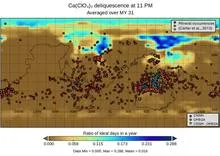
Every Martian night, salt crystals on the planet's surface soak up moisture from the thin air, much like a sponge draws water from a damp cloth. By morning, a microscopic brine accumulates inside them, and during the day, as temperatures rise, that brine finds itself trapped in tiny cavities.
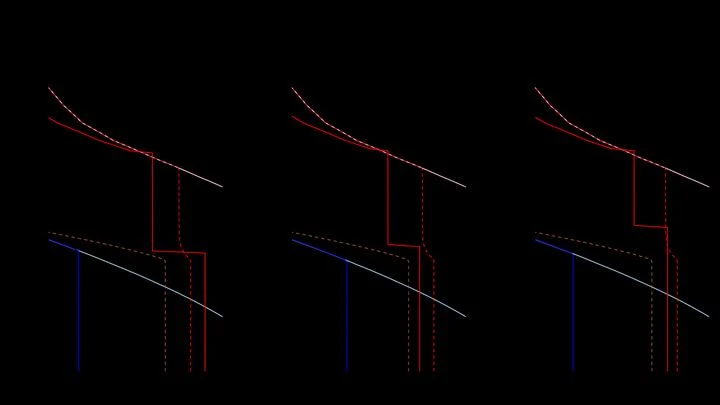
Jupiter's atmosphere resembles a layered cake, where each layer plays its role. Scientists took data from four instruments at once (VLT/MUSE, Cassini/VIMS, IRTF/SpeX, and Juno/JIRAM) and built a model of clouds and ammonia in the planet's equatorial zone, from 0.1 to 10 bar (pressure equivalent to hundreds of kilometers below Earth's…
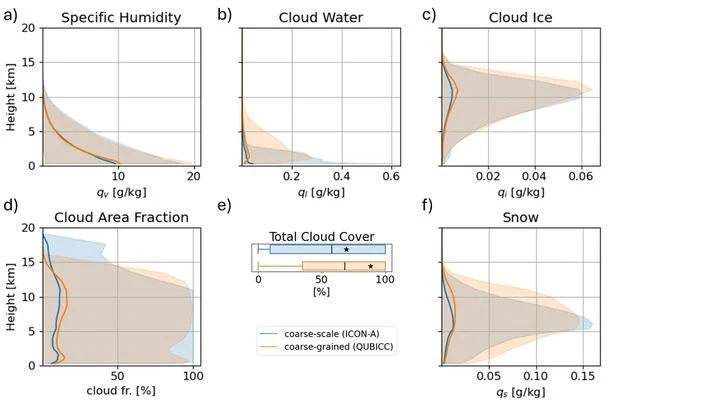
For decades, global atmospheric models resembled artists forced to paint planetary storms with coarse brushstrokes: a resolution of 25–100 km forced them to 'guess' convection through approximate schemes, introducing systematic errors in rainfall and climate forecasts.
The young super-Jupiter TWA5B, a scorching ball 25 times Jupiter's mass, floats just fifty light-years away. Its faint infrared glow long hid its chemical makeup. Now, high-resolution spectroscopy with CRIRES+ has registered the ghostly trace of SiO — silicon monoxide.
On a scorching afternoon, a stifling haze hangs over the city, and not a single cloud is on the horizon. Usually, in such weather, all you can do is wait for nature to take pity and send some cool relief. But what if shade and rain could be switched on schedule, like a light in a room?
In a grand courtroom, a meeting is in session. Hundreds of translator-neurons simultaneously hear fragments of phrases, and must piece them into a single coherent picture. This is exactly how large brain networks turn scattered signals from the eyes into a unified object image.
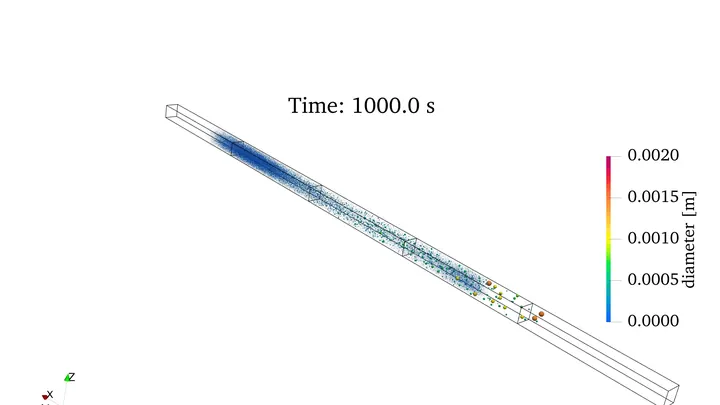
In a cloud, thousands of tiny water droplets hang in the air. For rain to fall, they need to grow: stick together into larger drops and become heavy enough to fall to the ground. But how exactly do droplets find each other in a huge cloud?
Scientists created a computer model that tracks each droplet individually, as if each one had its own little sensor.
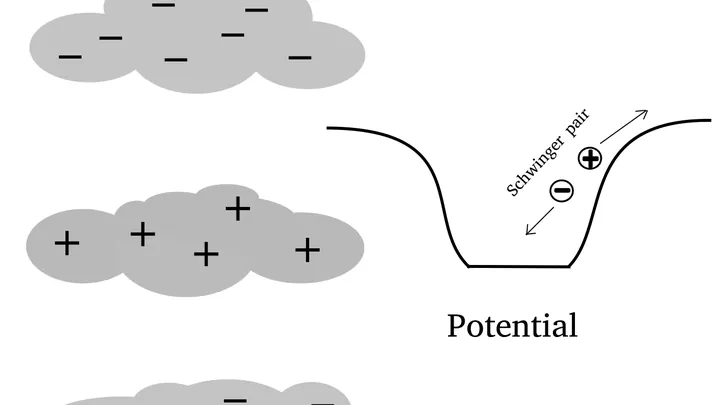
A thundercloud stores electricity like a battery before a flash. It can discharge in two ways: by lightning or by producing particles with a tiny charge: these are called millicharged particles. Such particles are nearly invisible to detectors, but their trace can be caught by how often lightning strikes.
The authors compared thunderstorms on different planets in the Solar System.
In the dense Virgo galaxy cluster, astronomers have spotted six strange clouds of neutral hydrogen — gas that emits no light and is therefore invisible to ordinary telescopes. Radio telescopes can pick it up, but where it came from was unclear.
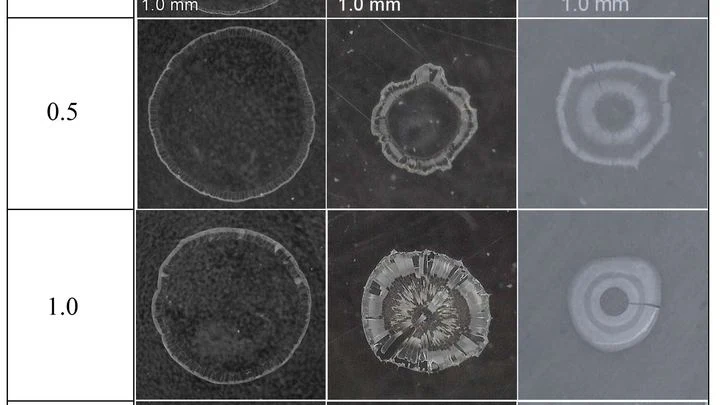
A coffee drop on a table dries and leaves a ring — coffee particles gather at the edge. But if charged nanoparticles float in the drop, the picture becomes richer: the deposit cracks like mud in a dried-up puddle. Physicists studied how the particle charge and the surface on which the drop dries change these cracks.
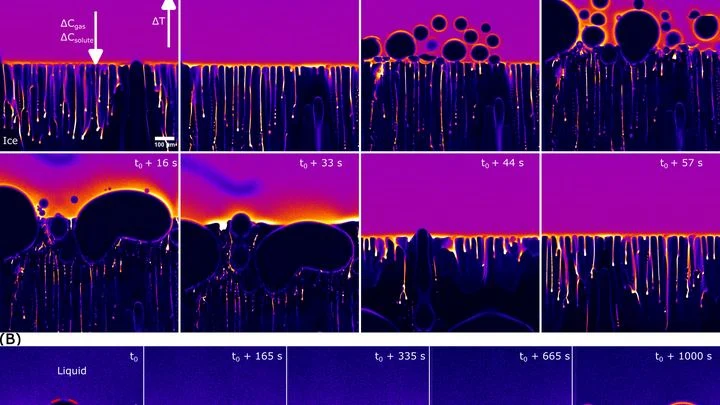
In a glass of soda, bubbles merrily rise to the top. But if you freeze the water, some bubbles end up trapped in the ice. How do they get there? After all, ice grows, pushing gas aside, but it doesn't always manage to.
Rain doesn't fall just any old way. If you take records from nearly fifty thousand rain gauges scattered across the globe and compare how much water falls on a rainy day in different parts of the planet, you'll spot a surprising pattern.
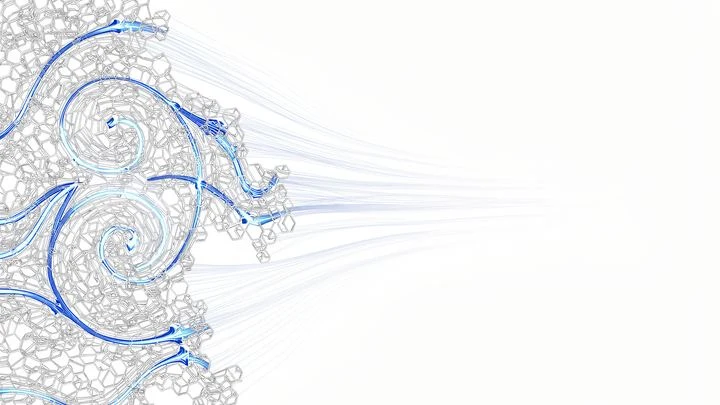
In a cloud, billions of droplets swirl around, collide, and merge: that's how rain is born. But exactly how turbulence, those invisible air swirls, helps or hinders droplet growth has been unclear. In the lab, researchers recreated a slice of a cloud and tracked every droplet.
Climate forecasting is like a complex recipe: one wrong pinch and the whole dish is ruined. So it is with clouds — small but decisive. Climate models divide the sky into 50–100 km cells and don't see individual clouds. It's like throwing pepper by the handful when the recipe calls for a pinch.
For 36 days, tropical cyclone Freddy raged over the Indian Ocean, the longest-lived cyclone on record. Meteorologists tracked it from satellites, aircraft, and ground stations. But one detail eluded all instruments: the precise air density deep within the vortex. And that density determines where the cyclone will turn tomorrow.
Every summer, a giant atmospheric engine unfolds over India: moist ocean winds bring the rains that sustain crops and the lives of two billion people. But this engine sputters, and forecasting it a season ahead remains elusive. Models give only rough answers, and a monsoon forecast error can cost millions of tons of food.