Simple

Two Probes Will Dive into the Tail of an Interstellar Comet ⚡ экспресс

Original: "Prospects for the Crossing of Comet 3I/ATLAS's Ion Tail"
· Samuel R. Grant, Geraint H. Jones
arXiv:2510.13222 · 2025-10-15 · CC BY 4.0 · ⏱ 1 min · Exoplanets Galaxies Instrumentation
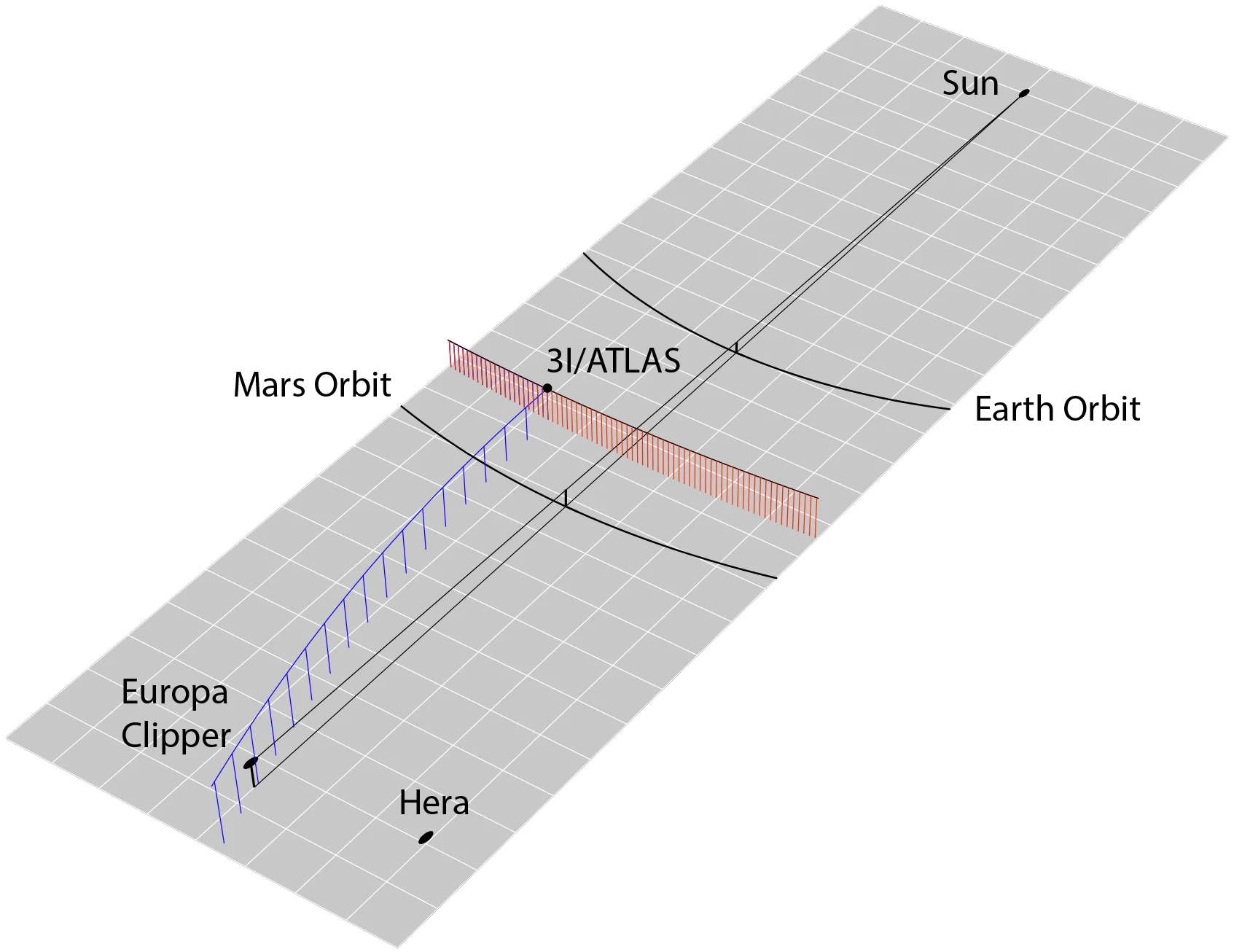
In late October 2025, the Europa Clipper and Hera spacecraft will find themselves inside the tail of Comet 3I/ATLAS.
Abstract

In late 2025, a comet from another star system will fly near two scientific probes. The probes might pass through its tail — like a boat cutting through a ship’s wake, but made of charged particles. This gives a unique chance to directly ‘touch’ material that came from far away. What will we learn about this cosmic wanderer?

Links in the knowledge graph 1

Stretched for millions of kilometers, the tail of Comet 3I/ATLAS consists of rarefied gas and microscopic dust grains. In late October 2025, two Earth probes—Europa Clipper and Hera—will plunge into it. Neither was designed to encounter a comet: Clipper is headed for a moon of Jupiter, Hera for an asteroid. But their trajectories accidentally intersected the tail.

Onboard instruments will capture particles of dust and hydrogen, and measure how the stream of charged particles from the Sun changes.

This is the first direct touch of material born around an alien star.

Composition analysis will tell us whether other worlds resemble ours. It’s like dipping a sample from an unfamiliar ocean. These data will turn hazy guesses about other planetary systems into measurable chemistry.

🎯 Comet 3I/ATLAS was discovered in 2025—it’s only the fourth interstellar object ever spotted by humans, after the asteroid ‘Oumuamua.

Scientists
Charles-Augustin de CoulombJames Clerk MaxwellLudwig BoltzmannJohannes RydbergTheodore LymanJames Jeans
Tags
cosmic dust hydrogen Sun
Laws
Coulomb's lawStefan–Boltzmann lawRydberg formulaJeans instabilityBalmer formula
Original: arXiv:2510.13222 · CC BY 4.0 · bridge42worlds