A comet tail is a stream of gas or dust that trails behind a comet as it travels through space, always pointing away from the Sun due to the pressure of sunlight and the solar wind. It is one of the most visible and iconic features of comets, often stretching millions of kilometers across the sky. The tail is not a static structure but a dynamic phenomenon that changes as the comet approaches or recedes from the Sun, and it provides crucial clues about the composition of the comet's nucleus and the conditions of the interplanetary medium.
History
The direction of comet tails was first correctly explained in the 16th century by Peter Apian, who observed that tails point away from the Sun. Later, in the 19th century, Friedrich Bessel and others developed more detailed theories involving solar radiationpressure.
How it works
When a comet gets close to the Sun, its icy nucleus heats up and releases gas and dust, forming a coma—a fuzzy atmosphere around the nucleus. The solar wind (a stream of charged particles) and radiationpressure from sunlight push this material away from the Sun, creating two distinct tails: a straight, bluish ion tail made of charged particles that follows the magnetic field lines, and a curved, whitish dust tail that lags behind due to the comet's orbital motion. The tails always point away from the Sun, regardless of the comet's direction of travel.
In practice
Studying comet tails helps scientists understand the composition of comets and the dynamics of the solar wind, which is essential for space weather forecasting and for planning spacecraft missions to comets.
Fun fact
A comet can have two tails that point in slightly different directions, and sometimes even a third, faint anti-tail that points toward the Sun, caused by larger dust particles that lag behind in the orbitalplane.
A stone thrown into water quickly loses speed. A meteor entering the atmosphere should behave the same way: air slows it down, and friction burns up its material. But cameras of the Global Fireball Observatory network have captured hundreds of bright fireballs over ten years that streak across the sky with almost no deceleration.
Dwarf galaxies orbiting the Milky Way look as if they’ve survived a gravitational storm. Their stellar bodies are stretched, scattered by tidal tails, and heated from within.
Cosmic rays do not travel in straight lines. Charged particles accelerated to enormous speeds loop through the Galaxy's magnetic field like dust motes in a gust of wind. It's usually assumed that they simply scatter along and across field lines.
In 2019, an unusual visitor, comet 3I/ATLAS, zoomed into the Solar System. It came from another star, and for the first time, astronomers were able to see what its dusty tail is made of.
The giant cloud of icy chunks on the outskirts of the Solar System, the Oort cloud, resembles a transparent bubble stretched to a light-year across. Usually, these chunks hang quietly in their distant corners, but sometimes something disturbs them.
Most often, it's the tidal influence of our Galaxy.
Moments before totality, swift shadow bands glide across the ground, like ripples from pebbles tossed into water. For centuries, this phenomenon baffled scientists. It turns out the key is that light is a wave.
The Sun isn't a pinpoint lamp but a vast disk. When the Moon nearly covers it, a thin glowing crescent remains.
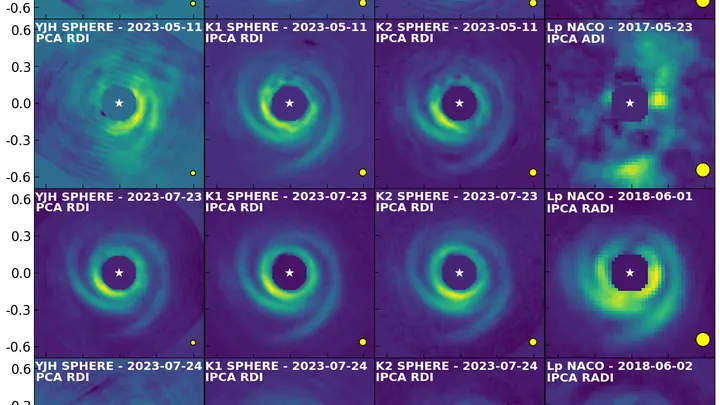
460 light-years away, around the star HD 135344B, a dense disk of gas and dust is swirling. It looks like a giant vinyl record that someone has cracked: a gap yawns in the disk, and across it, like a slender bridge, stretches a dust filament.
Perth residents know: when the daytime heat becomes unbearable, relief arrives from the ocean — a fresh breeze affectionately called the Freo Doctor. The same wind, only on a global scale, decides the fate of cosmic visitors plunging into the atmosphere. A meteorite fall is a two-act spectacle.
In July 1988, the automatic station Phobos 1 lifted off from Earth. Its target was Mars and its mysterious moon, Phobos. Two months after launch, an incorrect command was sent, communication was lost, and the probe fell silent forever. Since then, it was considered lost.
Decades later, astronomers spotted a strange object—1998 KY26.
Using the JWST space telescope, astronomers conducted a chemical analysis of the centaur Chiron, an icy body from the fringes of the Solar System. It turns out its gas activity resembles a layered cake. Carbon dioxide evaporates from the surface, forming a top crust.
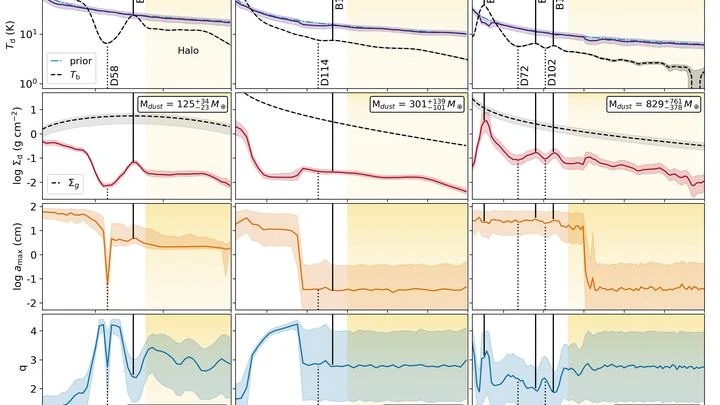
A young star is surrounded by a flat, rotating disk of gas and dust, like pizza dough that's been spun out. Planets are born inside such a disk. But around three stars (Elias 2-24, IM Lup, and DM Tau) astronomers noticed something odd: far beyond the edge of the bright disk stretches a barely visible but enormous dust halo.
An icy rock is flying through the Solar System on an open trajectory — coming in from interstellar space, swinging around the Sun, and heading back into the dark.
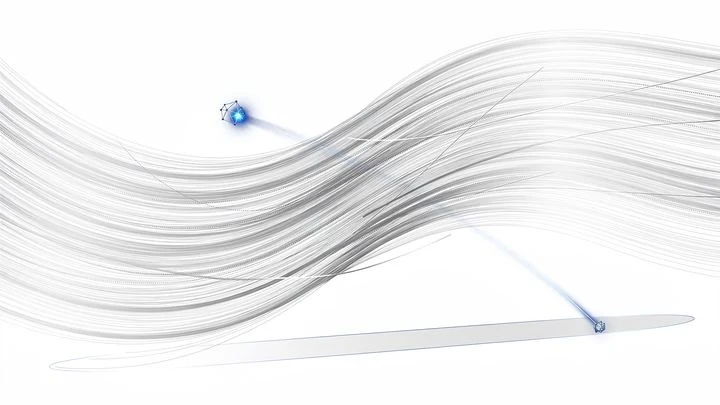
The neutron star PSR J1101-6101 is tearing through space at a breathtaking speed. It leaves behind a trail of charged particles, like a speedboat carving through water and dragging a foamy wake.
In the dense, star-forming gas cloud W44, the ALMA telescope has spotted eight tiny clumps racing at enormous speeds. In position–velocity maps, each one looks like the letter V, just like the previously discovered 'Bullet'. This resemblance hints at a common origin.
A hair dryer aimed at a block of ice strips vapor and droplets from its surface, and the ice slowly melts. The wind from the center of our Galaxy works in much the same way: it picks up cold gas clouds and carries them away, heating and shredding them along the way.
Astronomers decided to systematically search this flow for molecules, the coldest and densest form of gas, for the first time.
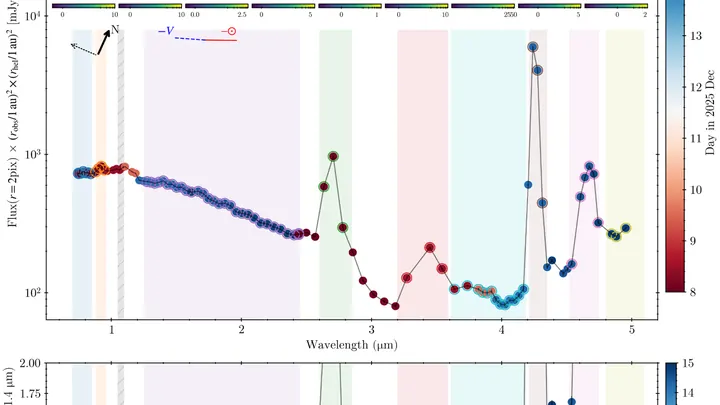
In December 2025, the SPHEREx telescope, using spectroscopy (breaking light into chemical 'fingerprints'), re-examined object ISO 3I/ATLAS — a wanderer from another star system.
The Sun doesn't rotate as a solid body: its equator spins faster than its poles. This difference in rotation speed creates layers that move at different speeds, like ocean currents at different depths.
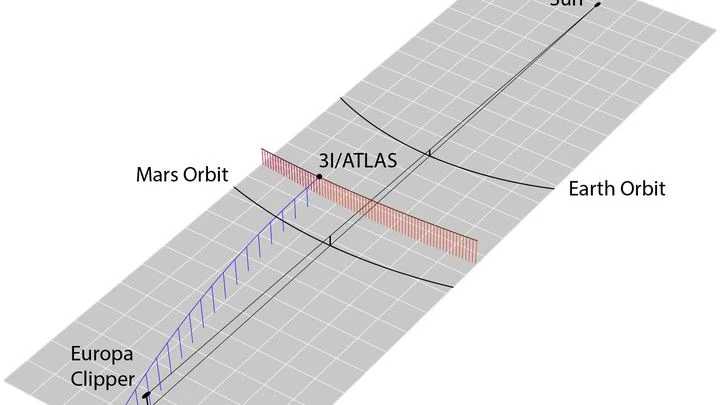
Stretched for millions of kilometers, the tail of Comet 3I/ATLAS consists of rarefied gas and microscopic dust grains. In late October 2025, two Earth probes, Europa Clipper and Hera, will plunge into it. Neither was designed to encounter a comet: Clipper is headed for a moon of Jupiter, Hera for an asteroid.
Planet WASP-121b orbits so near its star that the fierce heat boils its atmosphere away, streaming like a comet's tails. With the James Webb Space Telescope, astronomers continuously watched this process for the first time.
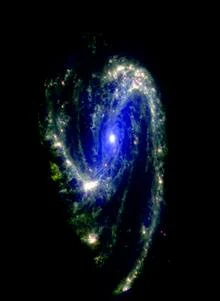
NGC 3627, a spiral beauty in the constellation Leo, harbors a trail that fits no standard scenario. A narrow band of cold gas, a molecular trail, stretches more than 8 kiloparsecs (thousands of parsecs, each about 3260 light-years) with a width of about 200 parsecs. That is like a thread as long as a football field and as thick as a pencil.