A comet is a small icy body that heats up as it approaches the Sun and releases gas and dust, forming a bright head and tail. A melting snowball leaving a trail of steam.
History
Until the 17th century, comets were considered atmospheric phenomena. Tycho Brahe in 1577, by measuring parallax, showed their cosmic nature. Johannes Kepler suggested straight-line trajectories, but Isaac Newton in 'Principia' (1687) applied the law of universal gravitation to calculate parabolic orbits of comets. Edmond Halley, processing data on 24 comets, identified the comet of 1682 with previously observed ones and predicted its return in 1758. In the 1950s, Jan Oort proposed the hypothesis of a giant spherical cloud on the periphery. Fred Hoyle studied organic molecules in comets and their possible connection to the origin of life.
How it works
A comet's orbit is determined by initial conditions and perturbations from planets. Long-period comets come from the Oort cloud with nearly parabolic orbits. During sublimation, reactive forces alter the orbit (non-gravitational acceleration). The brightness of the coma is modeled by the radiation transfer equation, accounting for dust scattering and gas fluorescence (e.g., CN, C₂ radicals). Tails are classified by type: type I — plasma, formed by ion interaction with the solar wind magnetic field; type II — dust, where solar radiation pressure F_{\text{rad}} = (S/c) Q_{\text{pr}} A, where S is the radiation flux density, c is the speed of light, Q_{\text{pr}} is the radiation pressure efficiency, A is the cross-sectional area of a dust grain. The Doppler effect contributes to emission when scattering on fast-moving particles. Wien's displacement law is used to estimate dust temperature.
Fun fact
A comet's tail always points away from the Sun because sunlight and the solar wind push the gas away, like a hair dryer blowing away smoke.
The JWST space telescope aimed its lens at the scorching rocky world 55 Cancri e, and spotted a dense gas envelope. But the cooler TRAPPIST-1 b, which orbits a dim red dwarf, showed no envelope: just bare rock. The picture came out upside down: hot planets hold onto atmospheres, while cooler ones lose them.
In the cold depths of space float rocks older than Earth itself. Inside some of them hide tiny glassy spheres — chondrules. They formed when a disk of gas and dust still swirled around the young Sun.
Carbonaceous meteorites Asuka 12236, Paris, and Maribo have preserved these spheres almost untouched.
A stone thrown into water quickly loses speed. A meteor entering the atmosphere should behave the same way: air slows it down, and friction burns up its material. But cameras of the Global Fireball Observatory network have captured hundreds of bright fireballs over ten years that streak across the sky with almost no deceleration.
The solar wind is a continuous stream of charged particles flowing from the Sun. It has two main components: protons (hydrogen nuclei) and alpha particles (helium nuclei, four times heavier).
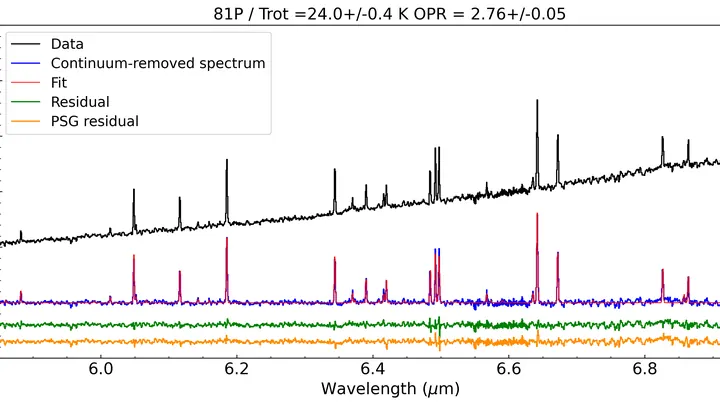
In March 2023, the James Webb Space Telescope pointed its instruments at the short-period comet 81P/Wild 2. This celestial body, about the size of a small town (nucleus radius around 1.77 km), is already familiar to scientists: in 2006, the Stardust probe flew through its tail and collected dust samples that were later studied in Earth laboratories.
In March 2023, the James Webb Space Telescope pointed its instruments at the short-period comet 81P/Wild 2. This celestial body, about the size of a small town (nucleus radius around 1.77 km), is already familiar to scientists: in 2006, the Stardust probe flew through its tail and collected dust samples that were later studied in Earth laboratories.
In the furnace of star formation, the heat reaches 900 degrees Celsius, like a glowing blast furnace. It is in this hellish heat that cosmic crystals are born. Astronomers have for the first time caught the moment when crystalline dust appears right during an accretion flare (when the star gobbles up surrounding gas) at the very young star EC 53, still cocooned in dense gas.
Among the scorching exoplanets that circle perilously close to their stars lies the secret of their birth. Nearly three decades ago, Michel Mayor and Didier Queloz discovered the first such world, and since then astronomers have been tormented by the question: how does a gas giant end up pressed against…
Remember the sensational comet 1I/‘Oumuamua — the first object to come to us from another star? Its hyperbolic trajectory left no doubt: it was a wanderer from the interstellar void. But astronomers wondered: could some of these visitors not be strangers at all, but our own, escaped from the Solar System millions of years ago?
Tiny seeds of life can cross the black void on icy wanderers like comet 3I/ATLAS. The James Webb Space Telescope found water and methane on it for the first time, and light analysis revealed an unusual gas composition.
In 2019, an unusual visitor, comet 3I/ATLAS, zoomed into the Solar System. It came from another star, and for the first time, astronomers were able to see what its dusty tail is made of.
The giant cloud of icy chunks on the outskirts of the Solar System, the Oort cloud, resembles a transparent bubble stretched to a light-year across. Usually, these chunks hang quietly in their distant corners, but sometimes something disturbs them.
Most often, it's the tidal influence of our Galaxy.
In the summer of 2021, comet 7P/Pons-Winnecke put on quite a show. A network of telescopes, the Las Cumbres Observatory, tracked it for nearly three months and counted eight sudden outbursts.
On the periphery of the Solar System lurk thousands of objects comparable in size to an exoplanet — a body of planetary mass not bound to our star. Their orbits are chaotic, and from time to time the trajectory of such a wanderer crosses Earth's path.
The Universe at 700 million years old was a noisy construction site, just beginning to light up. Telescopes caught a signal from that distant epoch: the galaxy REBELS-25, massive and full of stellar fuel.
Civilizations in the Universe are separated not just by distance, but by the vast gulf of time. Hunting for their traces is like archaeology: instead of palace ruins, we find clouds of cosmic dust.
Putting together the Solar System is like crafting a high-end tasting menu: the recipe isn't always set in stone — sometimes the final ingredient is added while the dish is already cooking.
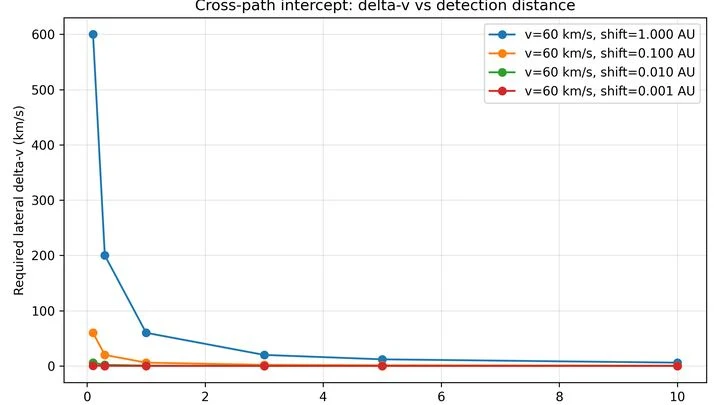
Interstellar space is not a cosmic desert, but a super-fast highway. Trillions of asteroids and comets from other systems race past us, yet camera-telescopes only catch a few. Imagine a night highway: the headlights of a distant car flash brightly, but if it zooms by too fast, the camera shutter can't click in time.
The young super-Jupiter TWA5B, a scorching ball 25 times Jupiter's mass, floats just fifty light-years away. Its faint infrared glow long hid its chemical makeup. Now, high-resolution spectroscopy with CRIRES+ has registered the ghostly trace of SiO — silicon monoxide.
In July 1988, the automatic station Phobos 1 lifted off from Earth. Its target was Mars and its mysterious moon, Phobos. Two months after launch, an incorrect command was sent, communication was lost, and the probe fell silent forever. Since then, it was considered lost.
Decades later, astronomers spotted a strange object—1998 KY26.
Among the icy chunks hurtling through the void, there are special travelers — interstellar comets. They were born around distant stars and happened to wander into our neighborhood. One of them, 3I/ATLAS, came under the gaze of telescopes as it approached the Sun. Its material, frozen gases and refractory dust, began to evaporate, leaving a glowing tail behind.
Using the JWST space telescope, astronomers conducted a chemical analysis of the centaur Chiron, an icy body from the fringes of the Solar System. It turns out its gas activity resembles a layered cake. Carbon dioxide evaporates from the surface, forming a top crust.
In December 2011, Comet Lovejoy boldly raced through the searing corona of the Sun. Right after — a flare. Scientists checked whether the comet could have caused it. The atmosphere of the Sun is threaded with taut magnetic loops, like a drawn bowstring.
When the interstellar comet 3I/ATLAS approached the Sun, its tail lit up with a metallic sheen, as if a tin can full of nickel and iron had burst open. By breaking down its light into colors, astronomers detected the lines of these metals using spectral analysis.
Recently, astronomers spotted three interstellar comets coming from deep space. One of them, 3I/ATLAS, turned out to be unexpectedly large: its nucleus is several kilometers across.
A planet's magnetic field is like an invisible shield: it catches charged particles from the solar wind and stretches out behind the planet into a long tail, like a fluttering scarf.
The Oort Cloud is a spherical swarm of trillions of icy bodies at the very edge of the Solar System, about a light-year from the Sun. These objects are almost motionless relative to one another until some gravitational disturbance breaks their calm.
An old chest of family heirlooms opens, and inside lie jewels that were thought to be as old as great-grandmother. But suddenly it turns out: the gold was remelted, the stones were recut, and this happened much later than thought. A similar story happened to the oldest particles in meteorites — calcium-aluminum inclusions, or CAIs.
A cold cloud of atoms is like a swarm of fireflies drawn to one another. The attraction between atoms tries to pack them into a single dense ball. But quantum jitter, the unavoidable motion of particles, keeps the ball from collapsing. When the attraction is strong, the cloud breaks into separate clumps.
Deep inside Earth lies a solid iron core about the size of the Moon. It floats in liquid metal and sways slightly, like a pit in a peach when you shake the fruit. Such oscillations are called Slichter modes: the core shifts both along the planet's axis and perpendicular to it.
Three forces act together to damp this motion.
In the cold outer reaches of the Solar System, water is considered the main building material for ices. But some comets and distant icy bodies have an unusually high ratio of carbon monoxide (CO) to water, as if a scoop of ice cream suddenly had too much syrup. The authors of a new study set out to find where this imbalance comes from.
When a baker kneads dough, the grains of flour can tell you which mill they came from. It's the same with Earth: the composition of iron in its depths preserves a memory of where the pieces that assembled the planet were born.
Comet 3I/ATLAS was spotted when it entered the Solar System from interstellar space. The James Webb Telescope split the light from its gas cloud into a rainbow, a spectrum, and in this pattern, the lines of rare molecules with deuterium (heavy hydrogen) appeared.
An icy rock is flying through the Solar System on an open trajectory — coming in from interstellar space, swinging around the Sun, and heading back into the dark.
A comet hurtling through space is a mountain of ice and dust that carries itself across the Solar System. If you mount small engines on such a mountain, it becomes a ship with its own fuel: gas from the interior can be vented through nozzles to change course.
In a constellation where new stars are born, one of them behaves like a faulty lightbulb: sometimes shining steadily, sometimes dimming by a factor of several. Astronomers have been monitoring the star Gaia-GIC-1 for several years and now understand that its blinking is the shadow of a huge dust cloud that periodically passes in front of it.
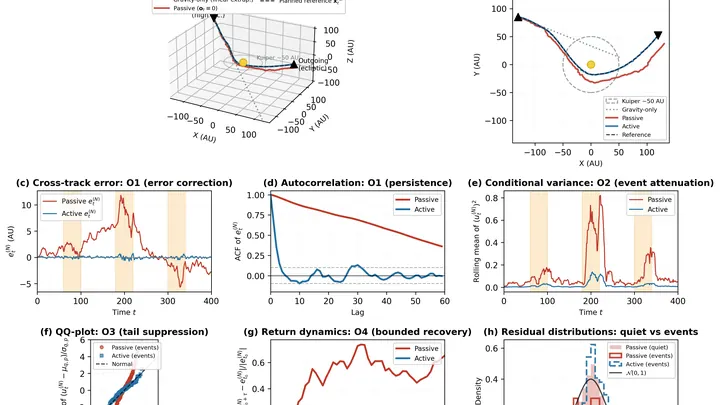
Comet 3I/ATLAS is a rare guest: it came from interstellar space, from another star. As it passed near the Sun, ice on its surface began to sublimate, and gas jets acted like tiny rocket engines. This force, called non-gravitational acceleration, nudges the comet off a purely gravitational trajectory.
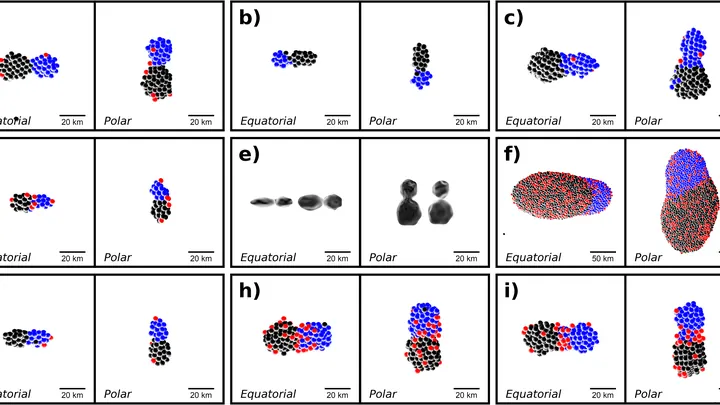
The icy body Arrokoth looks like a snowman: two spheres pressed together. Many such two-headed objects exist beyond Neptune's orbit, in the Kuiper Belt. For a long time, it was thought they formed from the slow collision of two separate bodies.
New simulations show a different path. A cloud of small pebbles around the young Sun collapses under its own gravity.
Life may be hiding in the oceans beneath the ice of Europa, Ganymede, and Callisto. Its carbon-based building blocks perhaps baked before the moons were born — in a disk of gas and dust around a young Jupiter. This giant cosmic oven ran on slow frictional heating, not harsh ultraviolet light.
In the dense, star-forming gas cloud W44, the ALMA telescope has spotted eight tiny clumps racing at enormous speeds. In position–velocity maps, each one looks like the letter V, just like the previously discovered 'Bullet'. This resemblance hints at a common origin.