Black Holes — Portals to a Mirror Universe express
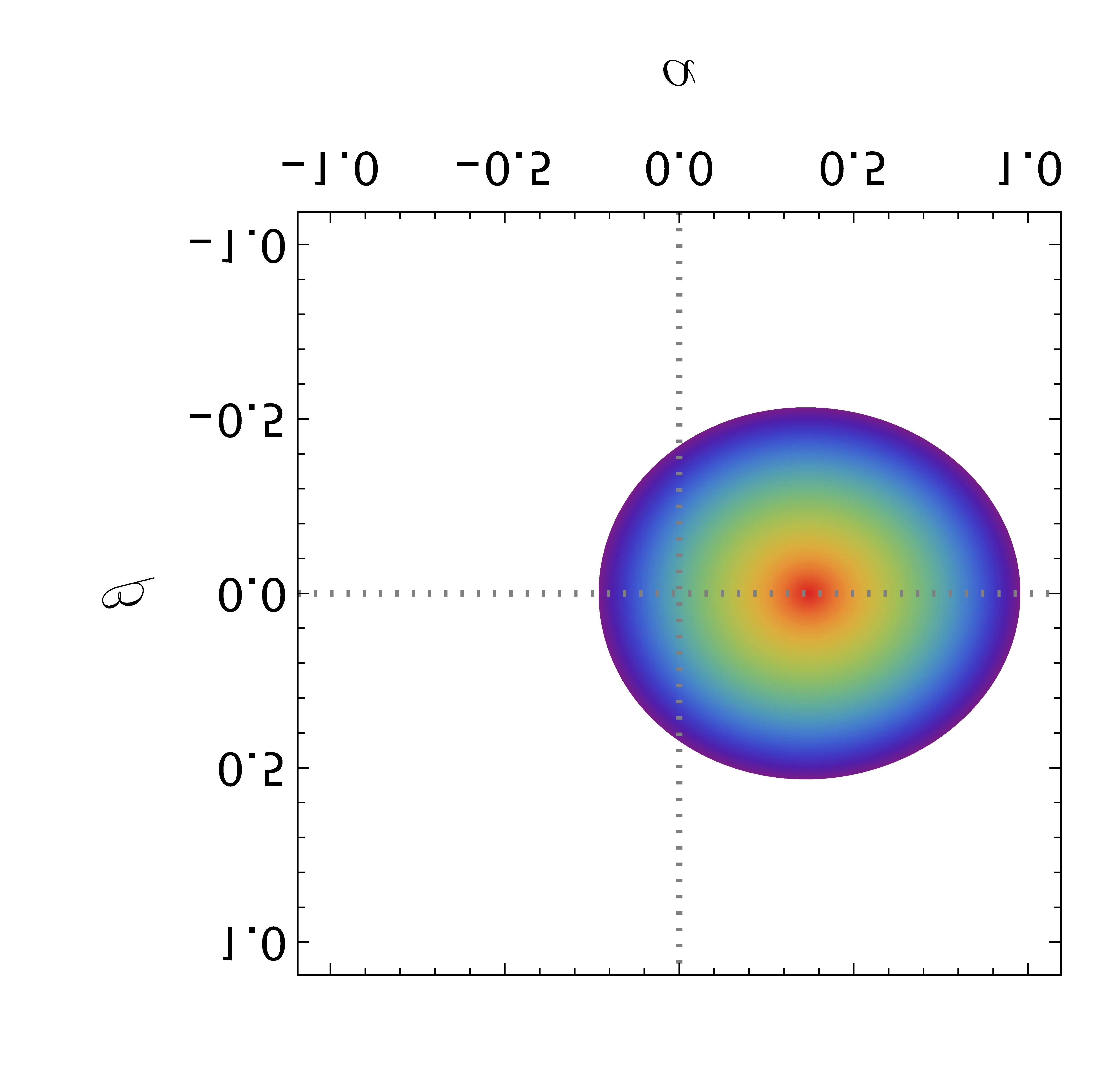
An ordinary black hole is a trap from which nothing escapes. But a rotating black hole is structured differently: at its center is not a point, but a ring of infinitely compressed matter. Space here is curved to the limit, and light rays trace unimaginable loops.
New research has revealed: thin beams of light slip through this ring, like a thread through a needle's eye. The slightest miss and the beam perishes, but a precise hit carries it into a mirror-reflected universe with inverted laws. From there, our sky would appear upside-down and distorted.
And so, information that falls into a black hole may not be lost, but seeps through the ring into another world.
Original abstract
as written by the authors arXiv:2511.18502
We study null geodesics that connect the two asymptotically flat regions of the maximally extended Kerr spacetime. These vortical geodesics traverse both horizons and pass through the ring singularity, linking the positive-$$r$$ exterior to the negative-$$r$$ asymptotic side. Using impact parameters, we identify a closed subset of parameter space, the inner throat, where the radial potential has no real roots, and photons exhibit no radial turning points. In this region, at most two constant-latitude geodesics exist, one of which is aligned with the principal null direction. We also identify the forbidden polar-angle band that limits the range of geodesics reaching an asymptotic observer. We solve the geodesic equations analytically and numerically in Eddington-Finkelstein-like coordinates, obtaining mutually consistent results that correct and extend previously available formulae. The resulting trajectories are used to construct simulated views for an observer in the negative-$$r$$ domain, revealing strong image distortion and inversion, with possible implications for analogous white-hole configurations.
The central ring of a rotating black hole is like a needle's eye: the slightest miss dooms a falling object, but a perfect hit ejects it into a mirror universe.
Passing through a rotating black hole into another universe echoes the wormhole concept shown in the movie 'Interstellar'.