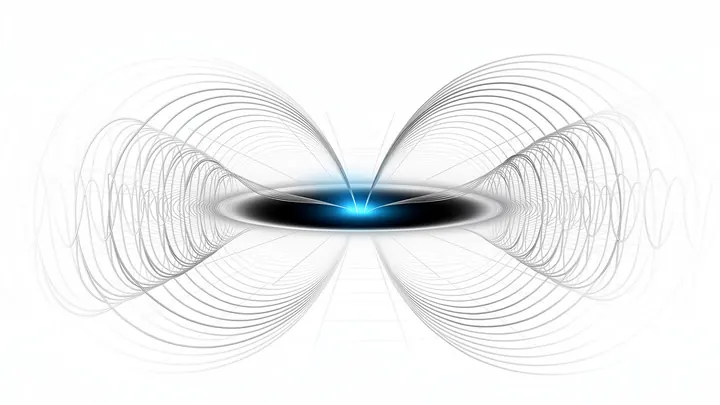
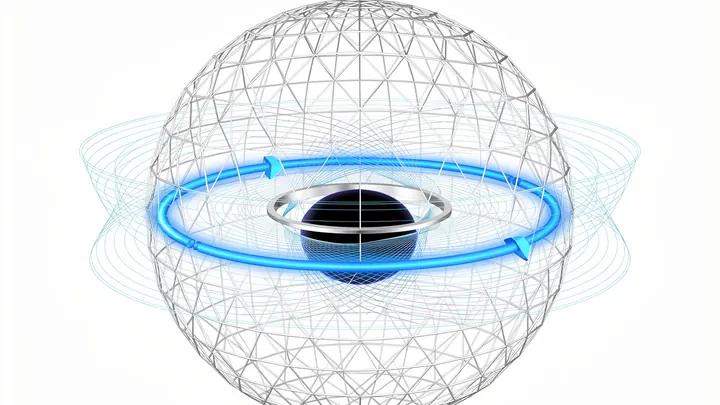
Horizon area is the surface area of a black hole's event horizon, the boundary beyond which nothing can escape. In classical general relativity, the horizon area is a crucial quantity: it never decreases (the second law of black hole mechanics) and is directly proportional to the black hole's entropy, as shown by Bekenstein and Hawking. This connection between geometry and thermodynamics is a cornerstone of our understanding of quantum gravity.
History
The area theorem was proven by Stephen Hawking in 1971, and the entropy connection was proposed by Jacob Bekenstein in 1972, with Hawking's subsequent work on black hole radiation solidifying the relationship.
How it works
The event horizon is a null surface defined by the escape velocity equaling the speed of light. Its area is computed from the spacetime metric, typically using the Kerr-Newman solution for rotating, charged black holes. The area increases when matter or energy falls into the black hole, and it is related to entropy via the Bekenstein-Hawking formula: S = A/(4ℓ_Pl²), where ℓ_Pl is the Planck length.
In practice
Horizon area is used in gravitational wave astronomy to infer the properties of merging black holes, and in theoretical models of black hole thermodynamics and information paradox resolution.
Fun fact
If you throw a book into a black hole, the increase in horizon area is proportional to the entropy of the book's information, a fact that inspired the holographic principle.
The heart of a black hole beats unevenly. One thump is brighter, another dimmer, and this rhythm encodes the temperature of the electrons swirling right at the horizon. Astronomers call this rhythm the spectral index: a number that shows how much brightness changes as you move from one radio frequency to another.
A network of radio telescopes scattered across the planet catches the whisper of a distant black hole. Each antenna records a signal, but how do you combine these recordings if the clocks at the stations tick at different rates and the atmosphere distorts incoming waves?
A black hole is a maze with no way out. But what happens to the information inside? To test this, physicists didn't fly to the nearest hole; instead, they built a tiny replica on a quantum processor. The maze was played by a chain of 32 superconducting qubits, where each step leads only forward, like a one-way corridor.
A black hole pulls in anything that gets too close. But if you toss in not one object but a pair, one of them can fly back out, carrying off some of the hole's rotational energy. This trick, devised by Roger Penrose in 1969, works only because a black hole has a horizon — a boundary beyond which nothing returns. Now it turns out the horizon isn't necessary.
Stare long enough into the night sky, and sooner or later your gaze hits a blackness beyond which nothing is visible. This is not just a distant fence: it is the edge of the universe accessible to us, the cosmic horizon. Light from more distant stars simply hasn't had time to reach us.
A boiling kettle on the stove eventually boils dry — and so, according to the classical picture, a black hole should gradually vanish in a hiss of radiation. But what if you add a special ingredient to the kettle?
A dance floor where couples whirl. At the center, an invisible master of ceremonies sets the rhythm. This is the supermassive black hole at the heart of the Milky Way, and the couples are stars whose orbits astronomers have tracked for years. But what if the master himself is wrapped in a fluffy fur coat of tenuous matter?
The idea was elegant: take a BTZ black hole (the three-dimensional analog of a regular black hole) and smooth its horizon with a special function. The hope was that inside, the spacetime signature might change — time becoming space, and space becoming time. But the calculations showed otherwise.
In the far reaches of space, there exists a hypothetical object: an ultracold black hole. It is charged and resides in an expanding universe (de Sitter space). Its temperature hovers just above absolute zero — about one trillionth of a degree above it.
A black hole spun up almost to its limit is like an athlete balancing on the edge of a record. The most interesting action isn't inside the hole itself, but in the thinnest film of spacetime at its horizon. It's there that tiny corrections to Einstein's gravity can suddenly swell to gigantic proportions.
A black hole's shadow isn't just a black circle. Usually, we see a dark void surrounded by a glowing ring of hot gas. But if a black hole wasn't born from a dying star but has existed forever, its shadow might hide a surprise.
An eternal black hole is a solution to Einstein's equations with no past and no collapse.
A black hole is not just an abyss. It is a seething cauldron whose temperature rises as it evaporates. The authors of the study found that when the heat reaches a critical threshold, the hole seems to boil. It emits superheavy particles — the very ones that exist on a scale where any theory of gravity collapses.
A black hole is not an absolutely black bag. In 1974, Stephen Hawking showed that it glows — faintly, but continuously. This radiation is born not inside, but outside, right at the boundary from which even light cannot escape.
A new study sharpens the picture.
Light from afar bends around a black hole like a cyclist taking a sharp turn. Get closer, and it starts looping around an invisible sphere of photons. Every black hole has such a sphere, but usually it's wobbly: the slightest nudge sends light flying away or falling in.
A black hole devours everything, even light. Yet it obeys the laws of physics: it possesses entropy — a measure of the hidden information an object 'remembers.' In the 1970s, Jacob Bekenstein and Stephen Hawking discovered a strange pattern: a black hole's entropy grows not with its volume, but…
In 1973, Jacob Bekenstein proposed that black hole possess entropy — a measure of hidden disorder. Stephen Hawking later confirmed this by adding radiation, but the microscopic origin of entropy remained obscure.
A climber on a ridge notices something strange: the horizon around them seems to freeze. No forward, no backward — only emptiness and silence. This is roughly the picture painted by new calculations for our Universe. At some point in its expansion, the invisible boundary, the future event horizon, stopped growing.
A pot of boiling water is covered with two lids — an inner and an outer one. The thermometer under each shows its own temperature, but their harmonic mean (a special averaging method where you add the reciprocals) always remains unchanged. Heat seems to obey an invisible rule.
A black hole is not an eternal vacuum cleaner. Surround it with a non-ideal fluid (matter with internal friction), and the geometry starts to lead a life of its own. The authors of the paper showed that a special geometric flow, the almost η-Ricci–Yamabe soliton, acts like an invisible sculptor.
An eardrum at the very edge of a waterfall. Sound behaves strangely here: echoes don't multiply: they fade. That's exactly what gravitational waves look like at the horizon of a black hole — the boundary beyond which even light disappears.
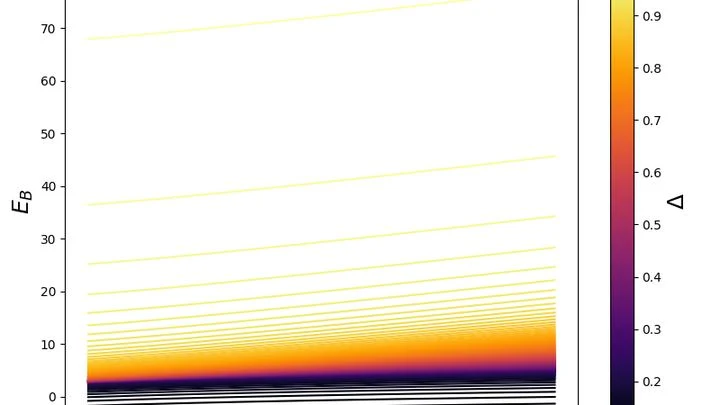
A black hole cooled to nearly absolute zero resembles a musical instrument with only a limited set of possible notes. Strike it, and it will respond not with any sound, but only with a strictly defined set of frequencies.
A light ray skimming along a black hole horizon doesn't just move: it carries heat and information. Physicists have long suspected that the geometry of such rays obeys strict rules, but the details remained blurry. The new work turns these rules into a sharp inequality.
A black hole is not eternal. Even in a perfect vacuum, it slowly loses energy — a process known as Hawking radiation. Quantum effects near the event horizon create pairs of particles, one of which escapes, carrying away some of the black hole's mass.
A black hole is not just an abyss where everything falls. Right at its horizon, in the so-called quantum atmosphere, a faint glow is born — Hawking radiation. This is not calm light but a churning stream of particles that can influence the most delicate quantum connections.
At the center of most galaxies lurk supermassive black holes — the overlords of gravity. Since 2019, thanks to interferometry with very long baselines, we’ve glimpsed their shadows: dark silhouettes set against a blazing gas backdrop. But what exactly is painting that shadow?
At the hearts of many galaxies, cosmic tops of incredible power spin — supermassive black holes. Their nature was first described by Schwarzschild right after Einstein gifted the world with general relativity.
At the center of attention is a black hole of unusual shape. Its geometry resembles a spindle: a slight elongation is added to the usual rotation. The parameter B measures this deformation.
The spindle deformation is not just a mathematical toy.
For a long time, the event horizon behaved like a cosmic dictator: everything that crossed its boundary vanished irretrievably from our Universe. But quantum mechanics, like a dissident's voice, whispered: information cannot simply disappear.
At the center of a classical black hole lurks a singularity — a point where the density and curvature of spacetime become infinite. Physics goes silent there.
The LIGO detectors caught the signal GW250114—a gravitational wave from the merger of two black holes. After the main burst, a decaying 'tail' remained — direct waves from the newborn hole's horizon. It was expected that their damping would reveal the gravitational strength at the horizon's surface. But the measured value came out smaller.
The cosmological horizon — the edge of the observable Universe, which is expanding at an accelerating rate — is like a safe with a timer. Information about what crosses this boundary doesn’t vanish but returns, albeit with a delay. Physicists have figured out how long this pause lasts.
For decades astrophysicists painted a neat picture: a galaxy, like a giant carousel, spins in a unified rhythm, and the supermassive black hole at its center inherits that dance.
A black hole is not just a dark spot. It rotates, drags space along with it, and can carry imprints of the quantum world. To describe such a hole, one must solve gravitational field equations.
In classical theory, a black hole is where matter collapses to a point of infinite density. Such a 'singularity' looks like an error in the equations: nature hardly tolerates infinities. Many physicists seek ways to 'smooth out' this flaw, and one idea is to modify the theory of gravity itself at small distances.
The merger of two black holes is not just a silent dance, but a grand act after which spacetime itself vibrates for a long time. These damped oscillations — quasi-normal modes — are like the ringing of a gigantic bell. But there is another echo: barely perceptible, almost ghostly.
At the centers of many galaxies lurk supermassive black holes. One of them, Sagittarius A* at the heart of the Milky Way, has become a testing ground for a new idea. The authors of the work took Einsteinian gravity and added an unusual electromagnetic field to it.
Imagine a steam engine where instead of a steel piston there is an event horizon, and the cylinder is curved space itself. This metaphor has gained mathematical flesh: physicists have for the first time constructed a complete set of reversible heat cycles with a Schwarzschild black hole confined in a spherical cavity.
A black hole's interior is layered like an onion. In the new model, instead of an infinite point at the center, there are three regions: a dense core, a transition layer, and a crust just below the horizon. All arise from a single field that interacts with itself.
A black hole is like a perfectly dark room: from outside, you can't see what's inside, and anyone crossing the threshold seems to vanish from the outside world. But what does the falling observer feel? In classical physics, nothing special: the event horizon isn't marked by any signpost.
A black hole is not just a vacuum cleaner. It glows faintly, emitting particles — this idea was proposed by Jacob Bekenstein, who connected the hole's temperature to its degree of disorder. Detecting such radiation in space is incredibly difficult.