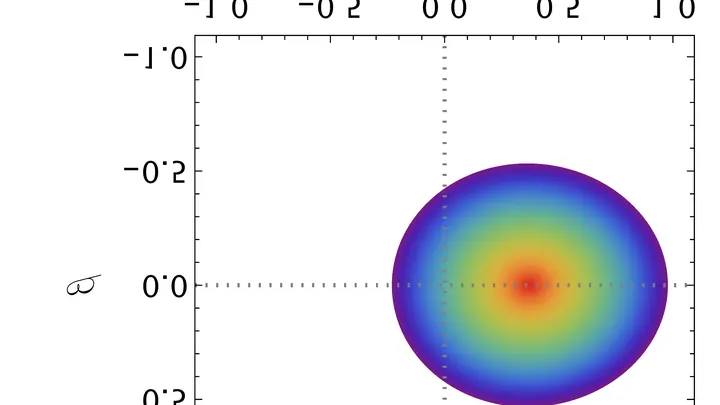
The Airy disk is the bright central spot in the diffraction pattern produced by a point source of light passing through a circular aperture. The Airy disk constant is the angular radius at which the intensity of this pattern first drops to zero, marking the boundary between the central bright region and the surrounding rings. For a circular aperture, this first zero occurs at an angle given by 1.22 times the wavelength divided by the aperture diameter.
History
The pattern was first described by George Biddell Airy in 1835, who derived the mathematical form of the diffraction pattern for a circular aperture.
How it works
When light passes through a circular opening, it doesn't simply cast a sharp shadow; instead, diffraction causes the waves to spread and interfere. The resulting pattern on a screen shows a central bright spot surrounded by faint rings. The first dark ring, where intensity falls to zero, defines the Airy disk. The constant 1.22 arises from the mathematics of Bessel functions, which describe the wave interference for a circular geometry.
In practice
The Airy disk constant sets the fundamental resolution limit for optical instruments like telescopes and microscopes, known as the diffraction limit, which determines how close two point sources can be and still be distinguished.
Fun fact
The same 1.22 factor appears in the design of radio telescopes and even in the focusing of laser beams, making it a universal constant for any wave-based imaging system.
A galaxy is like a city: bright lights and dense buildings at the center, sparse lights and emptiness toward the outskirts. But if you watch how gas rotates in a galaxy's disk, you see that its speed barely drops at the edges. As if invisible neighborhoods keep the motion going. Astronomers have found a way to map this invisible city.
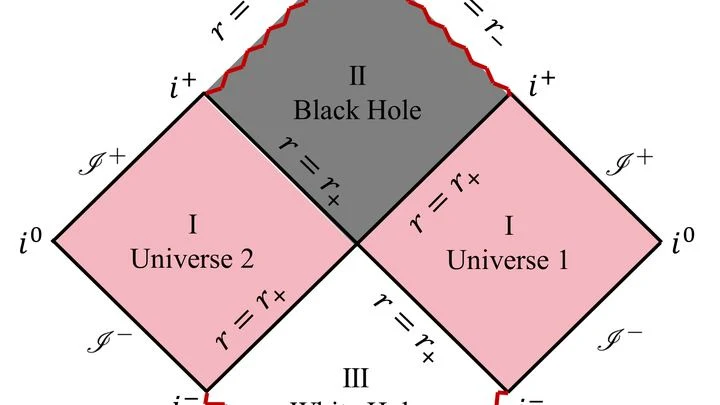
The idea was elegant: take a BTZ black hole (the three-dimensional analog of a regular black hole) and smooth its horizon with a special function. The hope was that inside, the spacetime signature might change — time becoming space, and space becoming time. But the calculations showed otherwise.
A neural network predicts the future of a system — say, how plasma will swirl in a magnetic field or how a face in a video will change. Errors are inevitable, and the further it looks ahead, the more they accumulate. Checking against the correct answer during operation is impossible: it simply doesn't exist.
In 2008, the Spitzer telescope aimed at the star HD 15407A and detected a strong infrared excess. Fifteen years later, in 2023, JWST repeated the measurements. The light from the dust had dimmed by 14%. But the mineral composition of the dust remained the same, like a fingerprint taken in different years.
A rotating black hole is like a whirlpool in a river — spacetime swirls around it, dragging along everything nearby. In some gravity theories, this whirlpool also includes an extra field — a vector field. At each point, it has a direction and a length, like a compass needle.
The cosmic spectacle unfolds on the stage of Galaxy галактики Centaurus A. In the lead role: a supermassive сверхмассивная чёрная дыра with a powerful jet that pierces space for hundreds of thousands of light-years.
Look at an equilateral triangle — the probability simplex for three assets. Each interior point is a portfolio: non-negative shares summing to one. The triangle's center, the barycenter, corresponds to an equal-weight allocation (1/3, 1/3, 1/3). It seems that by moving toward this point, you lower risk and avoid dangerous edges.
A drop of honey spreads slowly across a table, while water spreads quickly. The resistance to flow, viscosity, differs from one fluid to another. But what if the viscosity changes on the fly, as the substance compresses or expands?
An invisible film, a quantum field, is stretched over a rubber bagel. While the bagel is small, the film stays taut and doesn't sag anywhere: the vacuum remains empty. But once you stretch the bagel to a certain size, a dent spontaneously appears in the film — the field starts to be felt at every point.
This dent is not random.
The plasma jet from the center of a distant galaxy is like a river that flows from its source and gradually becomes clear. Near the black hole, the flow is dense and opaque to radio waves, like muddy water.
A coin spinning on a table is a familiar sight. At first it rotates quickly, then it tilts, and its rattling becomes faster and faster. In the last seconds it seems to hover: the rotation slows, but the coin just won't finally lie flat. This final moment is a real puzzle for physicists.
Around the young star MWC 480, a flat disk of gas and dust whirls, like a giant carousel where, instead of horses, you have building blocks for planets. Radio telescopes peered into this disk at different wavelengths, from millimeter to centimeter, and saw exactly where the dust accumulates and how large the grains are.
Light from the star HD 163296 passes through the surrounding gas-and-dust disk like a flashlight beam through murky water. The disk's particles scatter the light, giving it a special property — polarization: the waves begin to oscillate in a single plane, like a rope shaken strictly up and down.
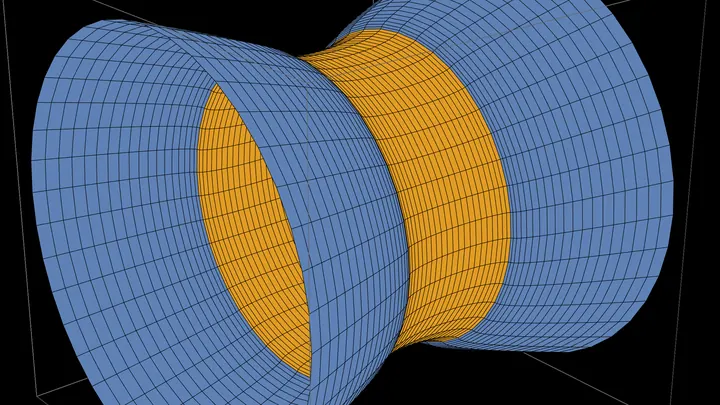
An ordinary black hole is a bottomless pit from which not even light can escape. However, physicists have found a way to turn this pit into a through-tunnel — a wormhole.
Around young stars, disks of gas and dust swirl: these are the construction sites for future planets. In the binary system HD 142527, such a disk is especially intriguing. Astronomers aimed three instruments working in the infrared range (thermal emission from dust) at it and saw a surprising picture.
An ordinary black hole is a trap from which nothing escapes. But a rotating black hole is structured differently: at its center is not a point, but a ring of infinitely compressed matter. Space here is curved to the limit, and light rays trace unimaginable loops.