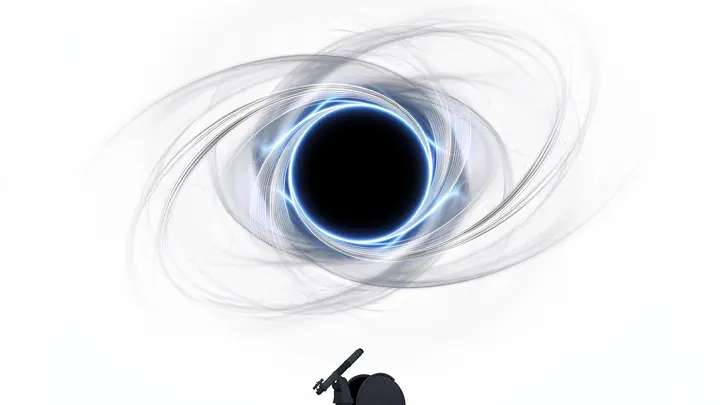
A rotating black hole, described by the Kerr solution to Einstein's field equations, is a region of spacetime where gravity is so intense that nothing, not even light, can escape once past the event horizon. Unlike a non-rotating (Schwarzschild) black hole, which has a point singularity, a rotating black hole has a ring-shaped singularity, and its rotation drags spacetime around it in a phenomenon known as frame-dragging. This rotation also creates an ergosphere, a region outside the event horizon where objects cannot remain stationary and from which energy can be extracted.
History
The Kerr solution was discovered by Roy Kerr in 1963, just a few years after the first exact solution for a non-rotating black hole was found by Karl Schwarzschild in 1916. Kerr's work was a landmark in general relativity, providing a realistic description of black holes formed from collapsing rotating stars.
How it works
The Kerr solution is characterized by two parameters: mass and angular momentum. The rotation causes the event horizon to be smaller than in the non-rotating case, and it creates a region called the ergosphere, where spacetime itself is dragged along at speeds approaching the speed of light. Particles entering the ergosphere can gain energy from the black hole's rotation via the Penrose process, and the extraction of this rotational energy is thought to power some of the most energetic phenomena in the universe, such as relativistic jets.
In practice
Rotating black holes are used as models for active galactic nuclei and quasars, where the extraction of rotational energy is believed to drive the powerful jets observed. They also serve as natural laboratories for testing general relativity in strong-field regimes.
Fun fact
The maximum spin of a Kerr black hole is limited by the 'cosmic censorship conjecture,' which suggests that the singularity must always be hidden behind an event horizon, preventing a 'naked singularity' from being observable.
A black hole pulls in anything that gets too close. But if you toss in not one object but a pair, one of them can fly back out, carrying off some of the hole's rotational energy. This trick, devised by Roger Penrose in 1969, works only because a black hole has a horizon — a boundary beyond which nothing returns. Now it turns out the horizon isn't necessary.
A laser beam is like a swift vortex that briefly captures a passing electron. As the particle moves through the pulse, its spin (the intrinsic rotation, like a tiny top) experiences a weak kick. After leaving the beam, the top no longer points in the same direction; it has turned a little.
Somewhere in the center of a galaxy, a black hole is spinning. It doesn't hang in a void — around it swirls an invisible swarm of dark matter particles. Until now, this swarm was described for non-rotating holes, but in reality, holes always rotate.
A rotating black hole is no calm whirlpool. Space around it shudders and rings at the slightest disturbance, like a guitar string after a pluck. These oscillations are described by the Teukolsky equation — a complex mathematical construct that physicists have studied for half a century.
Recently, a strange symmetry was noticed in this equation.
A black hole doesn't just spin: it's surrounded by bristles of an extra field (the Kalb–Ramond field). This paper explores how a massive field (waves with mass) behaves near such a black hole when it's almost spinning at its maximum rate.
The Klein–Gordon–Fock equation for this field was separated into two independent parts — radial and angular.
In a two-dimensional universe, a black hole looks like a funnel in spacetime. But the authors of the new work went further: they proposed that the space where particle momenta 'live' is also curved, like a saddle.
The spiral of water draining into a sink spins faster and faster toward the center. In an ordinary black hole, that funnel ends in an infinitely sharp point — a singularity where the laws of physics break down. But this new work considers a different picture: the funnel doesn't taper to a needle but ends in a smooth, swelling bubble.
A rotating black hole is like a whirlpool in a river — spacetime swirls around it, dragging along everything nearby. In some gravity theories, this whirlpool also includes an extra field — a vector field. At each point, it has a direction and a length, like a compass needle.
At the center of attention is a black hole of unusual shape. Its geometry resembles a spindle: a slight elongation is added to the usual rotation. The parameter B measures this deformation.
The spindle deformation is not just a mathematical toy.
Hot gas spirals inward, falling onto an invisible superdense object. Such a disk resembles a giant whirlpool, but it is often tilted: its axis does not align with the rotation axis of the central body. The gravity of the massive object makes the disk wobble slightly, like a spinning top losing its balance.
A black hole is not just a dark spot. It rotates, drags space along with it, and can carry imprints of the quantum world. To describe such a hole, one must solve gravitational field equations.
A cosmic ray approaches a black hole almost tangentially. Instead of falling straight in, it lingers on an unstable orbit, like an acrobat balancing on a tightrope over an abyss. After a few loops, the light finally escapes toward a distant observer. Such rays produce multiple images of the same source, known as higher-order images.
A black hole with a magnetic field resembles a whirlpool in a river, where water doesn't flow into the vortex but swirls in place. Usually, the hole's rotation picks up waves and amplifies them: this is called superradiance. But add a magnetic field, and everything changes.
At the centers of many galaxies lurk black holes — regions with gravity so strong that even light cannot escape. Stars often orbit them, and sometimes one of those stars is a pulsar, a cosmic lighthouse sending out strictly periodic radio pulses. When such a pulsar moves behind a black hole, its signals reach us with a delay.
A rapidly spinning black hole, where spacetime is curved to the limit, resembles a bell that can hum for centuries. Its special oscillations barely decay, losing energy incredibly slowly.
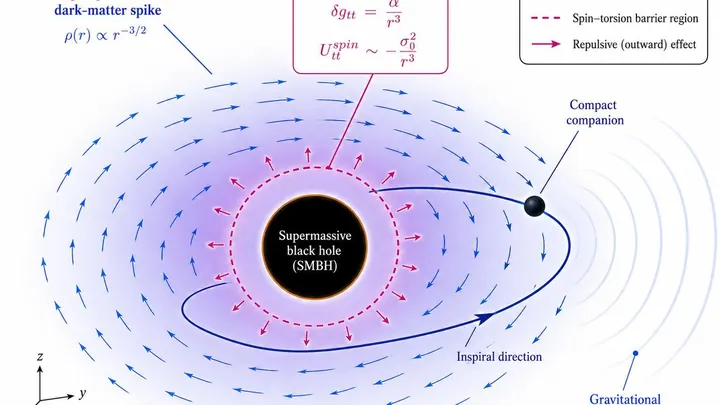
A supermassive black hole drifts through a cloud of dark matter. In the usual picture, this invisible substance just adds mass and barely interacts with ordinary matter. But dark matter particles could have intrinsic rotation — spin.
A black hole is not just a dark spot in space. It is a region where gravity compresses matter so intensely that even light cannot escape. Among all possible black holes, one stands out — the rotating Kerr black hole. Its description was long thought to be tied to Einstein's equations, like a recipe tied to a specific cookbook.
Gravitational waves from a tiny body falling into a black hole work like an X-ray image. Only instead of a bone, they illuminate the curved spacetime itself.
An orchestra plays out of tune, and the sound seems like chaos. But if you record all the notes and analyze them mathematically, you can reconstruct the shape of the concert hall — where the walls are, how high the ceiling is. Roughly in this way, physicists propose to derive gravity from quantum theory.
In everyday life, space and time are the stage on which events unfold.
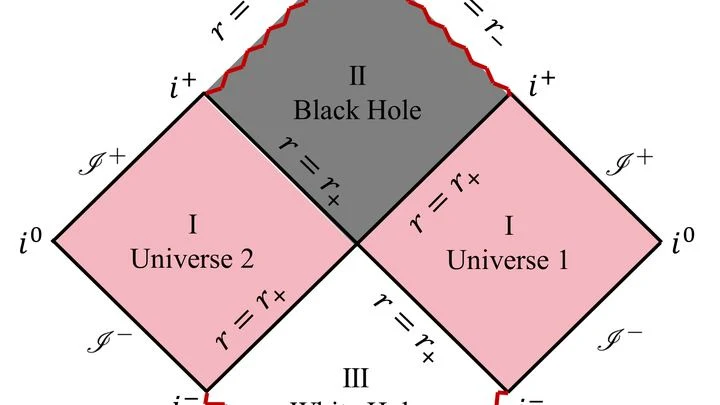
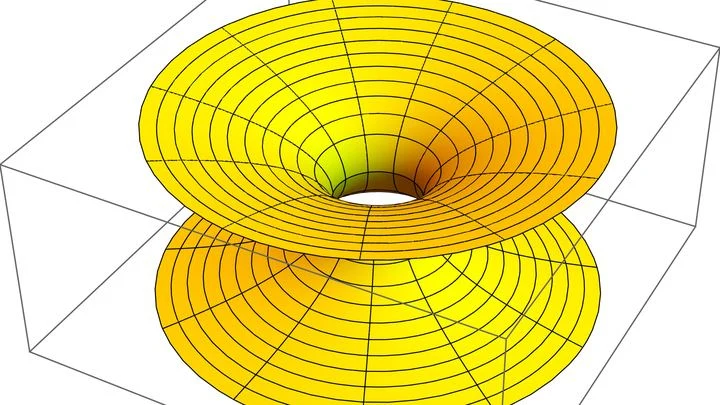
A wormhole is a hypothetical tunnel in curved spacetime connecting two distant regions of the universe and potentially shortening the journey between them.
A light beam approaches a black hole not head-on, but at a glancing angle. If the angle is just right, the light neither falls in nor escapes: it starts looping around, like a figure skater circling the rim of a funnel. This narrow track is the photon ring. It acts like a lens, repeatedly reflecting the image of everything that falls into the hole.
Spacetime flows like a river, and a black hole is a whirlpool. Particles in this flow are like waves with their own rhythm: alternating crests and troughs. It turns out the whirlpool shifts the wave's rhythm from a distance, without even sucking it in.
A massive top spins so fast that space itself twists into a spiral around it. This is a black hole — only instead of wood and metal, it's made of pure gravity. Add an unusual electromagnetic field that slightly changes the rules of the game, and you get a 'deformed' black hole: its shape and behavior differ a bit from the familiar ones described half a century ago.
The shadow of a black hole is not just a silhouette. It's the edge of the abyss, where space and time are twisted so tightly that even light is forced to swirl like a wood chip in a whirlpool. This 'cosmic whirlpool' arises from the monstrous mass warping spacetime.
Many black holes are surrounded by magnetic fields. As it spins, the black hole drags curved spacetime along with it, like a machine's flywheel, and sets the cosmic factory in motion.
Imagine an air mattress being stretched, with a whirlpool of water spinning on it. As you stretch, the whirlpool tightens: its size relative to the whole surface shrinks.
In a water vortex swirling toward the drain, the flow speed near the center can exceed the speed of sound. Sound gets trapped: waves cannot escape back, forming a silent region — a sound shadow. Half a century ago, William Unruh realized that this is an exact copy of a black hole, but for sound instead of light.
A wormhole is a tunnel through the fabric of spacetime, an idea expanded by John Wheeler and Kip Thorne. Just as a mountain passage tends to cave in, the throat of a wormhole wants to snap shut.
Sound travels through a medium at a certain speed. If the medium moves faster, the sound gets swept along by the flow — like a wood chip pulled into a whirlpool. In superfluid helium — a frictionless liquid — rapid rotation spawns vortex funnels. Inside them, an acoustic black hole forms: a region from which sound cannot return.
In 2019, the Event Horizon Telescope gave humanity the first image of a black hole shadow — a fiery ring around the abyss at the center of galaxy M87. This gravitational self-portrait, painted by the light of infalling plasma, instantly became an icon of modern astrophysics.
Drop a pebble into still water — ripples spread at once. Now strike a large church bell: first you hear a sharp clang, and only then a low hum swells. A black hole after a collision behaves more like a bell than a pond.
A black hole is like a whirlpool in a river: anything that falls in can never escape. But it also has an outer zone, the ergosphere, where space itself moves faster than light and drags any object along. Usually, the size of this zone is tightly linked to the hole's mass and spin rate.
A top spun to its limit changes the air flow around it — the air swirls differently than around a barely spinning top. Black holes in some extended theories of gravity behave similarly. When a hole spins fast enough, the curved spacetime near its poles acquires new properties.
At the center of a vast funnel sucking everything in, a small ball spirals inward. As it orbits, a low hum arises: it's spacetime itself trembling, and we call that trembling gravitational waves. The frequency rises, the pitch climbs, just like the sound of a siren from a passing ambulance.
A giant whirlpool spins at tremendous speed. If you toss a rope into it, securing one end at the rim and leaving the other outside, the whirlpool will wind the rope around itself, making it spin. That's roughly how a cosmic string behaves near a rotating black hole.
When two black holes merge, their event horizons – surfaces of 'no return' – combine like two pieces of sticky film. The total area never decreases. This is the law discovered by Stephen Hawking in the 1970s.
When two black holes spiral around each other and merge, they send ripples across the universe — gravitational waves. These waves carry the imprint of exactly how the objects moved before the collision. From the shape of this 'dance,' you can tell how closely the objects resemble perfect black holes.
Light reflecting off the scorching disk around a black hole can reveal more about it than we ever thought. When the disk emits heat, some of that light bounces back onto the disk and scatters, acquiring an unusual energy distribution, as if a new component, resembling a power law, is added to the ordinary glow.
Einstein's general relativity describes gravity as the curvature of spacetime — much like a heavy weight pressing down on a stretched elastic sheet. Black holes are regions where this curvature reaches extreme values, the deepest "funnels" in the fabric of the universe.
Stars on the outskirts of galaxies rotate unexpectedly fast. According to Newton, the farther from the center, the slower the motion should be, like in a round dance, where the outer dancers move more slowly. But in reality, stellar outskirts race along almost as fast as the core, resembling a giant carousel: on it, the outer horses fly faster so as not to fall behind the inner ones.