Noise Helps Quantum Computers express
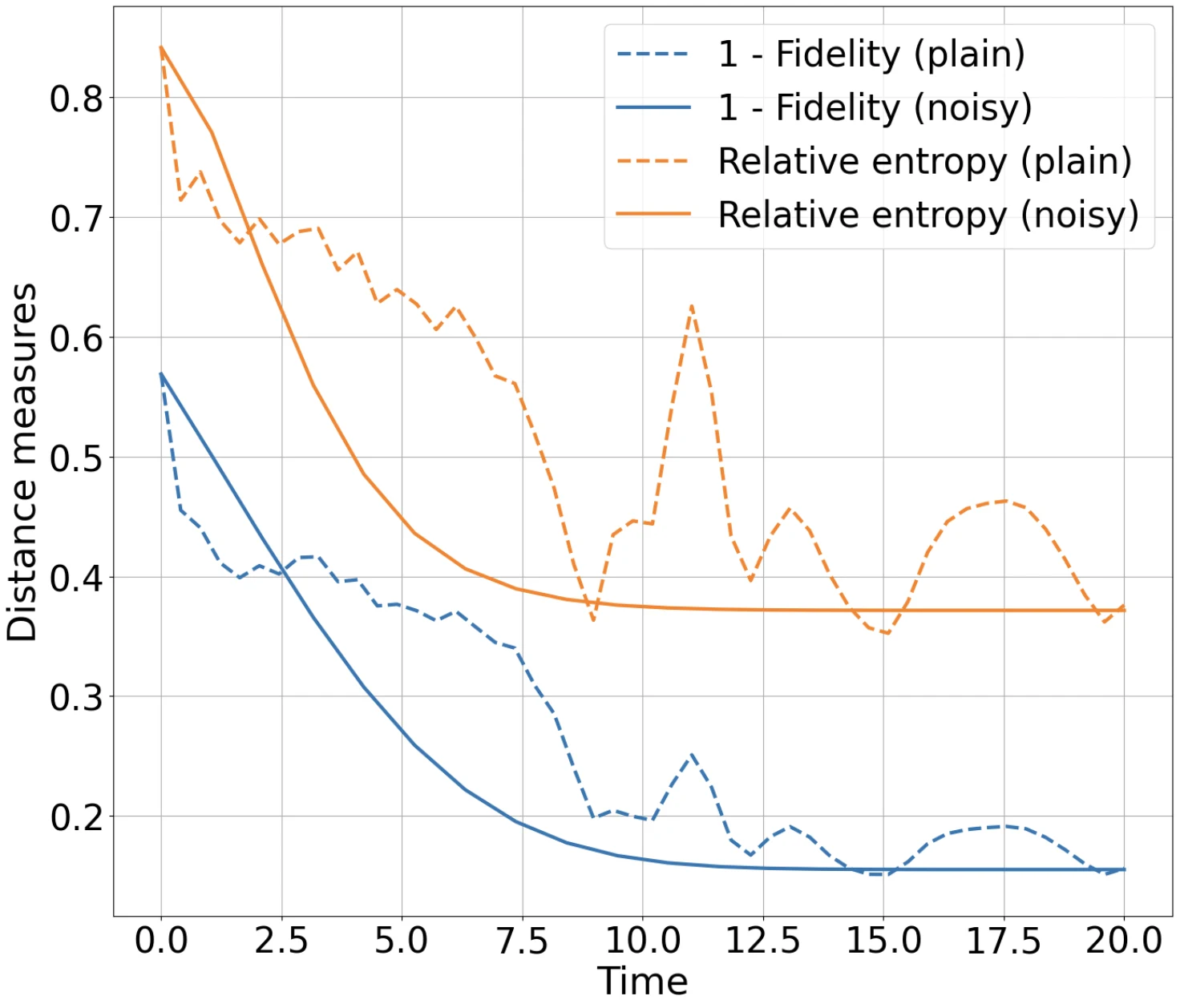
To quickly dissolve sugar, you don't need to stir carefully — just shake the glass. A similar principle works in quantum systems: noise, usually considered a disturbance, speeds up the transition to a thermal state. This is a state of complete chaos, where everything is mixed to the limit from the point of view of entropy — a measure of disorder.
Previously, noise was thought to interfere. But it turns out that without it, some systems cannot reach equilibrium at all.
Properly dosed noise works like a shake — helping the system shuffle everything faster.
This discovery is important for practice. Thermal states are needed for calculations, for example, to model materials. They are easy to verify, which means that today we can extract benefit from imperfect quantum machines. Paradoxically, the noise that engineers try to eliminate has turned out to be the key to the first useful quantum computations.
Original abstract
as written by the authors arXiv:2512.14842
In the current Noisy Intermediate-Scale Quantum era, noise is widely regarded as the primary obstacle to achieving fault-tolerant quantum computation. However, certain stages of the quantum computing pipeline can, in fact, benefit from this noise. In this work, we exploit the Eigenstate Thermalization Hypothesis to show that noise generically accelerates a fundamental task in quantum computing -- the preparation of Gibbs states. We demonstrate this behavior using classical and quantum simulations with Haar-random and phase-flip noise, respectively, on a spin-1/2 chain with a local Hamiltonian. Our non-integrable model sees ~3.5x faster thermalization in the presence of noise, while our integrable model, which would not otherwise thermalize, reaches a thermal state due to noise. Since certifying a local Gibbs state is relatively easy on a quantum computer, our approach provides a new practical solution to a key problem in quantum computing. More broadly, these results establish a new paradigm in which noise can be harnessed on quantum computers, enabling practical advantages before the years of fault-tolerance.
In some quantum models, without noise, the system freezes forever in its initial state — adding noise literally "turns on" its evolution.