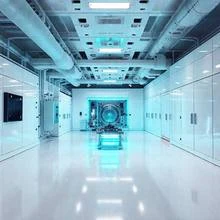
Heat dissipation is the process by which thermal energy moves away from a source, preventing overheating and maintaining stable operation. In everything from computer chips to quantum devices, managing heat is critical because excess thermal energy can cause performance degradation, physical damage, or loss of quantum coherence. The concept is central to thermodynamics and engineering, and it explains why systems as diverse as a laptop and a nuclear reactor require carefully designed cooling mechanisms.
History
The scientific understanding of heat transfer was formalized in the 19th century, with Joseph Fourier's 1822 work 'Théorie analytique de la chaleur' establishing the mathematical laws of conduction.
How it works
Heat is dissipated through three primary mechanisms: conduction, where energy transfers through direct contact between particles; convection, where a fluid carries heat away; and radiation, where energy is emitted as electromagnetic waves. In solid-state devices, heat often spreads via phonons—quantized lattice vibrations—and efficient dissipation requires materials with high thermal conductivity, such as copper or diamond, or engineered solutions like heat sinks and fans.
In practice
Heat dissipation is essential in designing microprocessors, LED lighting, and electric vehicle batteries, where inadequate cooling can lead to failure or reduced lifespan.
Fun fact
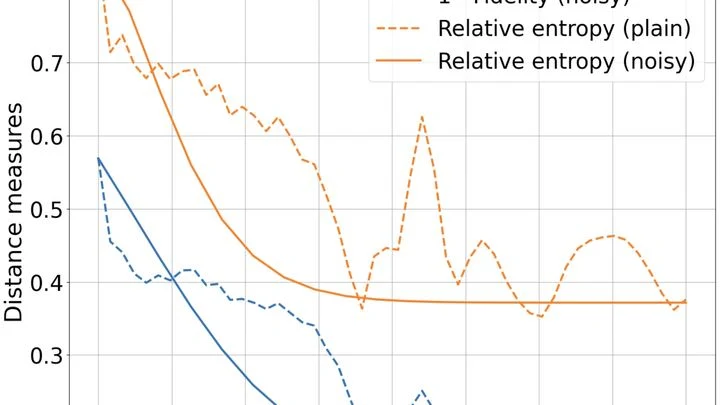
The quantum Mpemba effect, where a quantum system cools faster when starting from a hotter state, challenges classical intuitions about heat dissipation and has been observed in trapped-ion experiments.
A regular battery releases heat smoothly: what you store is what you get. The power is fixed once and for all, like a faucet that pours water in a single stream. But sometimes you don't need a steady flow; you need a short, powerful burst: to instantly heat a part, trigger a reaction, or dump excess heat.
A conventional computer computes by shuttling electric charges along wires. But can you compute with heat? A network of pipes carrying hot and cold water can perform simple logic operations if the pipes are connected in the right order.
In the first moments after the Big Bang, the universe resembled a boiling cauldron. According to one hypothesis, dark matter, the invisible substance that holds galaxies together, could have been born there.
In a glass of water, oil gathers into droplets: that's equilibrium separation dictated by chemistry. But there are systems where order arises not from rest but from a constant flow of energy.
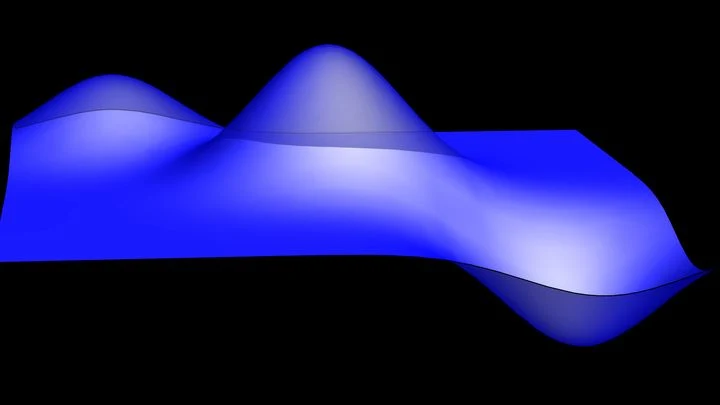
Glass lenses and mirrors appear perfectly smooth and still. But beneath the surface, a hidden life teems. Atoms in an amorphous material (a substance without a crystalline lattice) are packed haphazardly, and this disorder creates a complex energy landscape, like a mountainous region with countless hills and valleys.
In a hot mug, water sometimes freezes faster than in a warm one. This paradox is over half a century old and is called the Mpemba effect. It is usually attributed to fluid motion or evaporation. Now physicists have shown that a similar trick is possible without water, just through radiation of heat.
In boiling water you can see a prototype of a quantum trick: if part of the liquid turns into long-lived vapor bubbles, the main mass cools down. This is exactly what happens when you sharply jolt a system of interacting electrons: doublons flare up — pairs of particles that absorb excess energy and don’t decay for an astonishingly long time.
In the late 1990s, astronomers including Saul Perlmutter discovered that the universe is expanding at an accelerating rate. The cause was dubbed dark energy — an invisible force stretching the cosmos.
In a pot of soup, every grain is a tiny magnet that wants to flip opposite to its neighbor. Heat the soup, and the magnets start jittering, obeying the heat. But how do you know how unruly they are at each temperature? For an ordinary material, you'd calculate this on powerful computers by enumerating possibilities.
Ordinary water freezes as expected. But sometimes hot water turns to ice faster than cold — the Mpemba effect. Recently, a similar rule-breaking was found in quantum entanglement — the invisible link between particles discovered by Erwin Schrödinger.
A pot of soup forgotten on the stove cools to room temperature. It seems everything has come to rest. But if you look inside with a quantum magnifying glass, you'll find that water molecules haven't frozen: they continue their dance. It's just that now the dance is steady, not turbulent like when boiling.
A lithium-ion battery is like a multi-story building where lithium ions live on every floor. When you charge the battery, the ions move from floor to floor, and the whole building warms up a bit. Usually, this heat dissipates evenly, like from underfloor heating. But sometimes one spot gets too hot, and then the whole building can go up in flames.
Qubits in a superconducting quantum computer are like tightly stretched strings. When a particle from space or from a radioactive decay flies by, it strikes these strings and they start to vibrate. This vibration disrupts the fragile quantum states, and computations go awry.
In superfluid helium, a vortex is like a tornado in a bottle, but instead of water, it's a quantum liquid that flows without friction. Such a vortex doesn't dissipate on its own, so the question of where its energy goes has long remained open.
Two identical cars roll off the same assembly line. Body, wheels, steering — everything matches. Only one has a regular gasoline engine, while the other has a hybrid engine that can be tuned to the road. And the hybrid stalls after a couple of kilometers, while the gasoline one runs for tens.
Physical systems can compute. If you build a landscape of hills and valleys so that the lowest point corresponds to the answer, the system will roll there by itself, like a ball. The problem is that the bottom is often flat, and the ball crawls around for a long time before settling.
The authors propose nudging the ball to the right place before it even starts.
In the quantum world, the path to calm sometimes resembles a paradoxical race: starting further from the finish, the system reaches equilibrium faster. This effect, a quantum analog of the Mpemba phenomenon, is due to the rapid growth of entropy — a measure of disorder.
A quiet tube with a heated grid inside. The voltage on the grid is suddenly raised, and the tube starts to hum, sustaining itself. This is not a malfunction but a transition to another stable state, like a ball rolling over a hill into a neighboring hollow.
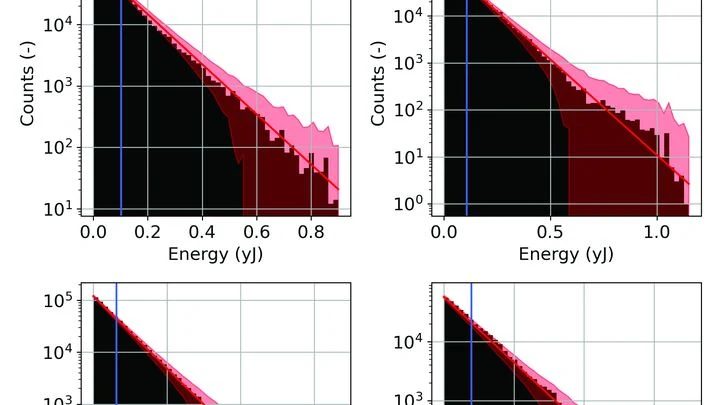
A quantum computer is like an orchestra, where each qubit is a musician playing their part. But every now and then, a cosmic ray bursts into the hall, and the violinist flinches, losing the rhythm. These particles from deep space pierce the chip, knock out extra electrons, and spoil the delicate quantum music.
Quantum materials are like finicky flowers: they only bloom in the cold. At room temperature, they hide their unusual properties, but when deeply cooled, they become superconductors or change their magnetic behavior. To understand how they work, you need to examine their atoms in the very cold where these properties reside.
A quantum computer is like a pot of boiling water: particles are jostling around chaotically, and you need to calm them down to get a useful answer. In a new study, physicists have devised a way to cool a chain of 19 quantum spins (tiny magnets) right on a real device.
Every machine, whether a car engine or a tiny nanocooler, runs with a jitter. Fuel burns unevenly, electrons slip through contacts off schedule, and the power needle on your instruments vibrates slightly. These vibrations are called fluctuations. They are not just noise: they tell you how stable a device is and how much energy it wastes.
To quickly dissolve sugar, you don't need to stir carefully — just shake the glass. A similar principle works in quantum systems: noise, usually considered a disturbance, speeds up the transition to a thermal state.
Everything tends toward equilibrium: tea cools, a pendulum swings to rest. The measure of this movement is entropy — growing disorder. But sometimes hot water freezes before warm. The Mpemba effect isn't just a curiosity: it shows up in the quantum world too. Scientists have devised a way to control this paradox.
A tiny seesaw weighing 1.5 nanograms oscillates not from the wind, but from the heat of its surroundings. Physicists nearly stopped it by cooling it to 0.006 degrees above absolute zero.
Two travelers head for the same destination. One starts closer but takes a winding country road. The other starts farther away but immediately hits the highway. The second arrives first. In quantum physics, this paradox is known as the quantum Mpemba effect: a state initially farther from equilibrium reaches it faster than one that starts closer.
Topological phases usually hide inside cryostats. Superconducting circuits, ultracold atoms, laser pulses: all of them shield quantum order from thermal noise.
Quantum entanglement is a fragile resource. Heat a system, and thermal fluctuations will tear the delicate threads of correlations: at a sufficiently high but finite temperature, the Gibbs state of a local Hamiltonian becomes separable, that is, representable as a probabilistic mixture of products of local states.
In a dilution refrigerator cooled to 170 millikelvin, a coherent state of the microwave field is born. This is laser light with minimal uncertainty: its amplitude and phase are defined as precisely as quantum mechanics allows.
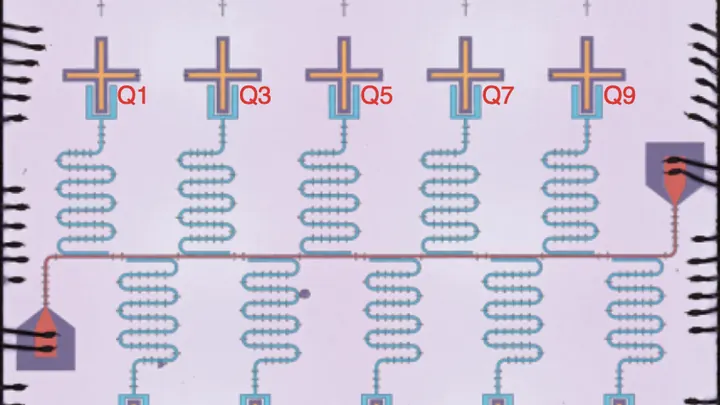
Five superconducting qubits on a chip: the stage for a performance of quantum chaos. Four qubits form the system, and the fifth acts as the environment, introducing dissipation. After a short evolution, the environment is discarded, leaving the system with an open quantum map, an operator that transforms the system's state.
Quantum entanglement is like an invisible spring between particles — squeeze one, and the other twitches, no matter where it is. In the new work, physicists built a model of four spins (tiny magnetic arrows) in a chain, where the end spins are held by a local magnetic field.