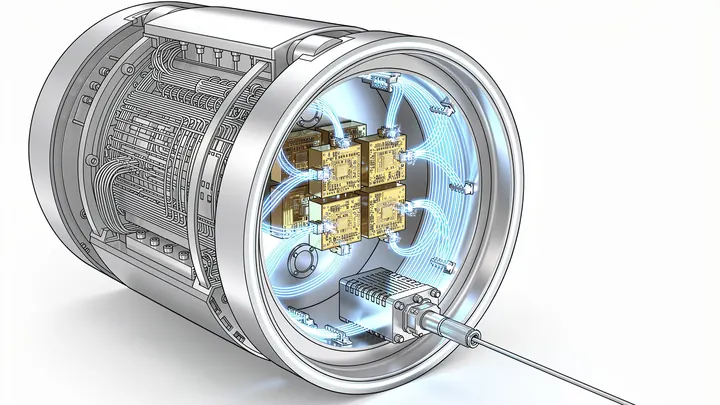
Quantum computing technology focuses on building processors that use quantum bits (qubits) to perform calculations that are intractable for classical computers. A major challenge is that qubits are extremely sensitive to environmental noise, requiring operation at temperatures near absolute zero (millikelvin range). Recent developments include using silicon carbide as a host material for qubits, which offers longer coherence times and potential for scalability, as well as innovative cooling systems that maintain the required ultra-low temperatures.
History
The idea of quantum computing was proposed by Richard Feynman in 1982 and independently by Yuri Manin in 1980. The first working qubits were demonstrated in the late 1990s, and silicon carbide qubits were first realized in the 2010s.
How it works
Qubits can be implemented in various physical systems, such as superconducting circuits, trapped ions, or electron spins on liquid helium. To function, they must be isolated from thermal fluctuations, which is achieved by dilution refrigerators that cool the processor to about 10 millikelvin. In silicon carbide, defects in the crystal lattice can trap single electrons, whose spin states serve as qubits. These can be manipulated with microwave pulses and read out optically. Cooling systems must also ensure that control wiring does not introduce heat, leading to designs with superconducting cables and specialized thermal anchoring.
In practice
Quantum computers are being developed for applications in cryptography, drug discovery, optimization problems, and simulating quantum systems that are impossible to model classically.
Fun fact
The dilution refrigerator used to cool a quantum computer can reach temperatures colder than deep space, just a few millikelvin above absolute zero.
A quantum lab is like a kitchen where the chef waits a day for the stove to cool down. Superconducting qubits only work at temperatures of a few hundredths of a kelvin, and each 'cool, measure, warm up' cycle eats a whole day. A team of engineers built a fridge the size of a melon, weighing 3 kg, that does the job in just two hours.
A superconducting quantum interferometer is a device that senses magnetic fields billions of times weaker than the needle of an ordinary compass. Inside it, there is a narrow bridge where superconductivity briefly breaks.
A quantum computer is like an orchestra: each musician plays their own part, but the slightest noise from the audience can throw off the whole ensemble. The particles that store information easily lose their coherence from thermal jolts or stray magnetic fields.
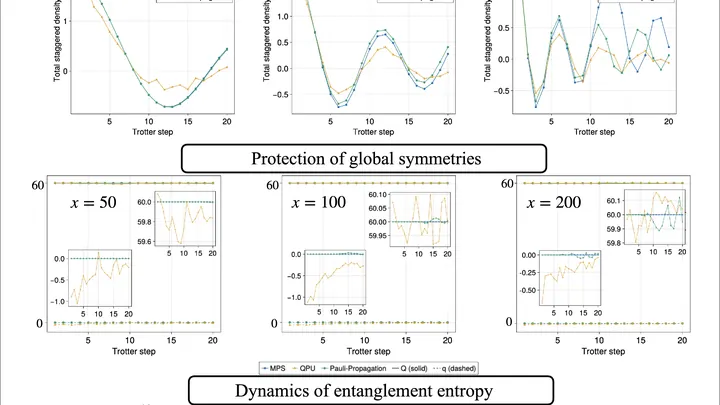
In a pot of soup, every grain is a tiny magnet that wants to flip opposite to its neighbor. Heat the soup, and the magnets start jittering, obeying the heat. But how do you know how unruly they are at each temperature? For an ordinary material, you'd calculate this on powerful computers by enumerating possibilities.
A tuning fork grows quieter not because someone stops holding it, but because the very hand that strikes it creates an invisible haze around it that damps the vibrations. A superconducting resonator behaves much the same way — a tiny track along which a microwave signal runs with almost no loss.
An ordinary kitchen thermometer shows the temperature at which mercury stops resisting electricity. For superconductors used in quantum computers, the critical temperature is like a quality passport: the higher, the better.
A quantum bit is like a spinning top that must keep spinning steadily for a long time. In germanium, researchers have learned to set such tops spinning, but the floor around them is always trembling: electrical noise knocks the spin off course.
Inside a proton, quarks are held together by gluons, like springs. Let go of one quark — the spring stretches and snaps, creating a new quark. That's the strong force at work, and simulating it in real time on a regular computer is nearly impossible: there are too many possibilities, all tangled together.
Enter the quantum computer.
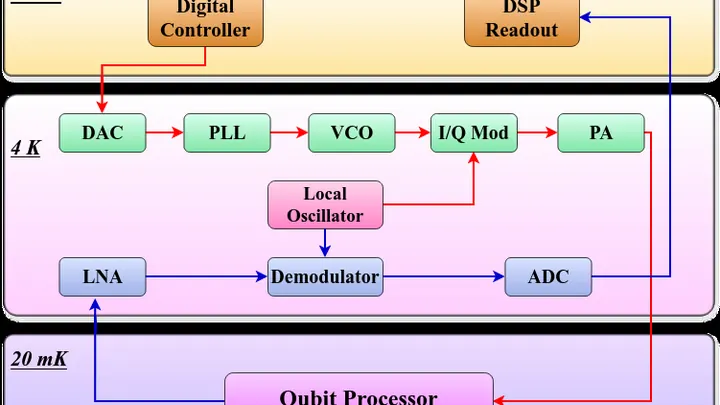
Quantum computers promise to solve problems beyond the reach of classical machines, but their heart, the qubits, requires ultra-low temperatures near absolute zero. Controlling qubits and reading out their states typically means working from a warm room, running many cables through the refrigerator.
A quantum computer is a machine where qubits replace ordinary bits. A qubit can be not just a 0 or a 1, but both at the same time. One way to make a qubit is to take an electron and make it hover above the surface of liquid helium. The helium is cooled to below two degrees above absolute zero.
A quantum computer is like an orchestra that has to tune its instruments before every piece. Tuning takes time and requires quiet — in our case, deep cold. For silicon chips with boron atoms, this tuning is usually done with microwaves, slowly and only at temperatures below 2 kelvin (minus 271 degrees Celsius).
A thermometer that doesn't lie for years. Ordinary resistance thermometers, even very accurate ones, start to err over time: the material ages, contacts oxidize, and readings drift. The new quantum thermometer works differently: it uses the rubidium atoms themselves as a reference.
To quickly dissolve sugar, you don't need to stir carefully — just shake the glass. A similar principle works in quantum systems: noise, usually considered a disturbance, speeds up the transition to a thermal state.
A qubit, the heart of a quantum computer, is like a soap bubble: the slightest puff and it bursts. On Earth, gravity pulls bubbles down, creating vibrations, and the thermal hustle of atoms adds jitter. Entropy, the measure of this chaos, destroys quantum information.
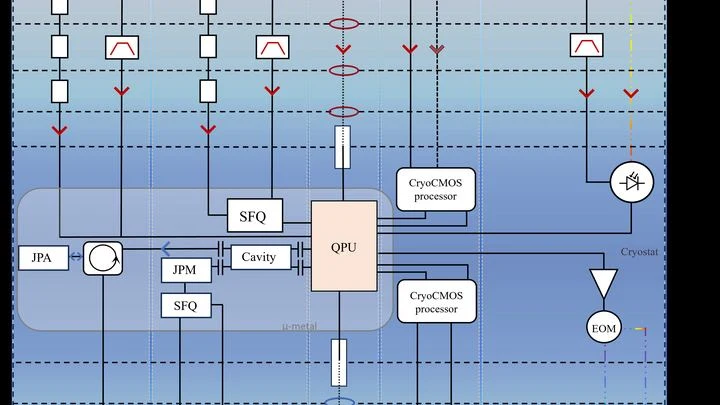
A superconducting quantum processor is like a microscopic metropolis locked in a cryogenic fridge: streets of superconducting lines, blocks of qubits. Each resident demands silence and cold, but expanding the city inside a single cryostat is like stacking skyscrapers in a cramped courtyard — wires heat the environment, noise builds up, coherence threatens to collapse.
Imagine an orchestra where every musician plays an instrument that breaks at the slightest warmth. The conductor is the quantum processor, and the musicians are the qubits — fragile carriers of quantum information. To keep them in harmony, you need a whole team of tuners sitting in the next room, sending commands through a soundproof wall.