Popular

Noise Helps Quantum Computers ⚡ экспресс

Original: "Noise-Induced Thermalization in Quantum Systems"
arXiv:2512.14842 · 2025-12-16 · CC BY 4.0 · ⏱ 1 min · Quantum Physics Statistical Mech
Quantum noise doesn't hinder, it helps create thermal states — just like shaking speeds up dissolving.
Abstract

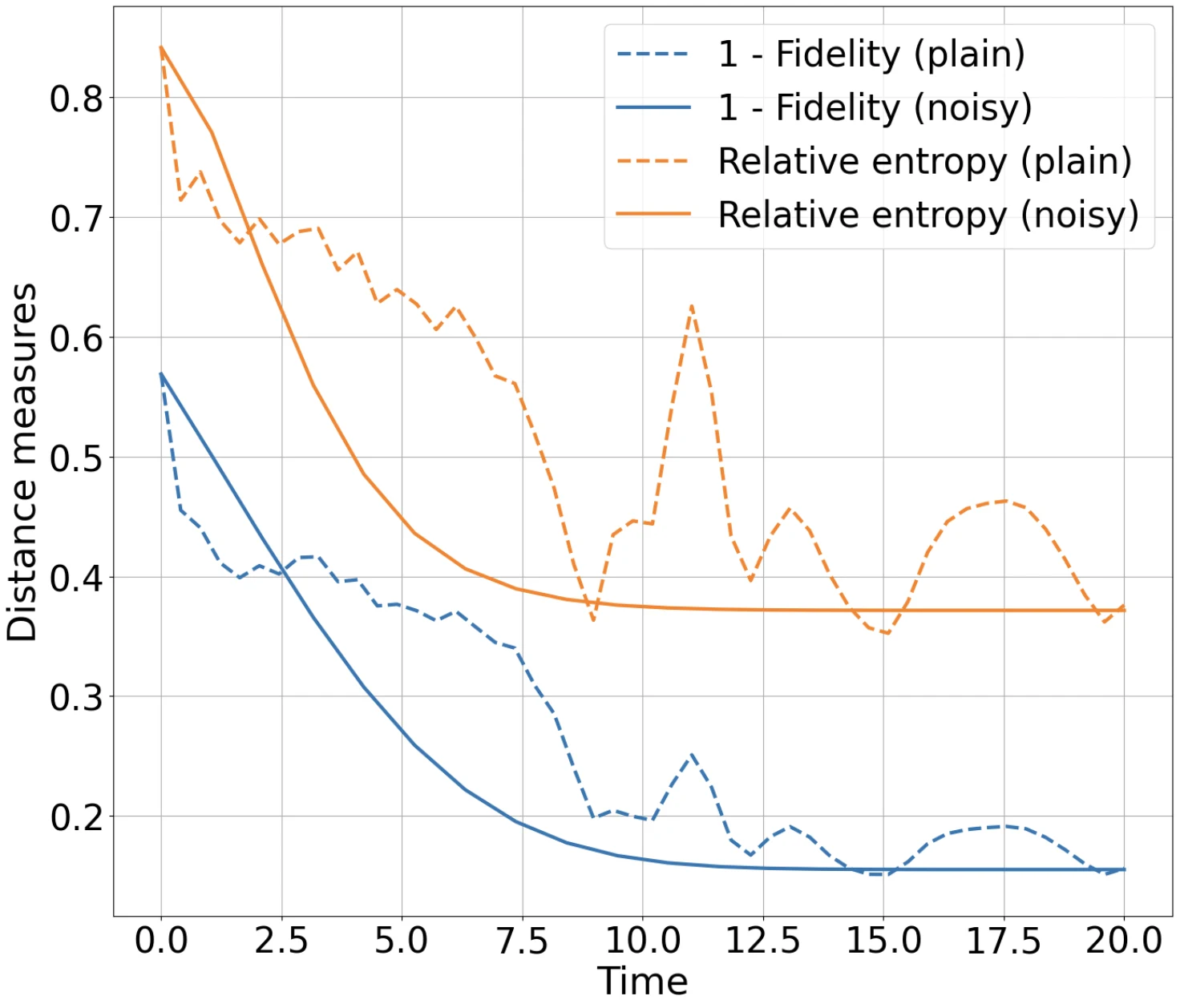
The work shows that noise in quantum circuits is not always harmful. Building on the eigenstate thermalization hypothesis (ETH), scientists demonstrated that noise speeds up the preparation of Gibbs states — an important class of quantum states. In experiments with a spin-1/2 chain, adding phase noise accelerated thermalization 3.5-fold in a non-integrable model, and forced an integrable model, which by itself never reaches equilibrium, to achieve it. This is like a catalyst: noise helps the system reach the desired state faster. Since verification on a quantum computer is easy, the method promises practical benefits long before full error correction.

Links in the knowledge graph 1

📄 Showing the "Simple" version — "Popular" is not ready yet. Add it to favorites to help prioritize it.

To quickly dissolve sugar, you don't need to stir carefully — just shake the glass. A similar principle works in quantum systems: noise, usually considered a disturbance, speeds up the transition to a thermal state. This is a state of complete chaos, where everything is mixed to the limit from the point of view of entropy — a measure of disorder.

Previously, noise was thought to interfere. But it turns out that without it, some systems cannot reach equilibrium at all.

In models where everything freezes without noise, adding noise literally "turns on" the mixing.

Properly dosed noise works like a shake — helping the system shuffle everything faster.

This discovery is important for practice. Thermal states are needed for calculations, for example, to model materials. They are easy to verify, which means that today we can extract benefit from imperfect quantum machines. Paradoxically, the noise that engineers try to eliminate has turned out to be the key to the first useful quantum computations.

🎯 In some quantum models, without noise, the system freezes forever in its initial state — adding noise literally "turns on" its evolution.

Scientists
Jacob BekensteinStephen HawkingLudwig BoltzmannEdward WittenJuan MaldacenaGerard 't Hooft
Tags
entropy
Laws
second law of thermodynamicsBekenstein-Hawking entropyBoltzmann distributionfirst law of thermodynamicsAdS/CFT correspondenceholographic principle
Original: arXiv:2512.14842 · CC BY 4.0 · bridge42worlds