How a Light Metal Twists Magnetism express
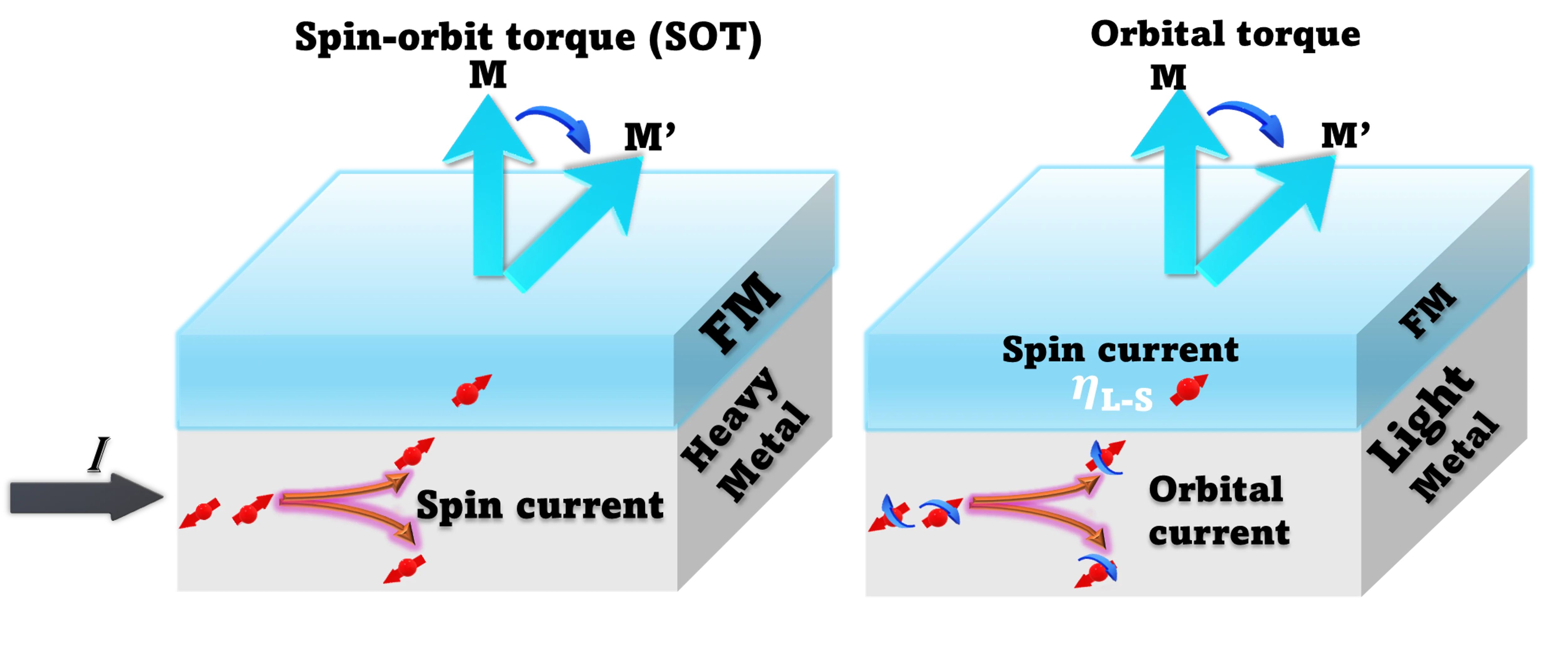
Usually, to flip a magnet in a memory device, heavy metals like platinum or tungsten are used. When current flows, their electrons are deflected sideways, like a crowd on an escalator, and this deflection imparts a rotational torque to the magnetic layer. But heavy metals are expensive and lose a lot of energy as heat.
Now researchers have replaced the heavy metal with a light one — vanadium nitride (VN). Here, a different mechanism is at play: the orbital Hall effect. Electrons in VN don't just fly; they move in orbits, like planets around the Sun. When current flows, the orbits tilt, and this tilt is transferred to the adjacent [Co/Pt]3 layer, where it becomes a conventional spin torque. That torque flips the magnetization.
Full switching required a current density of about 10⁷ A/cm² and an external magnetic field. Without the field, switching was only partial. The current density is comparable to tungsten-based devices, but the material itself is lighter and potentially cheaper. Calculations confirmed that VN has large orbital conductivity and small spin conductivity, meaning the orbital current indeed dominates.
This approach could underpin a new type of electronics—'orbitronics'—where information is carried by orbital angular momentum rather than spin or charge. It opens the door to more economical memory and logic devices.
Vanadium nitride is nearly as hard as steel but conducts electricity almost like a metal, so it's used in wear-resistant coatings and, as it turns out, in spintronics.