Vanadium is a transition metal with atomic number 23, known for its ability to form compounds with unpaired electrons that produce magnetic moments. In certain layered crystals, vanadium atoms arrange in ways that create exotic magnetic patterns, such as skyrmions or spin textures, which are of great interest in condensed matter physics. The element's versatility in oxidation states allows it to participate in a wide range of chemical and physical phenomena, from catalysis to magnetic data storage.
History
Vanadium was discovered in 1801 by Andrés Manuel del Río, but it was rediscovered and named by Nils Gabriel Sefström in 1830. Its magnetic properties in compounds have been studied extensively since the mid-20th century.
How it works
In vanadium compounds, the magnetic moment arises from unpaired d-electrons in the vanadium ions. When these ions are placed in a crystal lattice, their spins can interact through exchange interactions, leading to ordered magnetic states. By applying strain or altering the crystal structure, researchers can tune these interactions, sometimes turning a non-magnetic material into a magnetic one, as seen in studies where deformation induces magnetism in vanadium-based metals.
In practice
Vanadium compounds are used in redox flow batteries for large-scale energy storage, and its magnetic properties are explored for spintronic devices and magnetic sensors.
Fun fact
Vanadium is named after Vanadís, another name for the Norse goddess Freyja, due to the beautiful multicolored compounds it forms.
Picture an orchestra in which violins and trumpets play different parts but together create a powerful sound. In a crystal of the layered magnet Fe5GeTe2 doped with nickel, tiny regions of a different phase, Fe6GeTe2 nanoprecipitates, take on the role of those instruments. It is they, not the nickel itself, that keep the material magnetic at 478 kelvin, that is, at 205 degrees Celsius.
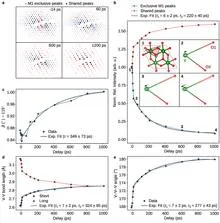
The camera captures not a race but a dance of atoms. In vanadium dioxide, the transition from an insulating to a metallic state occurs within trillionths of a second, yet until now no one had seen exactly how the vanadium and oxygen atoms move. Now, ultrafast electron diffraction has captured this route frame by frame.
A light beam usually travels in a straight line, but you can make it spin around its axis, like water swirling into a vortex as it drains. This 'twisted' light carries more information and is needed for ultra-fast communication and quantum computing.
An extra electron in a molecule is like a passenger barely hanging onto the step of a departing train. Such a 'passenger' turns the particle into an anion — a negative ion. Studying it is tough: the bond is weak, the electron cloud is diffuse, and any jolt can knock the electron off.
In a crystal, electrons are not distributed randomly. Their waves obey the lattice symmetry, like ripples on water taking the shape of a hoop thrown into it. The new work shows that at high-symmetry points, this ripple must have nodes — places where electron density is strictly zero.
In the world of magnetism, a simple dichotomy long reigned: ferromagnets, where spins point in one direction, and antiferromagnets, where they line up in a checkerboard pattern, canceling each other out. But a recent 'third player' — altermagnets — forced a rewrite of the rules.
Magnetic particles are attached to the surface of the diamond by DNA strands, like puppets on strings. They constantly dance under the thermal motion of the liquid molecules. The liquid's viscosity sets the pace: in honey, the particles barely tremble; in alcohol, they dance quickly.
The dance floor is full of couples waltzing. Usually, partners move in opposite directions: one steps forward, the other backward, to keep the overall rhythm.
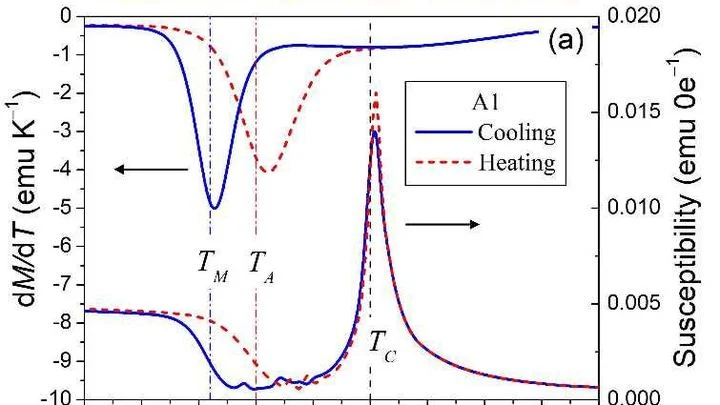
A metal bar suddenly becomes stiff when heated, and at the same time loses or gains magnetic properties. In alloys based on nickel and manganese, such transformations occur not smoothly but abruptly — atoms rearrange into a new order, and the material changes its behavior.
In the crystal Rb1-xV2Te2O, the spins of vanadium atoms arrange in a checkerboard pattern: each spin is surrounded by opposite spins. This pattern is called G-type antiferromagnetism. Neutrons passing through the sample scatter off this pattern and reveal its geometry, like light from a flashlight shining through blinds casting stripes on a wall.
In a molecule resembling chlorophyll and built from carbon, a metal atom at the center acts as a toggle. Shifting it by fractions of a nanometer can make the molecule glow, quench, or boost its brightness a hundredfold.
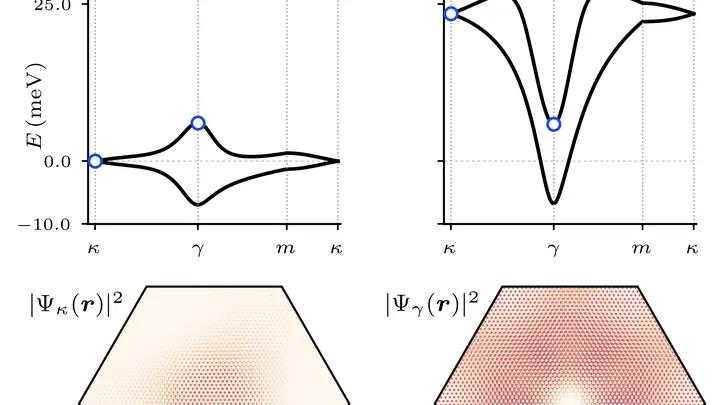
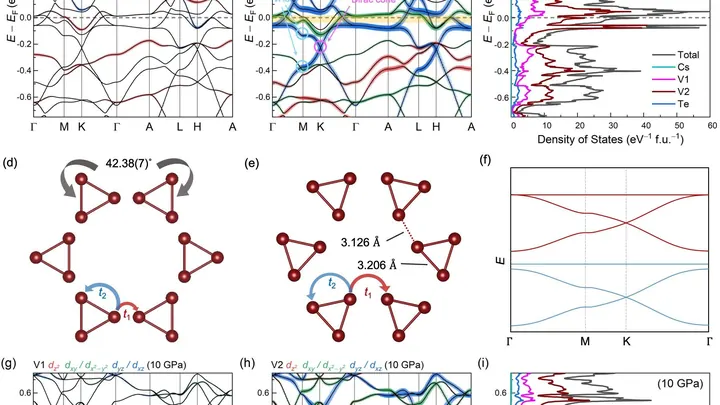
A woven basket made of willow twigs holds its shape thanks to the interweaving. A similar pattern, triangles linked into a flat network, has been found in a new crystal with the formula Cs₃V₉Te₁₃. Here, vanadium atoms form two sets of triangles that pierce each other like threads in fabric.
This pattern is not just pretty: it forces electrons to move along special "flat" energy pathways.
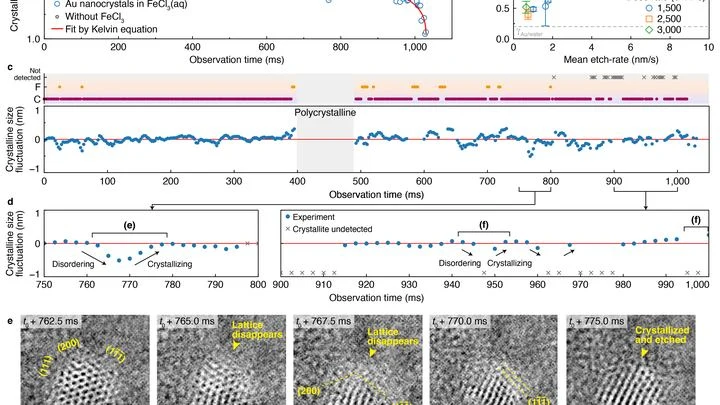
Gold nanoparticles in liquid are like tiny living creatures: they constantly change their internal structure, as if breathing. Scientists managed to peek into this process using an electron microscope that takes snapshots every millisecond, and a neural network that cleans the images from noise.
Magnetic moments in a crystal are like compass needles fixed at lattice sites. In the normal state, they line up in neat order, but if an electromagnetic wave strikes the crystal, the needles start to sway, like wheat stalks in the wind. These oscillations are called magnons, and they carry energy without the atoms themselves moving.
A chunk of nuclear fuel inside a reactor is not just a solid. When heated, the uranium atoms in it start to 'wiggle' their magnetic moments, and this motion changes thermal conductivity and other properties.
Turning light gases like hydrogen and nitrogen into metal is a long-standing dream of physicists. In a new experiment, nitrogen was compressed to 130–140 gigapascals (pressure equivalent to 14 million kilograms pressing on a fingernail) and heated to 3000°C.
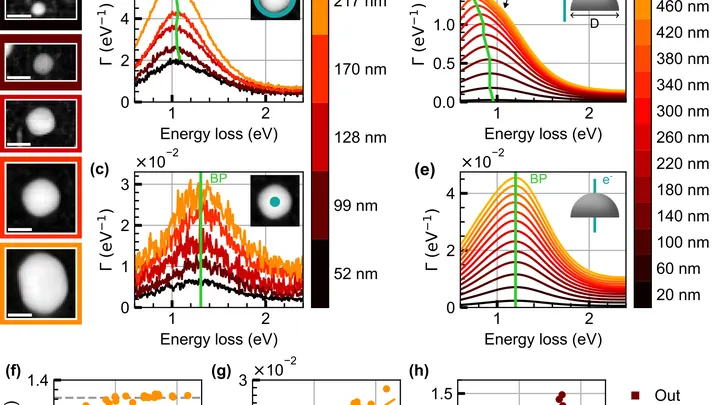
A tiny vanadium oxide particle behaves like a window with adjustable transparency: in one state it lets infrared light through, and in another it starts absorbing it. The switch doesn't happen abruptly but smoothly, like turning a dimmer knob to adjust a lamp's brightness.
A crystal one atom thick is like a sheet of paper you can write on with electricity. Such a material promises to become the foundation for tiny, fast microchips. But before putting it into production, you need to know exactly what it's made of. And that's where the usual formula falls apart.
Vanadium oxide is a material that can act as an insulator, not conducting electricity, or as a conductor, like a metal. The switch takes trillionths of a second, and that's what makes it a candidate for ultrafast electronic devices.
But exactly how it happens has long been a mystery.
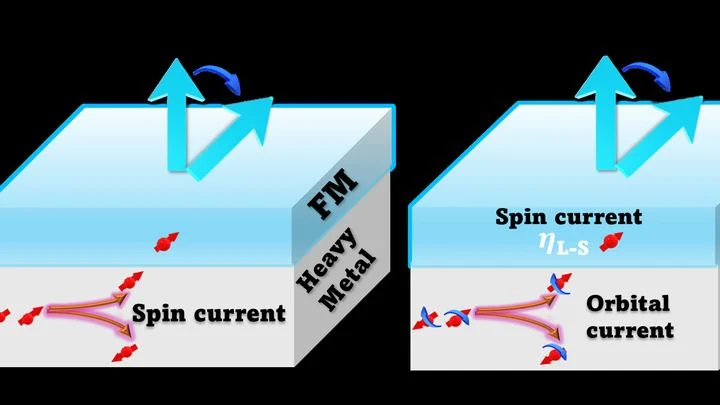
Usually, to flip a magnet in a memory device, heavy metals like platinum or tungsten are used. When current flows, their electrons are deflected sideways, like a crowd on an escalator, and this deflection imparts a rotational torque to the magnetic layer. But heavy metals are expensive and lose a lot of energy as heat.
Heat an ordinary quartz watch by ten degrees, and it will start losing seconds each day. Atomic clocks are more precise, but they take up an entire cabinet. Diamond with a tiny defect, a nitrogen vacancy, promises atomic-clock accuracy in the volume of a grain of sand.
Imagine a stack of pancakes where each pancake is magnetized, but the magnetization directions in adjacent pancakes are opposite. That's exactly how this new magnetic material is arranged: in each atomic layer, all magnetic moments — the atom's 'arrows'—point in one direction, while the next layer is magnetized in the opposite direction.
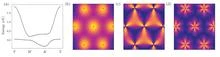
Electronic charge is a tumbleweed that moves camp depending on energy. In tungsten selenide (WSe₂) crystals, this is seen with utmost clarity: at a bias of −1.4 V, near the K point of the Brillouin zone, the maxima of tunneling current sit in the centers of hexagons, where there are no atoms.
A tuning fork sounds when you strike it. Its prongs vibrate, and you hear the sound until the vibration dies out. The quantum world has its own "tuning forks"—for example, a defect in diamond that responds to magnetic fields, and a carbon tube that can tremble at frequencies billions of times higher than the note A.