Currentdensity is a vector quantity that describes the amount of electric currentflowing through a unit area of a cross-section. It is denoted by the symbol J and is measured in amperes per square meter (A/m²) in the SI system. While electric current (I) tells you the total flow of charge, current density gives a more detailed picture of how that flow is distributed across a conductor's cross-section, which is essential for understanding phenomena like skin effect, current crowding, and the behavior of semiconductors.
History
The concept was formalized in the 19th century as part of the development of electromagnetic theory, particularly through the work of James Clerk Maxwell, who used currentdensity in his equations to describe how electric and magnetic fields interact.
How it works
For a uniform currentflowing perpendicular to a cross-sectional area A, the current density is simply J = I/A. In general, it is defined as the limit of the current per unit area as the area shrinks to a point, and its direction is the direction of positivecharge flow. In a conductor, the current density is related to the electric field by Ohm's law in local form: J = σE, where σ is the electrical conductivity. This local relationship is crucial for solving problems in electromagnetism and circuit design.
In practice
It is used in designing electrical wiring and circuit boards to prevent overheating, in semiconductorphysics to model transistor operation, and in electrochemistry to control plating rates.
Fun fact
In a lightning bolt, the currentdensity can reach millions of amperes per square meter, which is why the air around it becomes a glowing plasma.
Units by system: SI: ampere per square meter · CGS: statampere per square centimeter
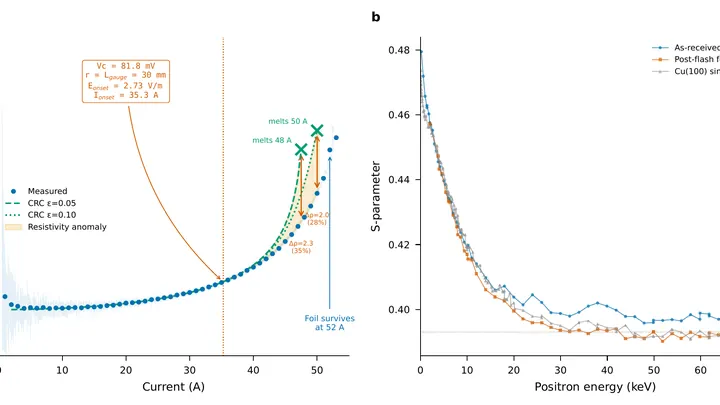
A copper wire under current is a familiar sight, but inside it something unexpected is happening. A strong electric current doesn't just heat the metal: it knocks atoms out of their rightful places, leaving behind tiny voids, as if a few balls were suddenly removed from a tightly packed arrangement.
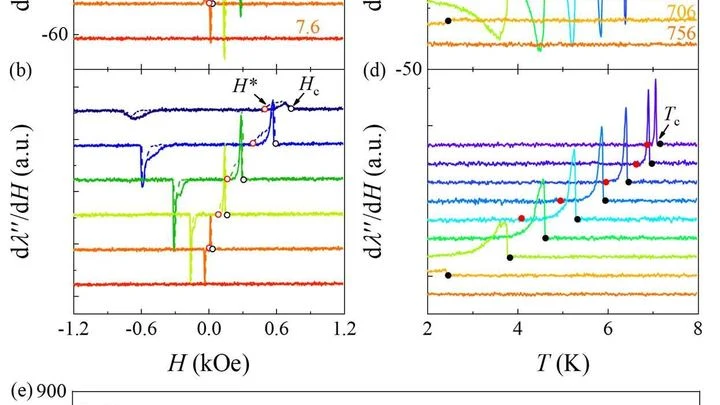
Ordinary magnetic measurements only see the surface of a superconductor, where barriers and viscous flows of magnetic field get in the way. Inside, in the so-called intermediate state, superconducting and normal domains coexist, separated by thin walls. These walls can oscillate, but hearing them directly has been difficult.
Electric current in a superconductor is like a crowd running down a frictionless corridor. But in type-II superconductors there are obstacles, tiny vortices of magnetic field, that the current shoves out of place. Once a vortex moves, resistance appears and the current drops.
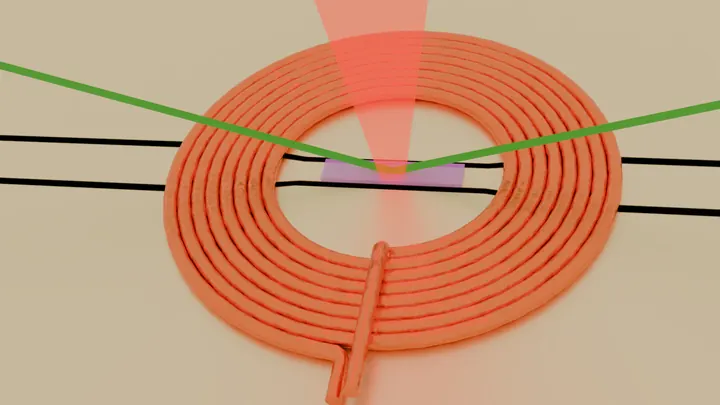
A tiny defect in a diamond crystal works like a sensitive antenna. When a magnetic field oscillates nearby, this defect, a nitrogen vacancy, responds by glowing. Previously, to hear the signal, you had to accumulate many repeated measurements, like listening to a whisper with your ear pressed against a door. Now a single short "look" suffices.
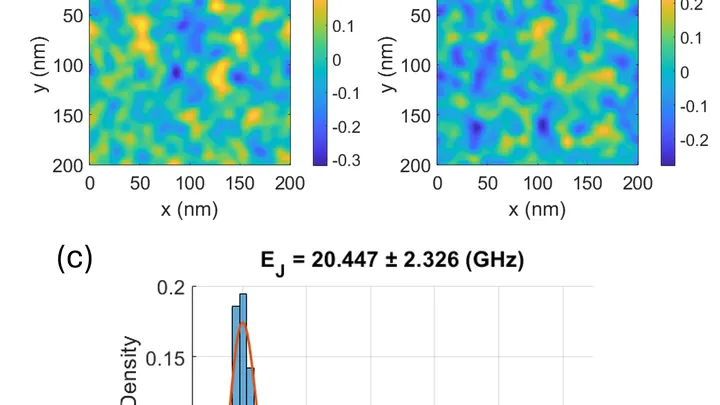
A quantum computer is built from many qubits, like an orchestra from musicians. But each instrument sounds a bit different. In superconducting qubits, the role of the string is played by a thin sandwich of aluminum and aluminum oxide: the Josephson junction.
A magnetic field is invisible, but you can make it 'glow'. To do that, take a tiny diamond with defects — places where a carbon atom is replaced by nitrogen and a neighboring lattice site is vacant. These defects, like sensitive compass needles, respond to the slightest changes in the magnetic field and emit light of varying brightness.