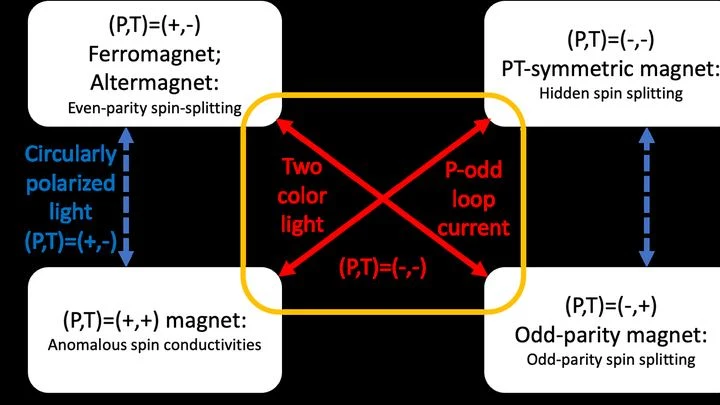
Hidden magnetic symmetry refers to a subtle ordering in magnetic materials that affects how heat and electricity flow through them, even though the material shows no net magnetization. Unlike conventional ferromagnets, where all magnetic moments align, these systems arrange their spins in patterns that cancel out globally—such as antiferromagnetic or more complex orders—yet the symmetry of this arrangement breaks time-reversal invariance in a way that influences transport properties. This hidden order can lead to anomalous Hall effects, magneto-optical responses, and other phenomena without any external magnetic field.
History
The concept emerged from studies of antiferromagnetic materials in the 1980s and 1990s, with key contributions from theorists like N. Nagaosa and collaborators who linked hidden magnetic order to topological transport phenomena.
How it works
In a crystal, electrons moving through a magnetic lattice experience a quantum mechanical phase (Berry phase) that depends on the spin arrangement. Even if the net magnetization is zero, the specific pattern of spins can create an effective magnetic field in momentum space that deflects electrons, producing transverse voltages or altered thermal conductivity. The symmetry of the spin lattice determines which transport coefficients are allowed to be non-zero, and breaking certain symmetries—like inversion or time-reversal—enables these effects.
In practice
These materials are explored for spintronic devices, where the absence of stray magnetic fields and the robustness of the hidden order could enable faster, more energy-efficient memory and logic elements.
A thin film of neodymium nickelate, fifteen nanometers thick, sits on a neodymium gallate substrate. Below one hundred eighty kelvin it behaves as an insulator: electrons are locked inside their atomic cells and cannot move freely.
Current in an ordinary metal flows like a crowd of people down a straight street: each electron is on its own, and if you turn on a magnetic field, the whole crowd shifts slightly sideways. This shift is called the Hall effect.
A thin magnetic film is like a row of toy soldiers with tiny magnetic arrows. In the flat world, thermal jostling quickly disrupts this formation — even the slightest heating destroys the order. This is the Mermin–Wagner prohibition: in two dimensions, continuous symmetry cannot survive at finite temperature.
Imagine a multilayered shell where metal and insulator layers alternate like pages in a book. Such a structure can make an object hidden inside invisible to an observer. Light bends around it as water smoothly flows around a smooth stone: no ripple, no splash — no reflection, no shadow.
Hot water sometimes freezes before cold: this is the Mpemba effect. In the quantum realm, a similar paradox appears: the more the equilibrium is disrupted, the faster it recovers. It's like fleeing from disorder (entropy) in reverse: the system rushes toward order, and a large initial imbalance only helps.
If you toss a handful of coins onto a table, they land in a jumble. But in some crystals, atoms arrange themselves into a pattern reminiscent of a woven basket — the kagome lattice. In the metal MgMn₆Sn₆, manganese atoms form such a lattice, and at room temperature they act like tiny magnetic needles.
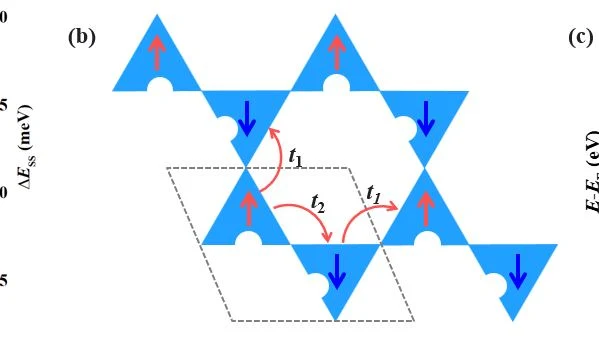
In a piece of ordinary magnet, all electron spins, tiny magnetic arrows, point in the same direction. It's a formation of soldiers facing their commander. This order is called a collinear altermagnet.
Gas falling into a black hole spirals inward like water down a drain. In this flow, magnetic loops constantly form and pop — somewhat like solar flares, but far more powerful. Each loop is a tiny magnet living its own life. When many of them are present, they start to influence each other: their north and south poles attract and repel in turn.
In a tiny magnet, information is encoded not in which way the arrow points, but in how the directions of its atoms alternate. In antiferromagnets, these arrows cancel each other out, so the material appears non-magnetic from the outside. The data is there, but you can't read it the usual way: the state is like a note written in invisible ink.
Honeycombs are built from identical cells, but tweak the shape of just one, and the whole structure gains new properties. Researchers did something similar to create a magnet without a single metal atom. They took flat carbon molecules shaped like triangles, triangulenes, and arranged them in a hexagonal lattice, just as bees build honeycombs.
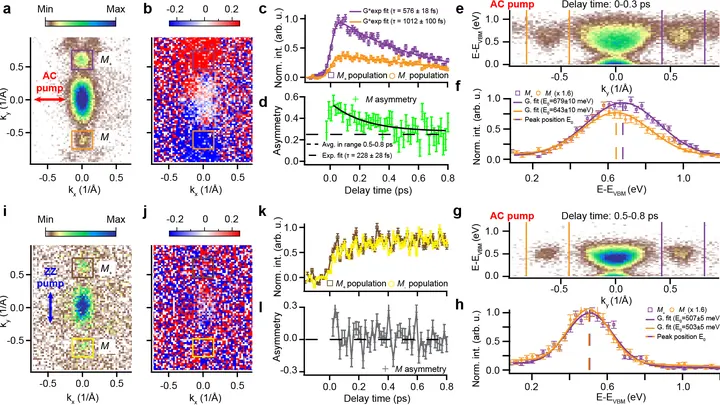
An ordinary sheet of black phosphorus looks like a layered cake of atoms. If you shine a regular lamp on it, nothing special happens: the electrons sit still, like spectators in a dark theater. But a short laser flash lasting millionths of a billionth of a second shakes up that theater.
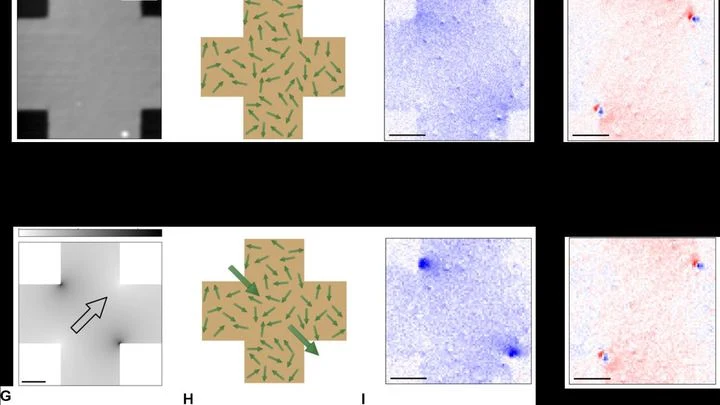
In a thin magnetic film, like in an overcrowded hall, each 'person' is a spin arrow that wants to align with its neighbors. But in the corners of the hall, jams occur — vortices where the arrows twist and cannot straighten out. These vortices live in pairs: one spins left, the other right, and together they prevent the hall from fully settling down.
Two sets of swings, rocking in opposite directions, don’t tilt the platform. Yet their motion creates invisible vortices that push a ball sideways. Alternagnets behave just like that: the atomic magnetic arrows are perfectly balanced, but a hidden symmetry bends the heat flow.
A flat magnet is like a thin sheet with waves of magnetization running across it. Under normal conditions, these waves quickly die out, but when a strong magnetic field is switched on, an unexpected signal appears in the material — sharp and narrow, like a shadow cast by the main wave.
An ordinary superconductor works like a perfect conductor: electrons pair up and flow without resistance. In the new material TaPtSi, the pairs are arranged differently: their internal symmetry is skewed, and when cooled below the critical temperature, tiny magnetic fields spontaneously emerge inside the crystal.
A laser flash strikes a copper oxide crystal, and magnetic excitation waves, magnons, ripple outward like ripples on water. For the first time, scientists traced their path from birth to disappearance with femtosecond precision (millionths of a billionth of a second).
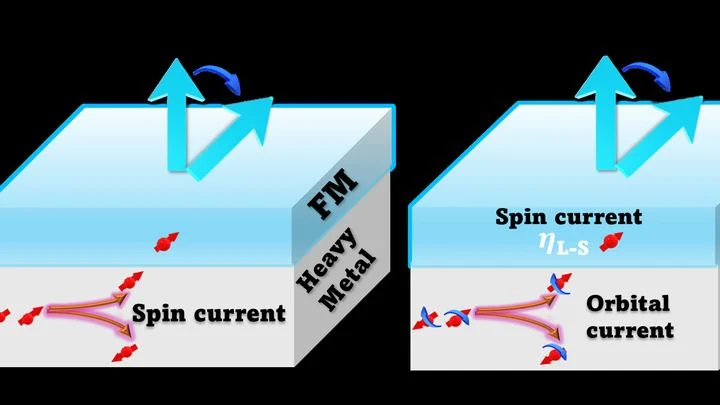
Usually, to flip a magnet in a memory device, heavy metals like platinum or tungsten are used. When current flows, their electrons are deflected sideways, like a crowd on an escalator, and this deflection imparts a rotational torque to the magnetic layer. But heavy metals are expensive and lose a lot of energy as heat.