Waves That Keep Their Formation express
Inside a fertilized frog egg, waves ripple, like ripples on water, but made of proteins that command cell division. These waves travel millimeters, even though the egg itself is less than a millimeter across. Previously, it wasn't understood why they didn't fall out of sync. It turns out the waves clear their own path.
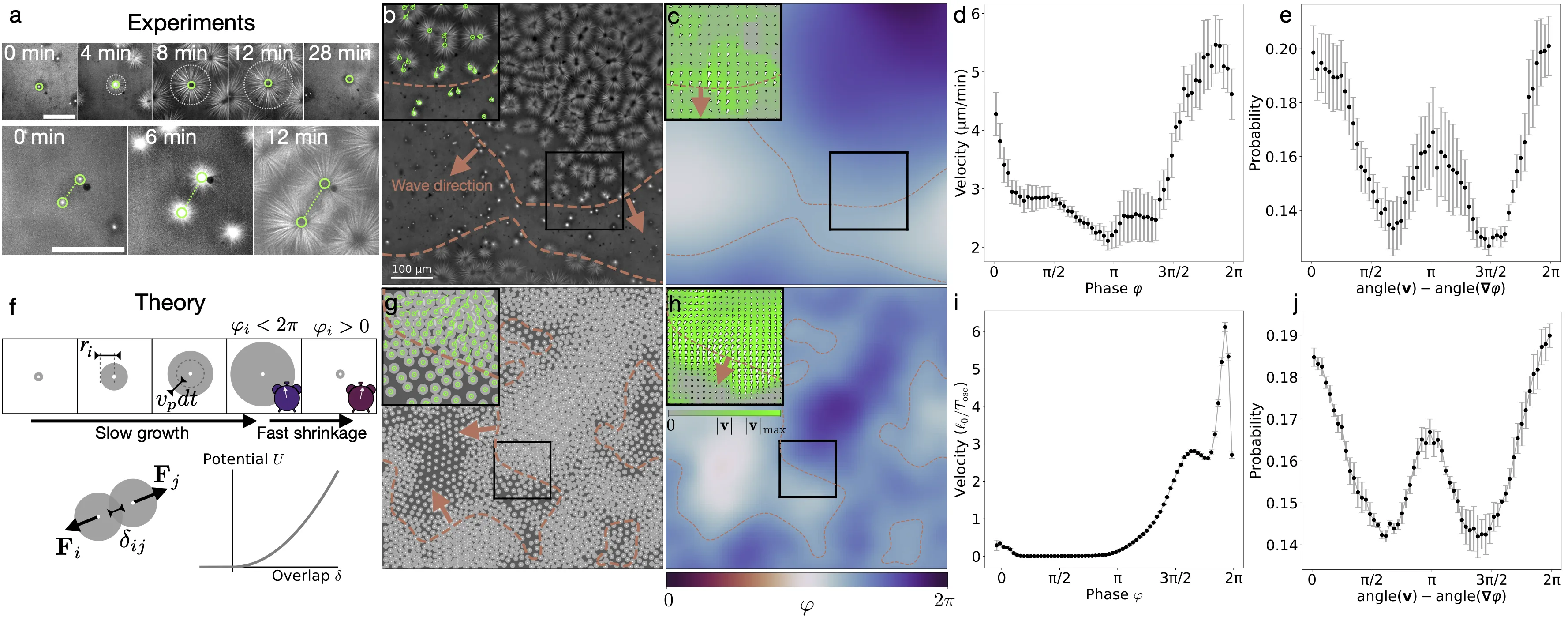
Proteins in the egg are packed into droplets that grow and burst in turn. When a droplet grows, it pushes its neighbors; when it bursts, it frees up space. The result is that the wave drives a fluid flow ahead of it. This flow nudges lagging droplets, so they fire on time. In this way, the wave maintains its own steady formation.
The scientists tested this using frog egg extract and a computer model. In the model, the droplets are virtual but behave like real ones: they grow slowly, collapse quickly, and jostle each other. The model showed that without flows, waves quickly die out, but with them, they march as evenly as soldiers in a parade. So mechanics isn't just a byproduct of chemistry: it's a faithful ally.
This mechanism might work not only in frog eggs but also in other living systems that need to synchronize processes over long distances — for example, in embryos or even in adult tissues. Order without a commander, yet as precise as clockwork.
Original abstract
as written by the authors arXiv:2601.05907
Oscillatory biochemical signals and mechanical forces must coordinate robustly during development, yet the principles governing their mutual coupling remain poorly understood. In syncytial embryos and cell-free extracts, mitotic waves propagate across millimeter scales while simultaneously generating cytoplasmic flows, suggesting a two-way interaction between chemical oscillators and mechanics. Here, we combine experiments in Xenopus Laevis cytoplasmic extracts with a minimal particle-based model to reveal a mechanochemical feedback that stabilizes phase wave propagation. In contrast to previous models of oscillatory active matter, an asymmetric size cycle, slow growth and rapid shrinkage, combined with size-dependent mechanical interactions generates a net particle displacement and flows aligned with the wave direction, which in turn drive a synchronization transition. Our results show that mechanical forces actively maintain the coherence of biochemical waves, providing a general mechanism for long-range order in oscillating active matter.
In a frog egg, the cell division wave travels at about 0.1 mm per minute — in an hour, it covers a distance hundreds of times the size of a single cell.