Chemotaxis is the directed movement of a cell or organism in response to a chemical gradient in its environment. It is a fundamental behavior observed across the biological world, from single-celled bacteria seeking nutrients to immune cells homing in on infection sites, and even in the guidance of growing nerve cells during development. The ability to sense and move toward or away from specific chemicals allows organisms to find food, escape toxins, and coordinate collective behaviors.
History
The term was coined by Wilhelm Pfeffer in the 1880s, who demonstrated that bacteria and plant sperm cells move toward chemical attractants. The molecular mechanism in bacteria was largely worked out by Julius Adler in the 1960s–70s.
How it works
Cells detect chemical gradients using surface receptors that bind to specific molecules. The binding triggers intracellular signaling cascades that modulate the cell's motility machinery. In bacteria like E. coli, this involves a biased random walk: when moving in a favorable direction (toward attractant), the cell suppresses tumbling and runs longer; when moving unfavorably, it tumbles more frequently to reorient. This temporal sensing mechanism allows even tiny cells to navigate gradients effectively.
In practice
Understanding chemotaxis is crucial for designing microrobots that navigate toward drug delivery targets, and for developing strategies to disrupt biofilm formation or control harmful algal blooms.
Fun fact
Some bacteria can detect and respond to chemical gradients as shallow as a few percent difference in concentration across their own body length.
Every fall, Issaquah Creek in Washington State turns into a maternity ward for thousands of salmon. The fish swim in, spawn, and die, and the water carries away their molecular traces: fragments of DNA, short-lived RNA, chemical marks on the genetic text. From September through November 2024, researchers collected a liter of water every week and ran it through a filter to catch those traces.
A courier carrying a package enters a dense forest of intertwined ropes. He needs to deliver the cargo deep inside, but along the way he loses strength, and each step becomes harder. This is what an enzyme looks like as it degrades a dense gel of biological molecules. Until recently, no one could simultaneously see how the courier moves and how the forest thins out.
The orchestra starts playing, but each musician has their own tempo. If everyone plays at roughly the same speed, the music flows in a continuous stream. But if one group of instruments plays noticeably slower than the rest, the sound gathers into a dense clump that slowly moves forward.
A worm a millimeter long eats labeled atoms, and then the dance begins. Every carbon and nitrogen atom that enters the body takes its place in the cells: it becomes part of proteins, fats, DNA. The scientists labeled the worm's food with the stable isotopes ¹³C and ¹⁵N, then switched it back to ordinary food and began tracking how quickly the labeled atoms leave the tissues.
The liver is an orchestra in which every cell plays its part from a shared score. Males and females have different scores: in males, the genes responsible for detoxifying foreign substances and steroid hormones sound louder, while in females, the genes for fat metabolism and bile acids do.
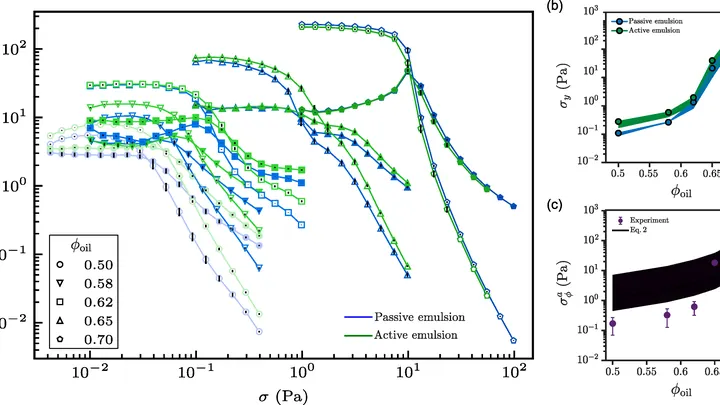
An oil droplet in water is like a ball in a crowd. When the crowd is sparse, the balls move apart freely. But if there are many people, each is squeezed by its neighbors, and the whole mass behaves like a single body. That's roughly how an emulsion works — a mixture where oil droplets float in water or vice versa.
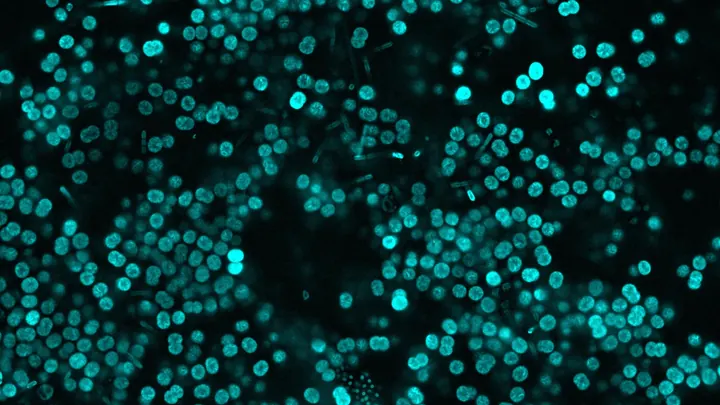
In a thin glass chamber filled with water, life is boiling over: millions of tiny bacteria Thiovulum sp. ST, freshly isolated from a natural spring, start moving as a single organism. At first, they are evenly distributed, but within a few minutes the water begins to stir — large vortices appear, just like those in a pot of soup heating up on the stove.
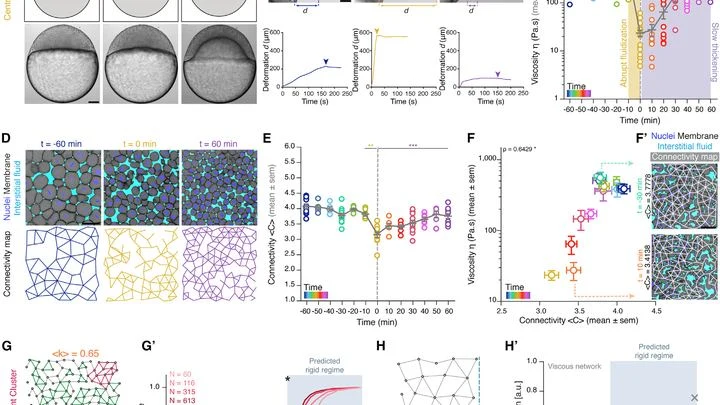
Epithelium lines our organs like tiles on a floor. At rest, cells cling to each other, and the tissue is elastic. But during embryonic development, wound healing, or tumor growth, this layer begins to flow like thick honey. What exactly triggers such softening?
Hot water sometimes freezes faster than cold. Ice forms more quickly from boiling water. This paradox, discovered by schoolboy Erasto Mpemba, long puzzled physicists. It turns out: the farther a system is from equilibrium, the faster it relaxes back to it.
The Mpemba effect remains controversial today: too many variables, hard to reproduce.
A kitchen mixer runs at a single speed, but start jabbing the button and the mixture whips up differently. Chemical reactions behave much the same way when the rates of their individual steps are not constant but pulse over time.
Cooking a complex dish requires a clear recipe: first chop, then sauté, add spices at just the right moment. Chemical transformations also follow step-by-step recipes — mechanisms where atoms of carbon and hydrogen rearrange in a strict order.
Previously, neural networks often invented nonexistent steps, like a whimsical cook swapping salt for sugar.
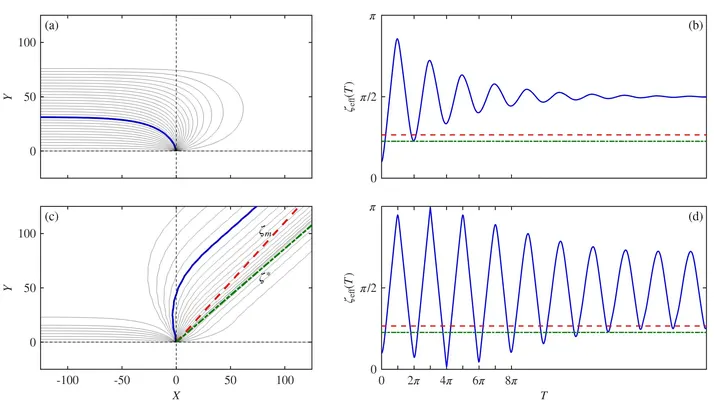
A colony of cells resembles a squad blazing a trail through unknown terrain. In living tissue, this role is often played by chemotaxis — movement along a gradient of a chemical that the cells themselves secrete. Earlier models described homogeneous groups, but in reality, different cell types interact.
Forget the flat sheet: embryonic tissue is a dynamic landscape of hills and folds. On convexities, cells stretch; in concavities, they compress, as if performing a dance governed by laws eerily similar to spacetime curvature.
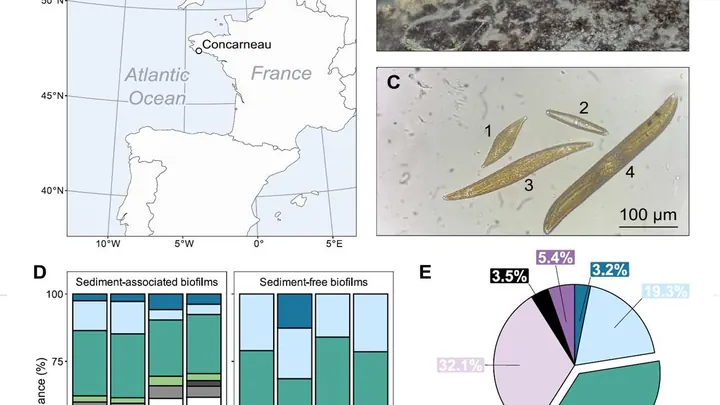
In the coastal shallows, where water retreats and returns, life follows the rhythm of the sun. The brownish film on the mud's surface is not just dirt but a dense community of tiny diatoms. By day they get plenty of light for photosynthesis, but when the sun gets too intense, a chemical storm brews inside the cells.
A living sheet of cells resembles a crowd on an escalator. In a calm state, everyone moves smoothly, but as soon as a crush occurs, movement comes to a halt. Similarly, cell layers under load can suddenly stiffen, turning from a pliable mass into an elastic scaffold.
A tightly stretched sheet lies on a table for days. Outwardly it's still, but the fabric fibers retain tension — loosen one edge slightly, and wrinkles will run across it, rearranging the whole pattern. That's roughly how a layer of epithelial cells behaves at rest. It doesn't just freeze; it accumulates mechanical stress — a kind of cellular memory of past movements.
A cell crawls over a gel (sometimes viscous, sometimes elastic) and decides on its own when to speed up. It doesn't just glide: its internal chemical motor (noise in gene expression can affect the production of 'fuel') pushes the leading edge, while the rear detaches from the substrate.
In the freshwater lakes, cyanobacteria Microcystis often cause toxic blooms. They gather into colonies — elastic little spheres, like dense jelly. The cells are glued together by a special substance based on carbon, acting as a powerful natural adhesive. Scientists tested these "jelly balls" for the first time and found their strength astonishing.
If you scatter seeds haphazardly, the seedlings will tangle into chaos. But if you lay them out in neat rows, the field will grow in an orderly fashion. A similar principle works with bacteria. Colonies of elongated cells usually churn with disordered flows, but scientists have found a way to impose order from the very start.
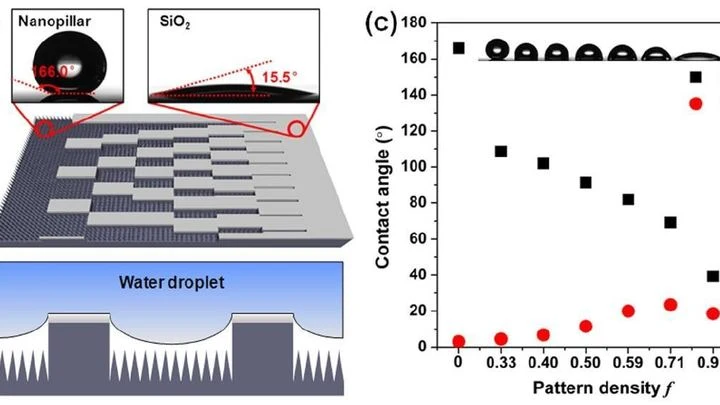
A drop of water on a table usually sits still. But make the table slightly softer on one edge and stiffer on the other, and the drop will crawl toward the stiffer side. This phenomenon is called durotaxis: the liquid itself chooses where to flow, without pumps or electricity.
This trick works because the surface under the drop is not uniform.
Imagine a city where streets are not straight but winding, with dead ends and hidden passages. A bike courier will take much longer to deliver a package than in a city with a regular grid of roads. Similarly, molecules inside living tissue: their path depends on how "tangled" the tissue structure is.
Scientists built a model that describes the movement of molecules in such a "tangled" environment.
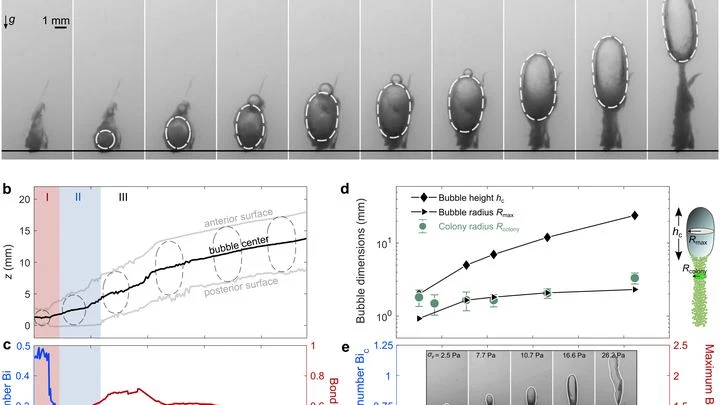
Yeast are trapped in a clear gel, like raisins in jelly. They can't move on their own, but soon they start rising to the top. The secret lies in their own homemade fizz.
During fermentation, yeast release carbon dioxide. In a thick medium, the gas doesn't escape but accumulates until bubbles form.
Inside a cell, there are tiny liquid droplets, like oil droplets in water. They form from proteins and RNA and serve all sorts of purposes, from storing molecules to speeding up reactions. But if droplets start merging with each other, you'd end up with one big puddle, which would wreck the cell's organization.
An amoeba turns left. For a long time, this was considered the result of a rigid chain of causes, like dominoes. But at the core of matter, there's a gap for freedom. The 'Agent Choice via Quantum Flux' model shows: each decision corresponds not to one, but to many quantum histories.
A colony of cells is like a city that grows from its outskirts: new houses appear where there's more space. Inside, it's crowded, and construction stalls. Similarly, cells divide more often at the edge, where neighbors squeeze them less. Scientists modeled this without any chemical commands — only mechanics.
In the model, each cell is a ball that presses on others.
When a crowd of bacteria (mostly composed of carbon) gathers in a droplet of water, a synchronized round dance begins: millions of tiny ones glide along giant ellipses, like dancers on a ballroom floor. Without a conductor, complex patterns emerge from simple movements.
In a thin film of water squeezed between two glass plates, bacteria live. Oxygen reaches them only through one wall, like air entering a room through a single window. When bacteria are few, they pay no attention to this: some stick to one wall, some to the other, and the picture is symmetric. But once they multiply, everything changes.
The tiny green alga Chlamydomonas spends its life rowing with two flagella toward light, like a swimmer heading for shore. It senses light with a photoreceptor protein, and behind it lies a red spot — the 'eyespot'—which casts a shadow and helps the cell figure out where the light is coming from.
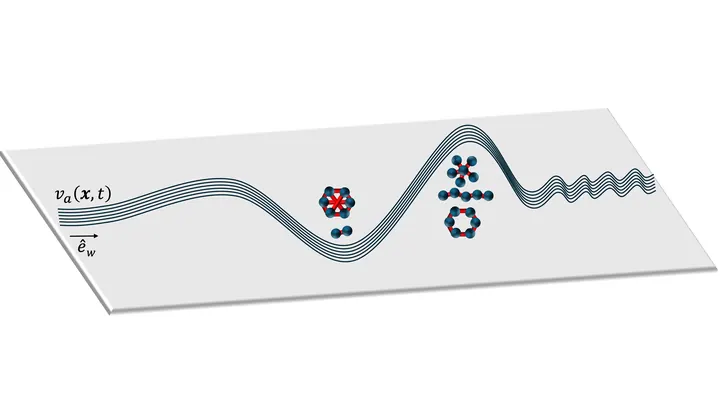
Polymers are long threads of carbon and hydrogen atoms. In living cells, they encounter streams of chemical signals that pulse like the surf. Long chains and closed rings behave like skilled surfers: they catch the wave and glide with it. Short fragments and tight coils, counterintuitively, move strictly against it.
Microbial communities are like a noisy orchestra: thousands of instruments, and it's hard to tell who's playing the lead. In the gut, ocean, or soil, millions of bacterial species live, and scientists need to figure out which ones truly matter for human health or soil fertility.
The new approach works like smart laundry sorting.
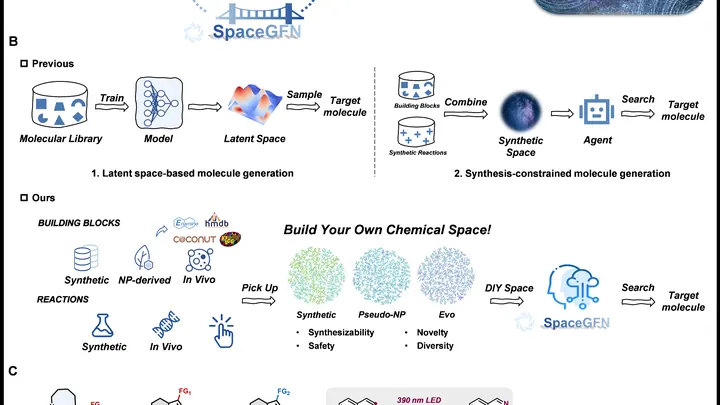
Previously, generative models for drug discovery worked like an artist painting without choosing a canvas. They learned from existing molecules and simply produced similar ones, without considering how the space of possible compounds is organized. SpaceGFN changes the approach: now chemical space is a construction set where the user specifies the parts and the assembly rules.
When you cut your finger, skin cells start working in concert: some divide, others crawl toward the wound, and still others pause. But exactly how a cell decides what to do next depends on its internal "schedule"—the cell cycle.
A bacterium in a drop of water is looking for food. Around it, there's a chemical gradient: more food molecules on one side, fewer on the other. How should it move to reach the tasty spot fastest? It could steer smoothly, like a cyclist dodging a puddle. Or, like a bacterium, it could periodically stop, tumble, and swim off in a random direction.
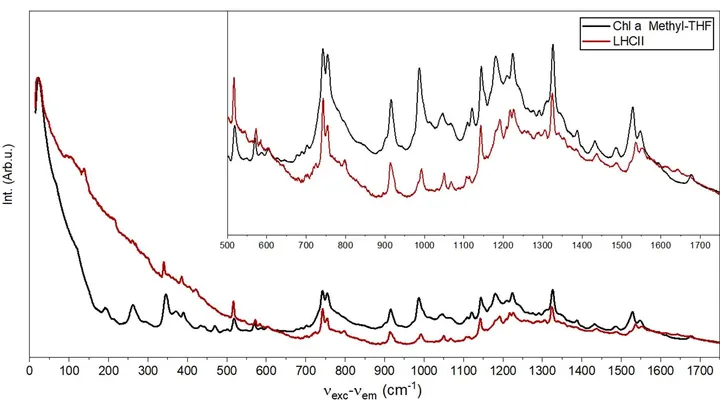
When a sunbeam hits a leaf, a relay race begins inside it. The energy of light passes from one chlorophyll molecule to the next until it reaches the reaction center — the place where the chemistry of life kicks off. This relay runs with astonishing accuracy: nearly every quantum of light finds its way.
A drop of ink in a glass of water spreads out on its own. But if the ink were made of tiny motors, they wouldn't just spread: they'd crawl, jostle, and cluster into swarms. Such self-propelled particles are called active. You can assemble them into molecules like beads on a bracelet. And here's the surprise: the order of beads on the bracelet changes everything.
A tumor doesn't stay put. Individual cells or whole groups break off and set off on a journey through the body. Some crawl solo, like scouts; others stick together, like a flock. Scientists built a computer model to understand how these cells pick a direction.
In the model, cells respond to two signals.
As an embryo grows, its cells don't just divide: they constantly touch their neighbors, like people in a crowded bus. The strength of these contacts determines where a cell moves and what shape the tissue takes. Scientists studied how cell 'stickiness' changes during the earliest stages of development.
A swimmer in a pool of syrup moves differently than in clear water: each stroke is harder, but you can push off more strongly. Roughly the same goes for single-celled organisms — tiny rowers that propel themselves through fluid using flagella.
An epidemic is like a forest fire: the flames race toward where there are more dry branches. Similarly, a virus spreads faster where people live in closer quarters. But old mathematical models described infection as an ink blot spreading evenly across paper.
In the mud at the bottom of a pond live bacteria that carry tiny magnetic compass needles inside them. These needles are chains of magnetite crystals that help the bacteria swim along Earth's magnetic field, like a compass needle, in search of better conditions.