A magneticwave is an oscillatory excitation in the magnetic order of a material, most commonly a magnon — a quantized spin wave. In a magnetically ordered solid, the spins of atoms are aligned; a magnetic wave is a collective disturbance where neighboring spins precess and propagate through the lattice, carrying energy and information without moving charge. These waves are the magnetic analog of sound waves in a crystal lattice, but they involve spin rather than atomic displacement.
History
The concept of spin waves was introduced by Felix Bloch in 1930, who described them as collective excitations in ferromagnets. The term 'magnon' was coined later, in the 1950s.
How it works
In a ferromagnet, spins are aligned in the ground state. A perturbation tilts one spin; exchange interactions between neighboring spins cause the tilt to propagate as a wave. Quantum mechanically, the wave is quantized into quasiparticles called magnons. Magnons have a dispersion relation — energy versus momentum — determined by the material's magnetic interactions. They can be generated by microwaves, heat, or spin currents, and they interact with electrons, phonons, and other magnons.
In practice
Magnons are used in spintronics for information processing and in magnonic devices that aim to replace electronic circuits with wave-based logic, offering lower energy consumption.
Fun fact
Magnons can be used to create 'magnon lasers' — coherent sources of spin waves — which have been demonstrated in laboratory settings.
A room of funhouse mirrors: you stand in the center, and the echo of your voice comes back from an unexpected direction, amplified and distorted. That is how spin waves in a thin magnetic film, excited by an antenna, reflect off defects and irregularities, creating a tangled pattern of fields.
When a star many times heavier than the Sun dies, it collapses and explodes as a supernova. This is not just a flash of light — the entire process, from core collapse to the ejection of the outer layers, makes space itself tremble. These ripples are called gravitational waves.
The very first moment of the universe's existence is like a taut string suddenly struck. It vibrated, and those oscillations froze into galaxies and voids. But physicists suspect there were other vibrations — fast, local, almost like a drumroll against a slow melody.
A bell rings not from the strike but from a fleeting shudder of space. A gravitational wave, like ripples on a pond, passes through a massive magnet, and it deforms ever so slightly. That deformation can be turned into an electrical signal.
The early Universe was like a rapidly cooling ocean. At colossal temperatures, everything was one — quarks, electrons, forces all blended into a symmetric 'steam.' But as it expanded and cooled, this steam condensed, phase transitions cascading one after another like water turning to ice.
A quantum particle traveling around a closed ring leaves two distinct 'records' along its path. The first is like a fingerprint on a doorknob: it remains unchanged no matter how many times you turn the knob, and it only tells you about the shape and material.
A giant drum has just taken a hit. Its membrane is still trembling, but besides the main boom, a fine ripple spreads across it — someone ran a finger over the taut skin. In much the same way, in the first moments after the Big Bang, spacetime vibrated not only with the "roar" of expansion but also with the tension of suddenly emerging magnetic fields.
In the first moments after the Big Bang, the universe was a boiling cauldron. But then, according to a new hypothesis, it suddenly cooled dramatically — far more than previously thought. In this icy world, dark matter particles, like tiny pendulums, froze and did not begin their oscillations.
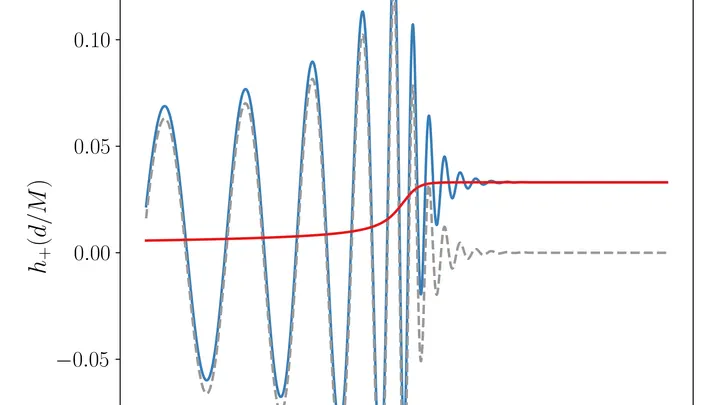
A black hole collision isn't just a burst of gravitational waves; it also leaves a lasting trace: an eternal curvature of spacetime — gravitational memory. Like a boat on water leaves a lingering wake, the cosmos 'remembers' the catastrophe.
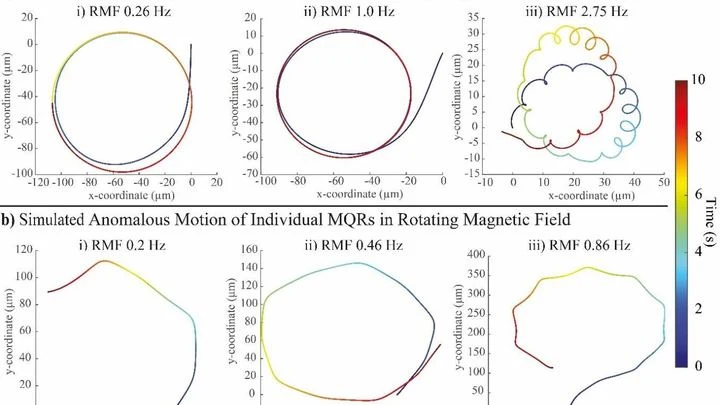
A small ball with an iron core lies on a surface while a magnetic field spins around it. The ball starts rolling like a wheel and usually goes in the direction the field rotates. But sometimes it suddenly turns around and rolls the other way — against the field.
The edge of a magnet works like a guitar fret: a string pressed near the edge sounds different, with a richer set of overtones. Magnetic waves in a thin strip of nickel and iron behave in much the same way.
If you compress a plate with accordion-like cells, a kink wave runs through it, like a wrinkle in a rug when you push it with your foot. Such waves can switch the material between two stable shapes, and this is the basis of mechanical memory. But if a table leg gets in the way of the wrinkle, it gets stuck. In a new study, researchers showed how to nudge it loose without brute force.
Toss a handful of pebbles into a pond, and the spreading ripples intersect, creating splashes and calms. That’s roughly how gravitational waves, predicted by Einstein, behave. Except it’s not water that’s oscillating, but spacetime itself.
If you toss a stone into a pond, ripples spread across the water. Tiny magnetic crystals also host waves — except it's not water that oscillates but the direction of magnetization. These are called spin waves. They travel through the crystal like ripples on a surface and can carry information.
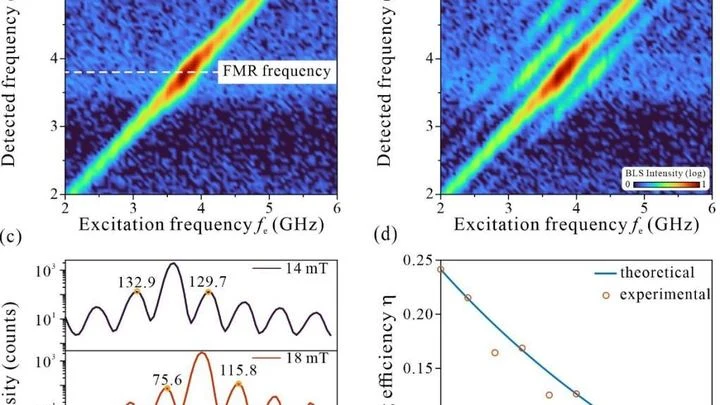
Waves in magnets resemble the vibrations of a string: if you pluck a string, it sounds a single note, but with a strong pluck, overtones appear — sounds at multiple frequencies.
A sugar solution can twist light — many have seen this in polarization experiments. Surprisingly, a similar trick appears in the fabric of the cosmos itself.
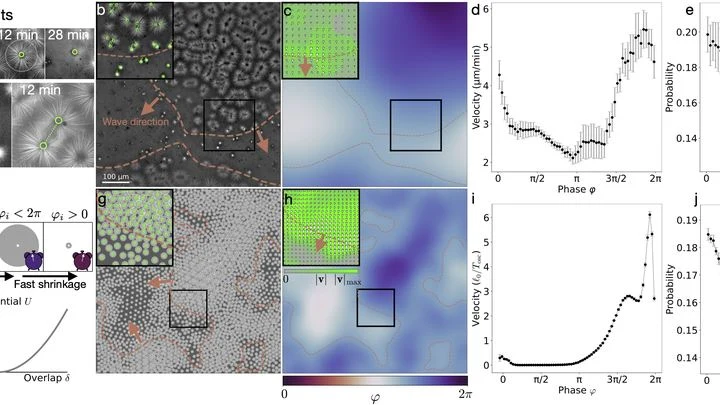
Inside a fertilized frog egg, waves ripple, like ripples on water, but made of proteins that command cell division. These waves travel millimeters, even though the egg itself is less than a millimeter across. Previously, it wasn't understood why they didn't fall out of sync. It turns out the waves clear their own path.
A magnetar's crust cracks in milliseconds. A deep shift generates seismic waves that run across the surface and shake the magnetic field. This starquake is like an earthquake, but on a neutron star with a field a quadrillion times stronger than Earth's.