A Battery Electrode That Refuses to Give Back express
A piggy bank where coins slip in easily but can only be retrieved by smashing it. Something similar happens with a new material for sodium batteries. It readily accepts sodium ions during charging, but during discharge, it gives back almost nothing.
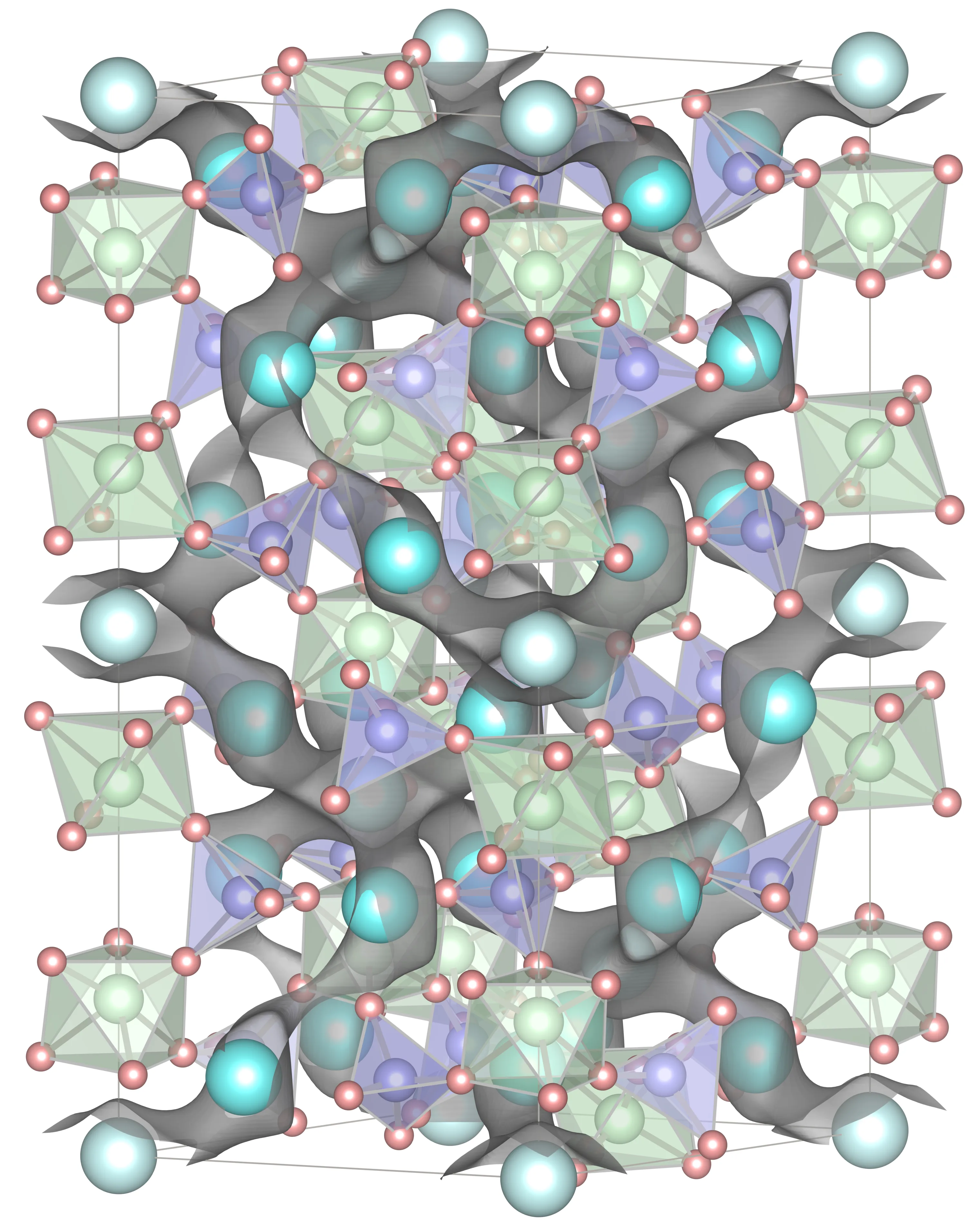
The material with the formula Na4NiCr(PO4)3 belongs to the NASICON family — framework structures where sodium ions can travel through a three-dimensional network of channels. Calculations showed that the barrier for ion movement is low — only 0.468 electronvolts, roughly the energy of thermal motion at room temperature. That means ions should be able to move freely.
After a charge-discharge cycle, the crystal lattice remained intact, and calculations showed that sodium ions could still migrate. So the problem isn't ion movement. Most likely, poor electronic conductivity is to blame: electrons can't reach the sites where ions are located to complete the reaction.
It's like having functional water pipes in a house but a broken pump. The water (ions) is there, the pipes (channels) are fine, but without the pump (electrons), the water doesn't flow.
To make such a material work, its electronic conductivity needs to be improved — for example, by adding dopants or altering the structure. Then the piggy bank will not only accept but also give back.
Original abstract
as written by the authors arXiv:2601.07012
We examine a new NASICON-type Na$$_4$$NiCr(PO$$_4$$)$$_3$$ material designed for high-voltage and multi-electron reactions for the sodium-ion batteries (SIBs). The Rietveld refinement of the X-ray diffraction pattern, using the R$$\bar{3}$$c space group, confirmed the stabilization of the rhombohedral NASICON framework. Furthermore, the Raman and Fourier transform infrared spectroscopy are employed to probe the structure and chemical bonding. The core-level photoemission analysis reveals the Cr$$^{3+}$$ and mixed Ni$$^{2+}$$/Ni$$^{3+}$$ oxidation states in the sample. Moreover, the bond valence energy landscape (BVEL) analysis, based on the refined structure, revealed a three-dimensional network of well-connected sodium sites with a migration energy barrier of 0.468 eV. The material delivered a good charge capacity at around 4.5 V, but showed no sodium-ion intercalation during discharge, resulting in negligible discharge capacity. The post-mortem analysis confirmed that the crystal structure remained intact. The calculated energy barrier values indicated a reversal in sodium site stability after cycling, though the barriers can still permit feasible ion migration. This suggests that ion transport alone cannot explain the lack of reversibility, which likely arises from intrinsically poor electronic conductivity. These findings highlight key challenges in achieving stable, reversible capacity in this system and underscore the need for doping, structural modification, and electrolyte optimization to realize its full potential as a high-voltage SIB cathode.
Sodium is the sixth most abundant element in Earth's crust and can be extracted from seawater. This makes sodium batteries a cheaper alternative to lithium-ion batteries.