Niobium is a chemical element (symbol Nb, atomic number 41) that becomes a superconductor at temperatures below 9.2 K. In its superconducting state, it conducts electricity with zero resistance, making it invaluable for creating extremely sensitive magnetic field sensors, such as SQUIDs (Superconducting Quantum Interference Devices). These sensors can detect minuscule magnetic fields, from brain activity to subtle changes in materials.
History
Niobium was discovered in 1801 by Charles Hatchett, who named it columbium. Its superconducting properties were identified in the 1930s, and its use in SQUIDs began in the 1960s following Brian Josephson's theoretical prediction of the Josephson effect.
How it works
When niobium is cooled below its critical temperature, its electrons form Cooper pairs that flow without resistance. In a SQUID, a loop of niobium with one or two Josephson junctions (thin insulating barriers) exploits quantum interference to convert magnetic flux into a measurable voltage. The extreme sensitivity arises because the device responds to changes as small as a single quantum of magnetic flux.
In practice
Niobium-based SQUIDs are used in medical magnetoencephalography, geological surveying, and materials testing, as well as in quantum computing research for reading qubit states.
Fun fact
Niobium is also used in particle accelerators, such as the Large Hadron Collider, where its superconducting cavities accelerate protons to near light speed.
Picture a fireplace poker shoved into a blast furnace. Ordinary steel would soften and sag within minutes. Nickel-based superalloys, which make up turbine blades in jet engines, work up to 1300 °C, but beyond that they give in too. Now look at this new niobium-based alloy: at 1500 °C it retains strength comparable to cold aluminum.
The secret lies in its internal architecture.
A tiny diamond, invisible to the naked eye, sits on a chip and senses heat like no ordinary thermometer can. Hidden inside it are two defects: places where a carbon atom is replaced by a nitrogen atom, with a vacancy nearby.
A tiny black hole flies through a hydrogen cloud and stretches atoms like taffy. That is what a superconductor looks like when it traps a persistent current: a material in which electricity flows without losses turns into a miniature permanent magnet.
The neutron is a particle that usually sits in the atomic nucleus and doesn't disappear. But some theories suggest that occasionally it might transform into its invisible twin — a particle that ordinary detectors can't catch.
A metal made of five different atoms is like a soup with bits of carrot, peas, potato, onion, and meat floating in it. Each bit is its own element: chromium, vanadium, titanium, niobium, and tantalum. Such an alloy is called high-entropy: there is no single order, and the atoms are mixed almost randomly.
You can make light turn on command, like water in a hose — if you know where to squeeze. That's what electro-optic circuits do: they change the direction of a beam inside a chip using an electric field. The classic material for such tricks is lithium niobate, a crystal that responds to voltage like a string to a pluck.
A bridge where pedestrians and cyclists flow together without getting in each other's way. That's roughly how hybrid systems of superconductors and semiconductors work: the former carry current without loss, the latter control that current.
A film sliver thinner than a human hair was placed between diamond anvils and squeezed. The pressure climbed — a hundred thousand atmospheres, half a million, a million… Yet the material kept conducting electricity without resistance.
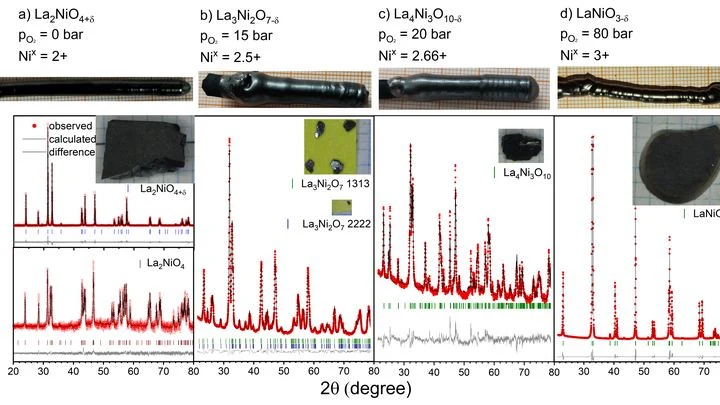
Lossless current is the dream of energy technology. Some materials become superconductors, but usually only at extreme cold. Recently, in the family of nickelates, compounds based on nickel, candidates were found that work at higher temperatures.
A piece of metal is cooled to minus two hundred degrees, and electric current begins to flow through it without the slightest friction, like water in a pipe flowing without touching the walls. This behavior is called superconductivity.
Building a quantum network node is like teaching a dancer to balance on a carbon thread over an abyss. One leg must spring lightly from the wire, hurling photon-messengers into the external world. The other must grip the rope tightly, guarding precious quantum information.
Superconductivity and magnetic field are age-old foes: the field barges in like a whirlwind, tearing apart the delicate pairing of Cooper pairs, destroying order.
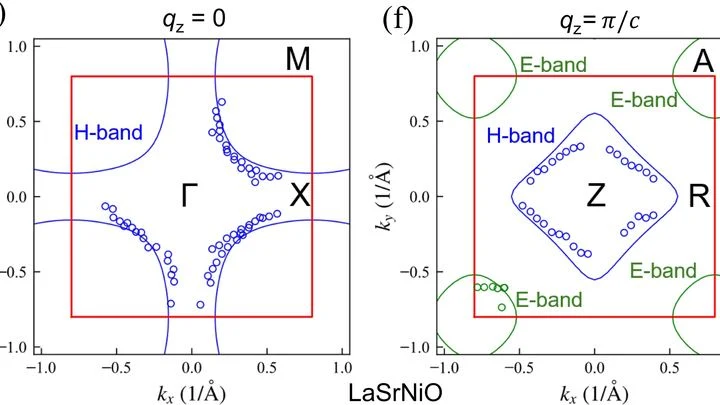
The nickelate family consists of layered crystals, like a stack of pancakes: nickel and oxygen layers alternate with lanthanum spacers. Two years ago, superconductivity was discovered in them — the ability to conduct electricity without resistance when cooled.
Some 158 light-years away, around the dim star TOI-6894, a red dwarf, a planet moves leisurely. Its year lasts less than two Earth days, yet it is a cool world with an equilibrium temperature around 420 K, just a bit warmer than a sauna.
A tiny defect in a boron nitride crystal behaves like a microscopic indicator bulb. Shine light on it, and it glows, with the shade shifting with temperature: the warmer it gets, the redder the glow.
A well-coordinated orchestra of electrons in a superconductor is easily thrown off rhythm. Thermal jolts destroy the fragile order, and resistance returns. For decades, scientists have sought ways to strengthen this ensemble — mostly by changing the material's composition or compressing it to unimaginable pressures.
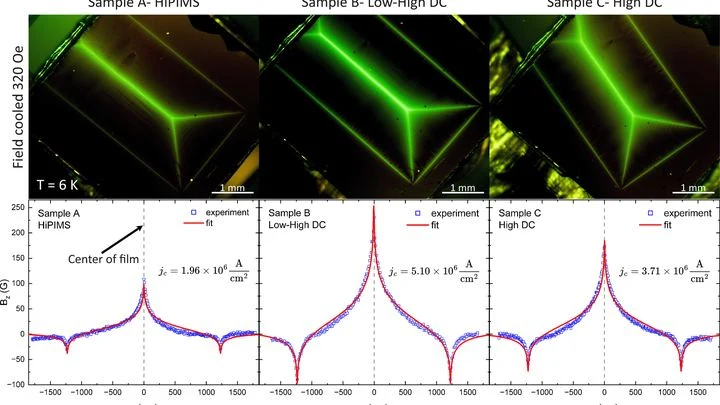
A potter uses a sharp stylus to trace a pattern on a still-damp clay tile. One wrong move, and the line blurs, the tile cracks. Physicists work with films of the high-temperature superconductor YBCO (a compound of yttrium, barium, copper, and oxygen) in much the same way.
In murky mud, between two electrodes, long chains of bacteria line up: each one as thin as a microscopic cable. Every such filament conducts current over a full centimeter, a true marathon for a microbe.
A magnet the size of a grain of rice floats in a vacuum without touching the walls. It is held by the magnetic field of a superconducting trap — a ring cooled to a state where current flows without resistance.
The atomic nucleus is a natural spring of colossal power. When the protons and neutrons inside it rearrange, it enters a special long-lived state — a nuclear isomer. It stores energy like a spring compressed to its limit.
The dance floor is full of couples waltzing. Usually, partners move in opposite directions: one steps forward, the other backward, to keep the overall rhythm.
Light from a distant star seeps through a planet's gaseous envelope, and astronomers try to guess what that envelope is made of. That's how we study the atmospheres of worlds we can never touch. When a planet passes in front of its sun's disk, its gaseous veil briefly intercepts some of the rays.
In the crystal Rb1-xV2Te2O, the spins of vanadium atoms arrange in a checkerboard pattern: each spin is surrounded by opposite spins. This pattern is called G-type antiferromagnetism. Neutrons passing through the sample scatter off this pattern and reveal its geometry, like light from a flashlight shining through blinds casting stripes on a wall.
An ordinary kitchen knife made of niobium would suddenly start conducting electricity with zero loss at −258 °C. That's how superconductivity works, and you can "switch it on" right at the metal's surface by blasting it with a laser in a nitrogen atmosphere.
Light can act as a courier carrying secret messages. But to ensure the courier doesn't lose a single letter, you need to meet and check it very quickly. The new chip made from a thin film of lithium niobate is like a turnstile that opens and closes in billionths of a second, letting light pulses through at just the right moment.
A superconductor is a material through which current flows without loss, like water through a perfectly smooth pipe. But to make the pipe perfect, you have to cool it to very low temperatures. Physicists have long been looking for ways to make such a pipe at warmer temperatures, and one clue is the quantum critical point.
A freshly polished niobium surface shines like a mirror. But within minutes, a dull oxide film, invisible to the eye, forms on it. For a superconducting qubit, this film is like sand in an hourglass: it causes the quantum state to decay prematurely.
A thin wire of the new material conducts electricity without loss when cooled to three degrees above absolute zero. It's like water flowing through a pipe without any friction against the walls. The material is called PtPb3Bi, and its hallmark is an internal structure resembling a bundle of threads: electrons run freely along a thread but struggle to jump between threads.
Niobium is a metal that, when cooled to a few degrees above absolute zero, conducts electricity without resistance. In labs, it is deposited as thin strips onto a substrate, like frosting on a cake. But during deposition, oxygen from the special mask seeps into the metal, and it spoils the superconducting properties.
Superconducting circuits often rely on Josephson junctions — places where current flows without resistance through a thin barrier. Typically, this barrier is an oxide layer, but its properties are hard to control at the nanoscale. In this new work, the barrier is a thin layer of niobium or titanium nitride sandwiched between niobium layers.
A solid electrolyte is like a sponge for lithium ions. In a regular lithium battery, ions float in a liquid, like fish in an aquarium. In a solid-state battery, they have to squeeze through the crystal lattice, like through narrow corridors.
A laser strikes a strontium atom, and two electrons fly out at once. Previously, it was thought that in such double ionization each electron acts on its own: one is knocked out first, the second later, randomly.
A chunk of nuclear fuel inside a reactor is not just a solid. When heated, the uranium atoms in it start to 'wiggle' their magnetic moments, and this motion changes thermal conductivity and other properties.
Scientists peered into a two-dimensional magnet made of nickel atoms arranged in triangles using a method created by Isidor Isaac Rabi — nuclear magnetic resonance (similar to MRI). Inside, they found magnetic arrows that, in a strong field, froze into an 'up-up-down' pattern, like a formation of soldiers: two steps forward, one step back.
Turning light gases like hydrogen and nitrogen into metal is a long-standing dream of physicists. In a new experiment, nitrogen was compressed to 130–140 gigapascals (pressure equivalent to 14 million kilograms pressing on a fingernail) and heated to 3000°C.
A superconducting strip thinner than a human hair lies on a silicon substrate. Next to it is a tiny waveguide through which a beam travels. When a photon hits the strip, it heats up by a fraction of a degree and immediately changes its resistance.
Sound on a crystal surface is like ripples on water, but traveling through a solid. This ripple is called a surface acoustic wave: it moves a hundred thousand times slower than light, so it can be compressed into very short segments and fit on a tiny chip. Usually, such waves are launched by metallic combs made of aluminum or gold.
A thin film of niobium and tin conducts electricity without resistance — until you make it really thin. Then it suddenly becomes an insulator. A team of physicists tested what happens when you add a bit more tin to the film than the formula calls for.
Sunlight hits a rooftop, and electrons are born in a thin film. They must reach the wires before they cool down and lose their energy. In tin sulfide, a cheap and accessible material for batteries, this sprint and cooldown has now been captured with unprecedented sharpness: frames follow every billionth of a billionth of a second.
A quantum computer is like an orchestra where every musician must play in perfect harmony. If even one instrument is off-key, the melody falls apart. Superconducting qubits play the role of these musicians, and their "off-key" is the loss of quantum coherence.