Thermal motion is the ceaseless, random jiggling of atoms and molecules within any substance that has a temperature above absolute zero. It is the microscopic manifestation of heat: the hotter an object, the more vigorous the motion of its constituent particles. This motion is not organized or directional but chaotic, with particles constantly colliding, bouncing, and exchanging energy. It is the fundamental reason why gases expand when heated, why solids melt, and why heat flows from hot to cold bodies.
History
The concept emerged in the 19th century, with James Clerk Maxwell and Ludwig Boltzmann formalizing the statistical description of molecular motion in the 1860s–1870s. Albert Einstein's 1905 analysis of Brownian motion provided decisive experimental confirmation.
How it works
At any finite temperature, particles possess kinetic energy. In a gas, this energy translates into free, straight-line motion between collisions. In a liquid, particles slide and tumble past each other, while in a solid, they vibrate around fixed lattice positions. The average kinetic energy of these motions is directly proportional to the absolute temperature. This random motion drives diffusion, where particles spread from high to low concentration, and is responsible for Brownian motion, the observable jitter of microscopic particles suspended in a fluid.
In practice
Thermal motion is exploited in technologies like heat engines, refrigeration cycles, and in the process of diffusion bonding in materials science. It also limits the precision of atomic clocks and is a key noise source in electronic devices.
Fun fact
At room temperature, a typical air molecule collides with others about 10 billion times per second, traveling a zigzag path that is far longer than the straight-line distance it covers.
A vacuum cleaner sucks in dust even if there is more of it near the nozzle. The same happens in a tokamak: plasma particles are drawn toward the center, even though their density is higher at the edge. This phenomenon is called particle pinch, and it contradicts the usual rule that everything tends to move from dense regions to sparse ones.
Glass lenses and mirrors appear perfectly smooth and still. But beneath the surface, a hidden life teems. Atoms in an amorphous material (a substance without a crystalline lattice) are packed haphazardly, and this disorder creates a complex energy landscape, like a mountainous region with countless hills and valleys.
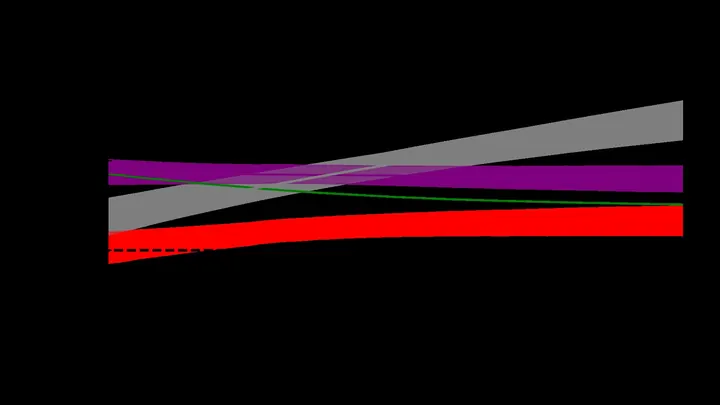
Ever since Fritz Zwicky noticed that galaxy clusters were moving too fast, and Vera Rubin measured the rotation of spiral arms, dark matter has remained cosmology's greatest mystery.
Space is full of invisible sprinters — particles racing nearly at the speed of light. They are caught in the solar wind, near neutron stars, and even in the intergalactic void between galaxies. But what accelerates them where there are no shock waves or magnetic reconnections?
Tea in a cup cools quietly on the table. But if you zoom past at near-light speed, the thermometer will read higher — even though no one heated the tea. Calculations confirm: the needle will creep up.
A century ago, physicists split into three camps.
A stream of electrons enters plasma like a jet of water hitting a calm pond. The jet disturbs the surface, giving rise to waves that grow quickly and mix the water. In plasma, this process is called the Buneman instability: the electron beam excites oscillations that then scatter its energy.
The young star HL Tau is surrounded by a disk of gas and dust — the cradle of future planets. Inside this disk, the gas is not static: it orbits the star, but it also trembles and churns, like water in a raging river. Astronomers have now directly measured the strength of this churning for the first time.
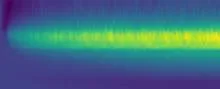
Ordinary window glass may seem frozen forever, but inside, atoms never stay still. In amorphous germanium telluride (GeTe)—a material used in rewritable discs and non-volatile memory — physicists have for the first time directly tracked how atomic bonds stretch and bend in trillionths of a second.
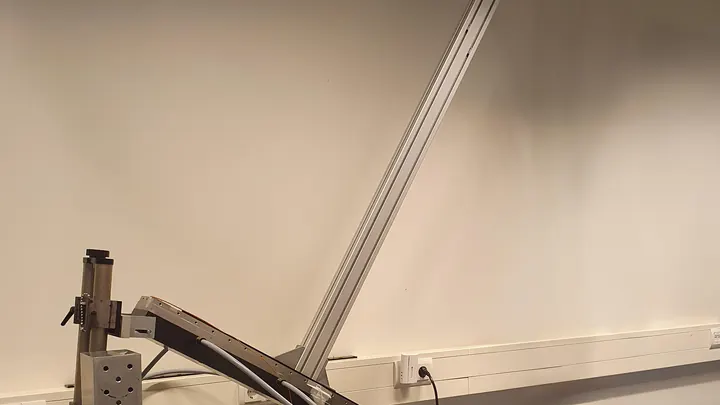
Ice on a warm frying pan doesn't just melt: it starts to move. A thin layer of water forms beneath it, and the piece glides as if on oil. The speed of this sliding depends on how quickly heat travels through the water film and how steep the incline is.
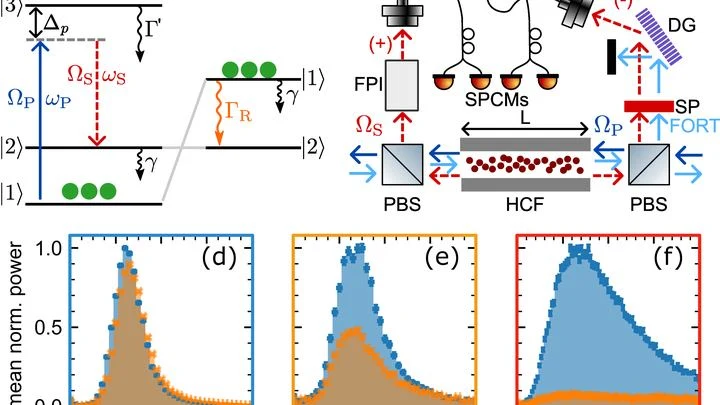
A swarm of fireflies in a night forest flashes randomly: each beetle blinks on its own, and the light scatters equally in all directions. Now imagine the fireflies agreeing to blink so that their combined light goes only north — even though they stay put and none of them turns. That's roughly what physicists did with atoms inside a thin glass tube.
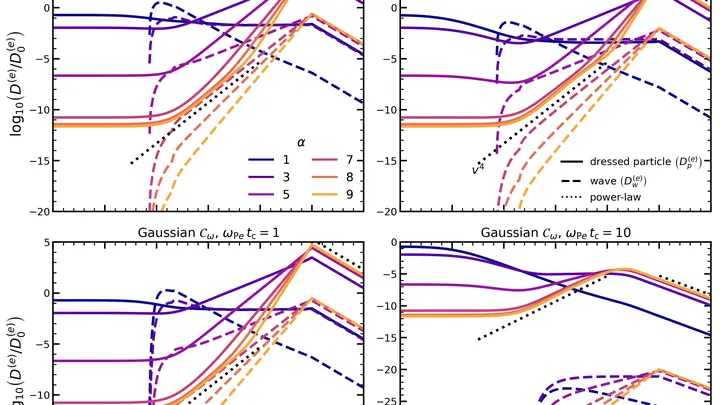
In a hot gas of charged particles — plasma — chaotic electric fields work like a sieve. A slow particle gets surrounded by a cloud of opposite charges, which cancels the external field. A fast one sheds this armor and gets accelerated.
Paraglider, hang glider, and glider — three different wings, but in the sky they behave the same. Pilots catch invisible warm air currents, rise on them, then glide to the next. Such flight is like a game of hopscotch: a jump upward, then a glide forward, and again a search for a place to jump.
Scientists analyzed thousands of real routes and found a common law.
In a dark room, a laser beam draws a bright spot on the wall. Light seems warm and uncontrollable, but for three decades physicists have used it as a conductor's baton, making atoms dance in unison.