A Laser Maze for Hunting Space-Time Tremors express
Gravitational waves are ripples in space itself, caused by events like colliding black holes. To hear these ripples, we build giant L-shaped facilities: a laser beam travels down two arms, bounces off mirrors, and returns. If space has been slightly squeezed or stretched, the light arrives with a difference, and we see a signal.
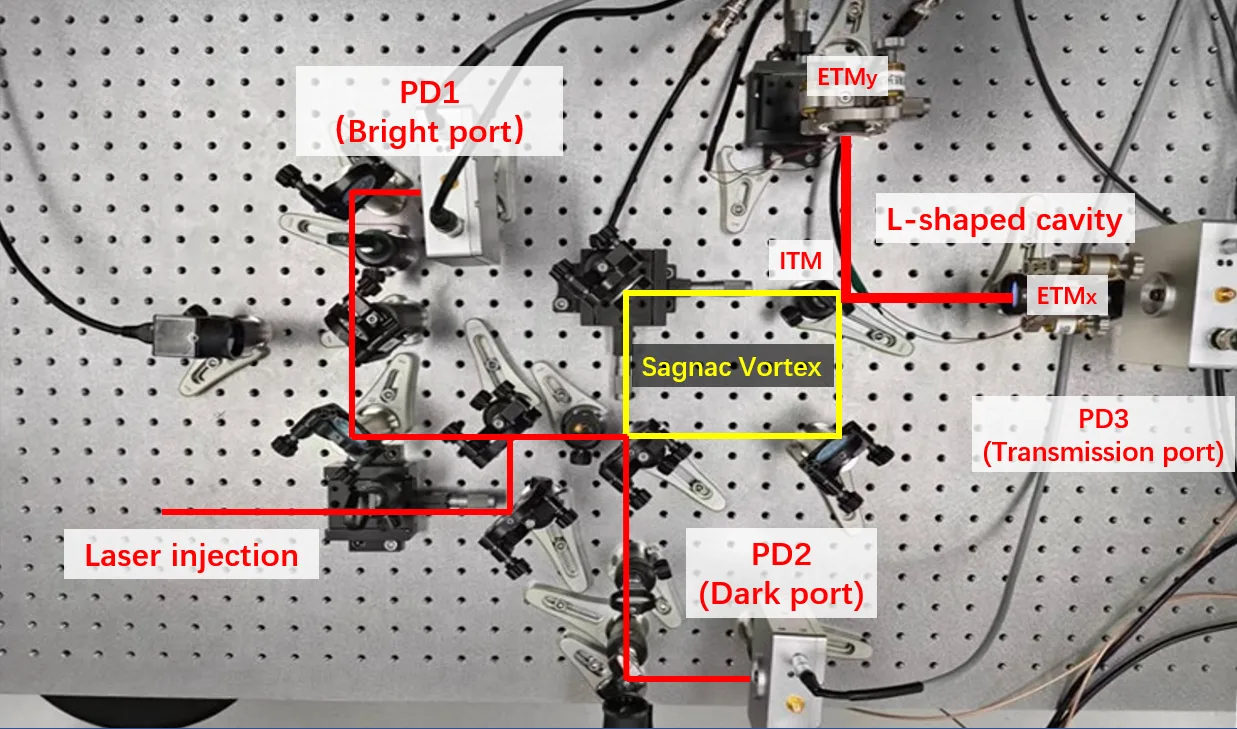
The new design adds a clever twist to that 'L': light is swirled around a ring, like water in a vortex, before entering the arms. The authors assembled such a device on an ordinary table and tested how it responds to slow mirror movements. They found that with precise laser tuning, the input mirror becomes transparent, and the instrument works like a classic Michelson interferometer, but with two independent pump paths.
This result provides an intuitive picture of how the new detector works and hints at how to switch it on and keep it running. Such devices are needed to catch gravitational waves at kilohertz frequencies — for example, from neutron star mergers, which ordinary detectors hear less well.
Original abstract
as written by the authors arXiv:2601.09764
A new interferometer topology for kilohertz gravitational-wave detection was recently proposed in [Zhang et al. Phys. Rev. X 13, 021019 (2023)]. The design is based on an L-shaped optical cavity pumped through a Sagnac-like vortex. We report a tabletop experiment that characterizes the interferometer's optical response near DC. When the laser frequency is locked to the resonance of the L-shaped cavity, we observe that the cavity input coupler becomes effectively transparent, yielding a simple Michelson-like response. Moreover, the Sagnac vortex separates into upper and lower paths, which behave as two independent pumping paths driving the cavity. These observations are in agreement with theoretical predictions. Our results provide an intuitive physical picture of this interferometer topology and offer insight into its lock acquisition strategy.
The most sensitive gravitational-wave detectors can spot a change in arm length smaller than a proton's diameter: that's like noticing the distance to the nearest star changing by the thickness of a human hair.